
Margaret’s successor, Eric of Pomerania (King of …
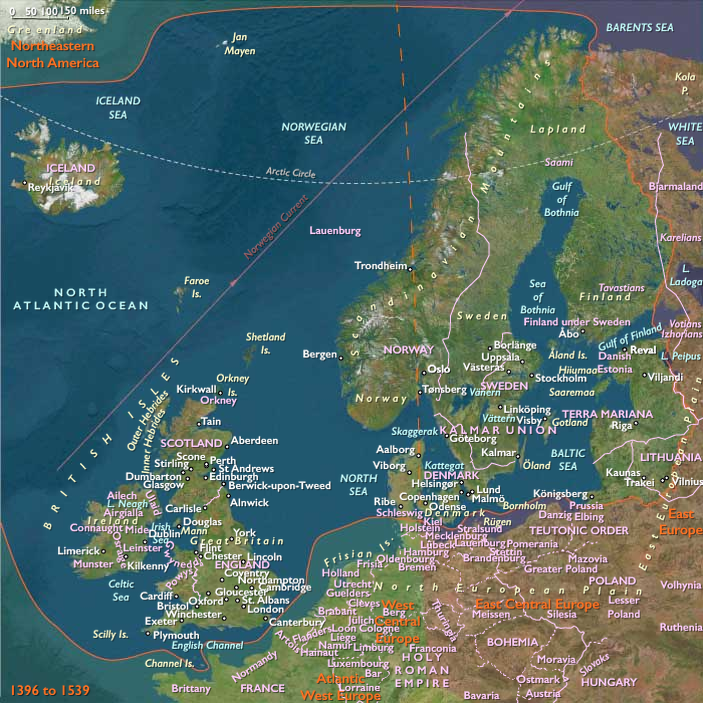
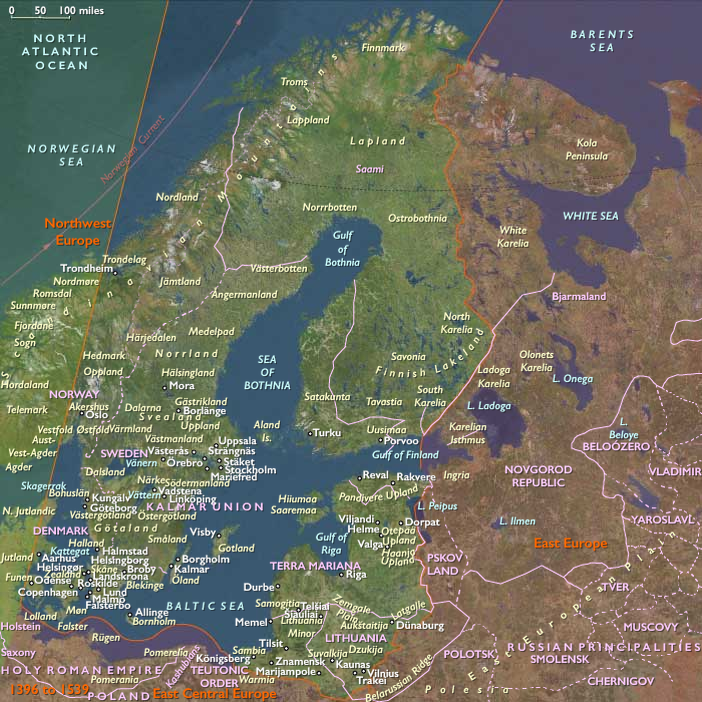
Years: 1396 - 1539
Eric's foreign policy engulfs Denmark in a succession of wars with the Holstein counts and the city of Lübeck.
When the Hanseatic League imposes a trade embargo on Scandinavia, the Swedes (who see their mining industry adversely affected) rise up in revolt.
The three countries of the Kalmar Union all declare Eric deposed in 1439.
However, support for the idea of regionalism continues, so when Eric's nephew Christopher of Bavaria comes to the throne in 1440, he manages to get himself elected in all three kingdoms, briefly reuniting Scandinavia (1442–1448).
The Swedish nobility grows increasingly unhappy with Danish rule and the union soon becomes merely a legal concept with little practical application.
During the subsequent reigns of Christian I (1450–1481) and Hans (1481–1513), tensions grow, and several wars between Sweden and Denmark erupt.
People
Groups
- Finns
- Danes (North Germanic tribe)
- Denmark, Kingdom of
- Holstein, County of
- Icelanders (Scandinavians)
- Sweden, Kingdom of
- Greenland, Norwegian Crown Colony of
- Swedes (Scandinavians)
- Norwegians (Scandinavians)
- Iceland (Norwegian dependency)
- Norway, independent Kingdom of
- Hanseatic League
- Kalmar Union (of Denmark, Norway and Sweden)
- Iceland (Danish dependency)
- Holstein, Duchy of
Topics
Subjects
Regions
Subregions
Related Events
Filter results
Showing 10 events out of 54 total
Monmouth’s rebellion is a fiasco, as the local gentry refuses to sanction civil war.
After failing to take Bristol and falling back on Bridgwater, Monmouth’s path is now blocked by the royal army encamped on Sedgemoor.
Monmouth attacks the King's forces at night, in a hazardous attempt at surprise, but and very nearly succeeds; but his small force of cavalry flees and his foot soldiers fail to cross the ditch separating them from the royalist front.
The element of surprise lost, Monmouth's untrained and unofficered followers are cut down by troops under the French-born Louis de Durfort, 2nd earl of Feversham, newly made commander of the royal forces in the west, and John Churchill, who on James’s accession had been made a lieutenant general and effective commander in chief, in addition to a peer of the realm.
Louis’s principal concern is the German powers in the Rhineland, dispelling fears in the Dutch Republic of a possible French attack upon them.
Thus, he does little to stop William’s invasion of England, enabling him on November 15, 1688, to land his forces unhindered at Brixham on Tor Bay.
Faced with the largest force ever to invade England, many Protestant officers defect and join William, including Churchill, James’s best general, and Princess Anne, James's own daughter.
James loses his nerve, sending his family to France and declining to attack the invading army, despite numerical superiority.
Atlantic West Europe (1696–1707): Dynastic Warfare, Economic Strain, and Cultural Continuity
From 1696 to 1707, Atlantic West Europe—including northern France, the Low Countries (Belgium, Netherlands, Luxembourg), and coastal regions along the Atlantic and English Channel—faced escalating dynastic conflict, economic pressures, and persistent religious and intellectual tensions. This era was dominated by the climax and aftermath of the Nine Years' War and the onset of the critical War of the Spanish Succession, significantly influencing the political landscape, reshaping economic networks, and reinforcing regional identities amid broader European power struggles.
Political and Military Developments
The End of the Nine Years' War (1688–1697)
-
The protracted conflict ended with the Treaty of Ryswick (1697), temporarily halting Louis XIV’s territorial ambitions. Under its terms, Louis returned territorial gains in the Low Countries and ceased claims in the Rhineland, reaffirming balance-of-power principles in Europe.
-
This treaty, while restoring temporary stability, left underlying dynastic tensions unresolved, laying the foundation for future conflicts.
The War of the Spanish Succession Begins (1701–1714)
-
The death of the childless Spanish king, Charles II, in 1700 triggered a continent-wide crisis. Louis XIV sought to place his grandson, Philip of Anjou, on the Spanish throne, creating fears of Franco-Spanish domination.
-
In response, England, the Dutch Republic, Austria, and several German states formed the Grand Alliance (1701), initiating a new, extensive conflict aimed at preventing Bourbon dominance over Europe.
Early Battles and Military Struggles
-
The Low Countries became a primary theater for fierce military engagements. Battles such as Ramillies (1706) witnessed decisive victories by allied forces under the command of English general John Churchill, Duke of Marlborough, significantly reducing French control in the Spanish Netherlands (modern Belgium).
-
Warfare placed immense pressure on northern French and Flemish towns, which experienced repeated sieges, requisitions, and economic disruptions, notably around cities like Lille and Brussels.
Economic Developments and Maritime Challenges
Economic Strain from Continuous Warfare
-
Constant military conflicts strained regional economies, causing increased taxation, inflation, and interruptions in trade and agricultural production. Northern France’s economy was particularly burdened by wartime expenses and demographic losses due to conscription.
-
The Dutch Republic, while maintaining substantial maritime trade networks, faced severe fiscal pressures supporting the alliance against France, gradually losing ground in economic competitiveness to England.
Shifts in Maritime Trade
-
The English and Dutch maritime empires continued to dominate Atlantic commerce, securing critical trade routes. Ports like Amsterdam, Antwerp, and increasingly Rotterdam benefited from stable, albeit strained, maritime trade networks.
-
French Atlantic ports—particularly Nantes, La Rochelle, and Bordeaux—endured significant hardship from naval blockades and restricted Atlantic commerce, profoundly affecting regional prosperity, especially the wine and textile industries.
Religious and Intellectual Developments
Persistent Religious Tensions and Huguenot Legacy
-
Louis XIV’s revocation of the Edict of Nantes (1685) continued to affect regional religious dynamics, reinforcing strict Catholic orthodoxy but perpetuating economic and intellectual consequences from the Huguenot exodus.
-
Protestant refugees significantly contributed to cultural and intellectual life in host nations, notably the Dutch Republic, England, and Prussia, fostering thriving expatriate communities renowned for craftsmanship, publishing, and commerce.
Early Enlightenment Thought and Critical Scholarship
-
Intellectual centers like Amsterdam, Rotterdam, and Leiden continued to serve as crucial nodes for early Enlightenment thought. Scholars such as Pierre Bayle (d. 1706) promoted ideas of religious tolerance, rational skepticism, and critical inquiry, deeply influencing European intellectual developments.
-
In France, despite stringent censorship, intellectual salons and clandestine publications proliferated, subtly challenging traditional authority and paving the way for future Enlightenment thinkers.
Cultural and Artistic Continuities
Baroque and Rococo Transitions
-
Cultural patronage in France and the Spanish Netherlands persisted, showcasing ornate Baroque styles symbolizing royal and ecclesiastical power. At Versailles and in Paris, Baroque aesthetics reached new sophistication, anticipating early signs of Rococo refinement in interiors and decorative arts.
-
Flemish cities, notably Brussels and Antwerp, continued producing significant works of art, though cultural patronage increasingly reflected commercial rather than purely aristocratic tastes.
Flourishing of Music and Theater
-
Music flourished, notably through composers such as Marc-Antoine Charpentier (France), François Couperin, and Flemish-born composers active throughout the region. Their works enriched religious, courtly, and civic musical life.
-
Theater remained a vibrant cultural force, with playwrights like Jean-Baptiste Racine and Jean-François Regnard continuing to shape French drama, influencing European theatrical traditions.
Social and Urban Developments
Urban Strain and Demographic Challenges
-
Continuous warfare, heavy taxation, and economic disruption intensified urban poverty, particularly pronounced in northern French and Flemish cities. Towns endured demographic challenges, including population decline due to military recruitment and wartime hardships.
-
Despite difficulties, urban centers such as Amsterdam, Antwerp, Brussels, Lille, and Rouen persisted as critical commercial and administrative hubs, supporting vibrant merchant classes amid economic adversity.
Reinforcement of Local and Regional Identities
-
Despite broader centralizing trends, distinctive regional identities persisted strongly, particularly in the Low Countries and northern France. Flemish, Dutch, and Breton cultural traditions remained resilient, asserting local pride and cultural distinctiveness amid centralized French and Spanish governance.
Legacy and Long-Term Significance
The period from 1696 to 1707 deeply influenced Atlantic West Europe:
-
Politically, this era marked intensified warfare and dynastic struggles, setting the stage for future geopolitical alignments, notably through the unresolved Spanish Succession conflict.
-
Economically, ongoing warfare and maritime competition strained regional economies, reshaping trade patterns and reinforcing Dutch and English dominance in global commerce.
-
Intellectually, early Enlightenment thought gained strength, disseminating critical scholarship and ideas of tolerance, rational inquiry, and skepticism that profoundly shaped European intellectual landscapes.
-
Culturally, the continued prominence of Baroque aesthetics, music, and drama reinforced artistic traditions while signaling subtle shifts toward more refined Rococo styles.
Overall, the period significantly shaped subsequent political stability, economic vitality, and cultural dynamism, laying critical foundations for Atlantic West Europe’s future development through the eighteenth century and beyond.
Queen Mary's death in 1694 had eventually led to a formal but cool reconciliation between William III and Princess Anne, now heir to the throne.
Marlborough had hoped that the rapprochement would lead to his own return to office, but although he and Lady Marlborough had been allowed to return to court, the Earl had received no offer of employment.
Marlborough, together with Godolphin, Admiral Russell, and the Duke of Shrewsbury, had in 1696 yet again been implicated in a treasonous plot with James II, this time instigated by the Jacobite militant John Fenwick.
The accusations were eventually dismissed as a fabrication and Fenwick executed—the King himself had remained incredulous—but it is not until 1698, a year after the Treaty of Ryswick brought an end to the Nine Years' War, that the corner is finally turned in William's and Marlborough's relationship.
On the recommendation of Lord Sunderland (whose wife is a close friend of Lady Marlborough), William eventually offers Marlborough the post of governor to the Duke of Gloucester, Anne's eldest son; he is also restored to the Privy Council, together with his military rank.
When William leaves for Holland in July, Marlborough is one of the Lords Justices left running the country in his absence; but striving to reconcile his close Tory connections with that of the dutiful royal servant is difficult, leading Marlborough to complain, "The King's coldness to me still continues." (Chandler, David G (2003). Marlborough as Military Commander. Spellmount Ltd)
The French had reoccupied Kaiserswerth on the Rhine in 1701 and the Allies lay siege to it again in 1702.
The town surrenders after a long and hard struggle.
The Alliance, led by Queen Anne's Captain-General John Churchill, decides to demolish the fortifications.
The city of Venlo has been besieged several times because of its strategic importance,.
The most significant siege is that of 1702, carried on by Menno van Coehoorn, who commands a corps in the army of the Duke of Marlborough from 1701; in the constant siege warfare of these campaigns in the Low Countries, his technical skill is of the highest value.
Consequently, Venlo is incorporated into the Generaliteitslanden of the United Provinces and later became part of the Kingdom of the Netherlands.
Sir George Rooke and the Battle of Vigo Bay (1702): A Mixed Start to the War of the Spanish Succession
At the opening of the War of the Spanish Succession (1701–1714), Sir George Rooke, a senior English admiral, commanded the Anglo-Dutch fleet in an unsuccessful expedition against Cádiz (1702). However, on the return voyage, he redeemed himself by destroying the Spanish treasure fleet at Vigo Bay, securing one of England’s greatest naval victories and earning the thanks of Parliament.
The Failed Attack on Cádiz (1702)
- As part of England’s campaign to weaken Bourbon Spain, Rooke led an Anglo-Dutch fleet to capture Cádiz, a major Spanish port and naval base.
- The assault was poorly executed, suffering from:
- Weak coordination between English and Dutch forces.
- Failure to capture the city.
- Indiscipline and looting among English troops, which undermined local support.
- The expedition was abandoned, marking a humiliating start to the war for England.
The Battle of Vigo Bay (October 23, 1702): A Stunning Recovery
- On the return voyage, Rooke received intelligence that the Spanish treasure fleet from the Americas had taken refuge in Vigo Bay, protected by French warships.
- Determined to salvage the campaign, Rooke launched a surprise attack, leading to:
- The destruction of the entire French escort fleet.
- The capture or sinking of Spanish treasure galleons, though much of the gold and silver had already been unloaded.
- Despite not securing all the treasure, the victory crippled Spanish naval power, boosting England’s prestige in the war.
Aftermath and Recognition
✔ Rooke received widespread praise for the victory, despite the earlier failure at Cádiz.
✔ Parliament formally thanked him, recognizing Vigo Bay as a major naval triumph.
✔ The battle reinforced England’s dominance at sea, undermining French and Spanish maritime strength early in the war.
Conclusion: A Setback Turned into Triumph
Though the Cádiz expedition (1702) was a failure, Rooke’s decisive action at Vigo Bay redeemed his reputation and delivered a strategic blow to Bourbon Spain. His victory demonstrated England’s growing naval supremacy, setting the stage for future successes in the War of the Spanish Succession.
Churchill forces the surrender of Liège.
The War of the Spanish Succession is in its fourth year by 1704.
The previous year had been one of success for France and her allies, most particularly on the Danube, where Marshal Villars and the Elector of Bavaria had created a direct threat to Vienna, the Habsburg capital.
Vienna had been saved by dissension between the two commanders, leading to the brilliant Villars being replaced by the less dynamic Marshal Marsin.
Nevertheless, the threat is still real by 1704: Rákóczi's Hungarian revolt is already threatening the Empire's eastern approaches, and Marshal Vendôme's forces threatened an invasion from northern Italy.
In the courts of Versailles and Madrid, Vienna's fall is confidently anticipated, an event which will almost certainly lead to the collapse of the Grand Alliance.
To isolate the Danube from any Allied intervention, Marshal Villeroy's forty-six thousand troops are expected to pin the seventy thousand Dutch and English troops around Maastricht in the Low Countries, while General de Coigny protects Alsace against surprise with a further corps.
The only forces immediately available for Vienna's defense are Prince Louis of Baden's force of thirty-six thousand stationed in the Lines of Stollhofen to watch Marshal Tallard at Strasbourg; there is also a weak force of ten thousand men under Field Marshal Count Limburg Styrum observing Ulm.
Both the Imperial Austrian Ambassador in London, Count Wratislaw, and the Duke of Marlborough realize the implications of the situation on the Danube.
The Dutch, however, who cling to their troops for their country's protection, are against any adventurous military operation as far south as the Danube and will never willingly permit any major weakening of the forces in the Spanish Netherlands.
Marlborough, realizing the only way to ignore Dutch wishes is by the use of secrecy and guile, sets out to deceive his Dutch allies by pretending to simply move his troops to the Moselle—a plan approved of by The Hague—but once there, he will slip the Dutch leash and link up with Austrian forces in southern Germany.
Allied troops under John Churchill, the Earl of Marlborough and Prince Eugene of Savoy on August 13, 1704, defeat the Franco-Bavarian army in the Battle of Blenheim.
French losses are immense: over thirty thousand killed, wounded and missing.
The myth of French invincibility has moreover been destroyed and Louis's hopes of an early and victorious peace have been wrenched from his grasp.
Although the war will drag on for years, the Battle of Blenheim is probably its most decisive victory; Marlborough and Eugene, working indivisibly together, have saved the Habsburg Empire and thereby preserved the Grand Alliance from collapse.
Years: 1396 - 1539
People
Groups
- Finns
- Danes (North Germanic tribe)
- Denmark, Kingdom of
- Holstein, County of
- Icelanders (Scandinavians)
- Sweden, Kingdom of
- Greenland, Norwegian Crown Colony of
- Swedes (Scandinavians)
- Norwegians (Scandinavians)
- Iceland (Norwegian dependency)
- Norway, independent Kingdom of
- Hanseatic League
- Kalmar Union (of Denmark, Norway and Sweden)
- Iceland (Danish dependency)
- Holstein, Duchy of
