Mardāvīj arrives in Isfahan on December 2, …
Years: 931 - 931
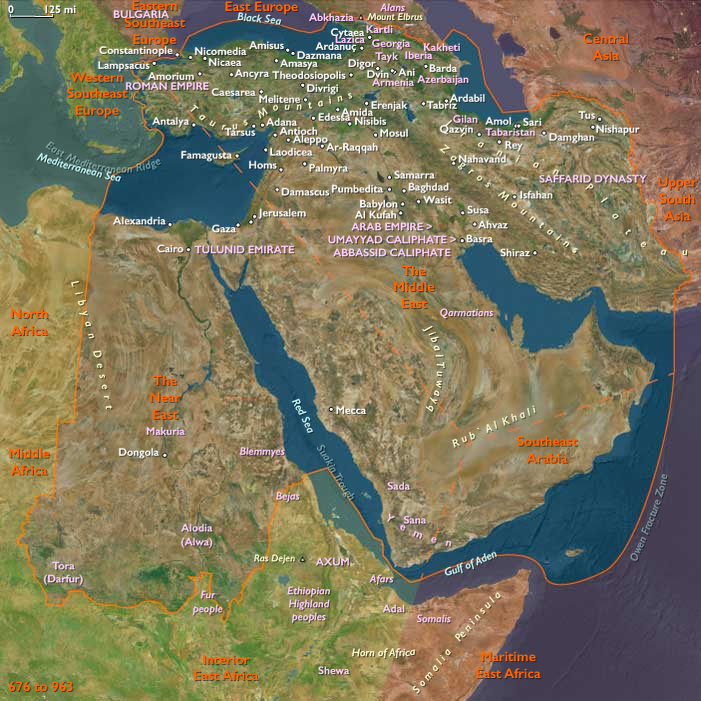
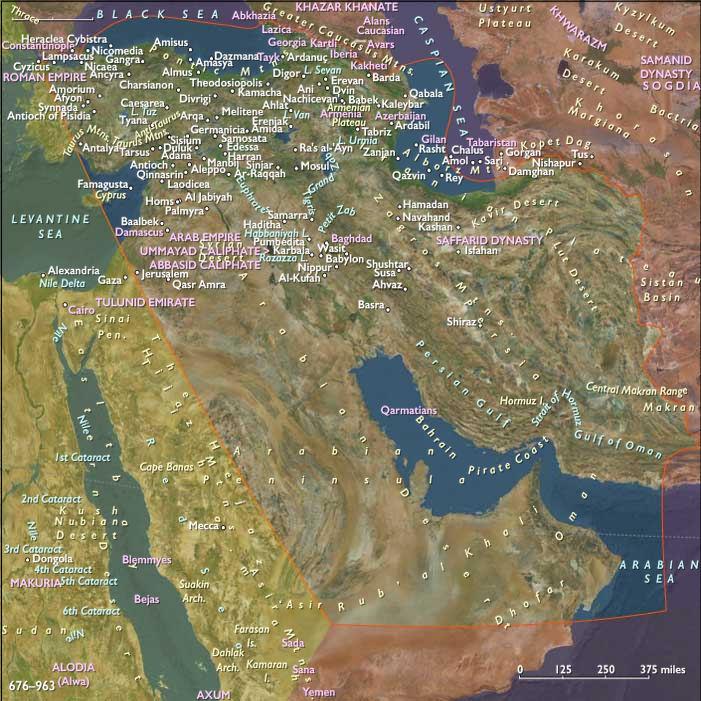
Mardāvīj arrives in Isfahan on December 2, 931, names himself the Amir of Iran, and makes Isfahan his capital.
From the advent of Islam until Mardāvīj's arrival, Isfahan has been under the jurisdiction of the Arabs.
Mardāvīj plans to conquer Baghdad, remove the caliphate, be crowned in Ctesiphon and restore the Persian empire.
Locations
People
Groups
- Iranian peoples
- Arab people
- Persian people
- Zoroastrians
- Tabaristan, (Ka'usiyeh) Principality of
- Samanid dynasty
- Abbasid Caliphate (Baghdad)
- Ziyarid dynasty
Topics
Commodoties
Subjects
Regions
Subregions
Related Events
Filter results
Showing 10 events out of 53166 total
Abu Tahir, in 931, turns over the Qarmatian state to the Mahdi-Caliph, who institutes the worship of fire and the burning of religious books during an eighty-day rule, which culminates in the Mahdi ordering the execution of members of Bahrain’s notable families, including those of Abu Tahir’s family.
Fearing for his own life, Abu Tahir announces that he had been wrong and denounces the Madhi as ‘false’.
Begging forgiveness from the other notables, Abu Tahir has the Mahdi executed.
Charles-Constantine had gained complete control of Vienne by 930, but a year later Rudolph of France is claiming suzerainty over the Viennois and Lyonnais.
In light of these reverses in his transalpine policy, Hugh turns his attention towards securing his rule in Italy and receiving the imperial crown.
He induces the Italian nobility to recognize his son Lothair as their next king and crowns him in April 931.
That same year, he accuses his half-brother Lambert of Tuscany of conspiring for the crown—perhaps with the support of a faction of nobles—and deposes him, bestowing the March of Tuscany on his brother Boso.
Hugh, however, has other reasons for deposing Lambert, who presents an obstacle to his second marriage to Marozia.
Lambert's supporters call in Rudolph of Burgundy, whom Hugh bribes off with the gift of the Viennois and Lyonnais, which Rudolph successfully occupies.
Both Leo VI and Stephen VII, the popes following John X, have been Mazovia’s puppets.
Stephen, a Roman by birth, the son of Theodemundus, had been elected—probably handpicked—by Marozia from the Tusculani family, as a stopgap measure until her own son John was ready to assume the chair of Saint Peter.
Prior to his election, Stephen had been the cardinal-priest of St. Anastasia in Rome.
Very little is known about Stephen’s pontificate.
During his two years as pope, Stephen had confirmed the privileges of a few religious houses in France and Italy.
As a reward for helping free Stephen from the oppression of Hugh of Arles, Stephen had granted Cante di Gabrielli the position of papal governor of Gubbio, and control over a number of key fortresses.
Stephen is also noted for the severity with which he treats clergy who stray in their morals.
He is also, apparently, according to a hostile Greek source from the twelfth century, the first pope who goes around clean shaven while pope.
Stephen dies around March 15, 931, and is succeeded as Pontiff by Mazovia’s twenty-one-year-old son, under the name of John XI.
The parentage of John XI is still a matter of dispute.
According to Liutprand of Cremona (Antapodosis, ii. c. 48) and the Liber Pontificalis, he was the natural son of Pope Sergius III (904–911), (Johannes, natione Romanus ex patre Sergio papa, Liber Pont. ed. Duchesne, II, 243).
Ferdinand Gregorovius, Ernst Dümmler, Thomas Greenwood (Cathedra Petri: A Political History of the great Latin Patriarchate), Philip Schaff, and Rudolf Baxmann agree with Liutprand that Pope Sergius III fathered Pope John XI by Marozia.
If that is true, John XI would be the only known illegitimate son of a Pope to have become Pope himself. (Silverius was the legitimate son of Pope Hormisdas).
On the other hand, Horace Kinder Mann, Reginald L. Poole, Peter Llewelyn (Rome in the Dark Ages), Karl Josef von Hefele, August Friedrich Gfrörer, Ludovico Antonio Muratori, and Francis Patrick Kenrick maintain that Pope John XI was sired by Alberic I of Spoleto, Count of Tusculum.
The Partition of León and the Rise of Ramiro II (929 CE)
After deposing Alfonso Fróilaz, the three sons of Ordoño II, with the support of the Kingdom of Pamplona, divide the realm among themselves:
- Sancho Ordóñez rules in Galicia,
- Alfonso IV governs León, and
- Ramiro II controls the newly conquered lands to the south, with Ibn Hayyan identifying his court at Coimbra.
Ramiro II Seizes Power
When Sancho Ordóñez dies in 929, his kingdom is absorbed by Alfonso IV, reuniting the territories. However, soon after, a power struggle erupts.
In a swift turn of events in León and Zamora, Ramiro II forces Alfonso IV to abdicate. To secure his rule, Ramiro has both Alfonso IV and Fruela II’s three sons blinded, rendering them incapable of claiming the throne.
This brutal consolidation of power establishes Ramiro II as the undisputed ruler of the Kingdom of León, marking the beginning of a reign that will define Christian resistance against Al-Andalus.
Co-emperor Romanus I Lekapenos had in 917 been admiral of the imperial fleet on the Danube when, hearing of the defeat of the army at Achelous, he resolved to sail for Constantinople.
Soon after the marriage of his daughter Helena to Emperor Constantine VII, he was crowned colleague of his son-in-law and, from 920, has exercised all real power.
In 927, after a series of eco-disasters, including a plague, he calls for another forced conversion of Jews, and in 932 commands that the Jews in the realm be forcibly baptized.
Though it results in a mass emigration of Jews, many of whom find welcome in Khazaria, his decree is never fully realized.
The courtiers at Bagdhad, who fear that al-Muqtadir's son might revenge his father's death upon them, choose instead the late Caliph's brother al-Qahir; but he is an even worse lord than al-Muqtadir.
With an outward affectation of godliness, he goes to every excess of cruelty and extortion, even torturing the mother of al-Muqtadir and his sons and favorites, to squeeze from them the wealth built up throughout the former caliph’s reign.
Many flee from his grasp.
Hugh's attempt to strengthen his power further by a second marriage fails disastrously.
His bride is Marozia, senatrix and effective ruler of Rome and widow first of Alberic I of Spoleto and then of Hugh's own half-brother Guy of Tuscany.
This last fact, though, means that the marriage is illegal under canon law, because of the affinity relationship between them—a matter that Hugh tries to circumvent by disowning and eliminating the descendants of his mother's second marriage and giving Tuscany to a relative on his father's side of the family, Boso.
This in turn, however, alarms Alberic II, Marozia's teenage son or stepson from her first marriage, who, appealing to Roman distrust of the foreign troops Hugh had brought with him, launches a coup d'état during the wedding festivities.
Alberic and his new stepfather quarrel violently after Hugh slaps Alberic for clumsiness.
Infuriated by this and perhaps motivated by rumors that Hugh intends to have him blinded, Alberic leaves the festivities and incites a Roman mob to revolt against Hugh.
In December 932 Hugh flees the city, managing to escape the castle by sliding down a rope and rejoining his army, but Marozia is cast into prison, where she will remain until her death a half-century later.
Alberic takes control of Rome.
The succession crisis that had struck León after Ordoño II's death in 924 had caused hostilities to cease until Ramiro II obtains the throne in 932; a first attempt by him to assist the besieged rebels in Toledo is repelled in 932, despite the Christian king having captured Madrid and scoring a victory at Osma.
The Struggle for Aquitaine: Ebalus, King Rudolph, and the Power Shift in the South (927–932)
After the death of Duke Acfred of Aquitaine in 927, his chosen heir, Ebalus (or Ebles Manzer), an illegitimate son of Ranulf II of Aquitaine, assumes control over the Duchy of Aquitaine, the Counties of Berry, Auvergne, and Velay. However, his hold on power is soon challenged by King Rudolph of West Francia, who seeks to curb Ebalus’ influence in the south.
Ebalus Becomes Duke of Aquitaine (928)
- Acfred of Aquitaine dies in 927, leaving his titles to Ebalus, whom William the Pious had protected.
- In 928, Ebalus formally assumes power, taking control of:
- Duchy of Aquitaine
- County of Auvergne
- County of Berry
- County of Velay
King Rudolph’s Efforts to Diminish Ebalus’ Power (929–932)
1. Loss of Berry (929)
- In 929, King Rudolph of Burgundy, seeing Ebalus as too powerful, begins to limit his authority by removing Berry from his control.
- This move signals the king’s intent to weaken the Ramnulfid dynasty (the ruling family of Poitou and Aquitaine) and assert royal influence in the south.
2. Transfer of Aquitaine and Auvergne to Raymond Pons of Toulouse (932)
- In 932, Rudolph strips Ebalus of his ducal title and grants it instead to Raymond Pons, Count of Toulouse.
- Raymond Pons travels north, accompanied by:
- His brother Ermengol of Rouergue.
- Sancho IV, Duke of Gascony.
- They perform homage to King Rudolph, solidifying their royal allegiance and shifting the balance of power against Ebalus.
3. La Marche Becomes an Independent County
- To further weaken Ebalus, Rudolph creates the County of La Marche, removing it from Ebalus' vassal, the Lord of Charroux, and making it an independent entity.
Unexpected Outcome: Strengthening the Ramnulfid Dynasty
- Despite these land transfers, Rudolph’s strategy does not yield the expected results.
- Rather than eliminating Ebalus, Rudolph soon finds himself cooperating with him in fighting against Viking incursions.
- This military alliance reinforces the Ramnulfid position, ensuring that Ebalus remains a significant force in Aquitaine.
- The struggle for supremacy between the Ramnulfids and the House of Rouergue (Raymond Pons’ family) continues for decades, reflecting the fragmented political landscape of southern France.
Conclusion: The Fragile Balance of Power in Aquitaine
The events of 929–932 demonstrate the continued decline of royal authority in West Francia, as King Rudolph fails to impose lasting control over the south. Though he transfers titles away from Ebalus, the reality of feudal power ensures that the Ramnulfid dynasty remains a dominant force, highlighting the limits of royal influence in an increasingly decentralized kingdom.
The Magyars (Hungarians), Eurasian nomads who had originally served as mercenaries under Emperor Arnulf, after his death in 899 had begun to campaign in the Kingdom of Italy and East Francia.
In 906, they had broken up Great Moravia and one year later destroyed a Bavarian army under Margrave Luitpold at the Battle of Pressburg.
A Magyar army invading the German duchy of Saxony in 924 had defeated King Henry I in the field, but an Árpád prince—possibly Zoltán—captured near Pfalz Werla had allowed Henry to negotiate for terms.
A truce of nine years, during which annual tribute was required of the Germans, had been declared in 926.
During the truce, Henry has reorganized the defenses of his Saxonian duchy and subdued the Polabian Slavs in the east.
At an 926 assembly, Henry had secured the construction of new castles and the authorization of a new form of garrison duty: the soldiery are organized into groups of nine agrarii milites (farmer-soldiers), one of which is doing guard duty at any given time while the other eight work the fields.
In time of invasion, all nine can man the castles.
Once he believed the necessary reforms had been made, Henry had secured the support of the church in reneging on tribute payments in 932.
Allegedly he had a dead dog thrown down in front of the Magyar negotiators, which amounts to a declaration of war.
In preparation for the campaign, Henry has levied mounted contingents from every region and stem duchy of the German kingdom, though only French chronicler Flodoard of Reims records the Bavarian presence.
The Magyars had besieged an unknown town but attempted to withdraw in the night because Henry and his army have camped in the neighborhood at Riade.
Henry sends forward a small contingent of foot soldiers with a few cavalrymen as a screen for his main army.
The king had learned what to expect from the preceding struggles, where the rapidity of the Magyar light cavalry and archers had brought them success.
He confronts their onset with lightly armored combatants at first, followed by a massed heavy cavalry attack.
According to Widukind of Corvey, the Magyar forces readily fled at the coming of Henry's horsemen and the victorious German troops declared Henry emperor on the battlefield.
The exact location of the battle is unknown and several municipalities in Central Germany claim to be the site of the combat, among them Kalbsrieth, at the confluence of Unstrut and Helme, and the Hunnenfeld near Riethgen.
However the place of Riade rendered by Widukind denotes the army camp of King Henry, probably not identical with the battlefield.
The Magyars, who will not dare to make a further raid on East Francia in Henry's lifetime, will again invade Germany in 954 during a rebellion instigated by Duke Liudolf of Swabia; they will be finally defeated the following year by Henry's son and successor King Otto I at the Battle of Lechfeld.

Years: 931 - 931
Locations
People
Groups
- Iranian peoples
- Arab people
- Persian people
- Zoroastrians
- Tabaristan, (Ka'usiyeh) Principality of
- Samanid dynasty
- Abbasid Caliphate (Baghdad)
- Ziyarid dynasty