
Since Augustus has no sons, his nephew …
Years: 25BCE - 25BCE
Since Augustus has no sons, his nephew Marcellus is one of his closest relative—already at the age of three, when his uncle had needed to make peace with Sextus Pompey, Marcellus had been engaged to a daughter of Sextus (though the engagement was forgotten when Sextus Pompeius was defeated).
As he has grows older, Marcellus has been seen often in public with Augustus, including at his triumphs over Mark Antony and Cleopatra and a campaign against the Cantabri.
In 25 BCE, Marcellus marries Augustus' only daughter, Julia the Elder, with Agrippa officiating in Augustus's absence.
Locations
People
- Augustus
- Julia the Elder
- Marcus Claudius Marcellus (Julio-Claudian dynasty)
- Marcus Vipsanius Agrippa
- Vitruvius
Groups
Subjects
Regions
Subregions
Related Events
Filter results
Showing 10 events out of 62203 total
Galatia, a Roman protectorate from 85 BCE, is ruled by puppet kings.
No military effort is needed in 25 BCE when Galatia is converted to a Roman province shortly after Amyntas of Galatia is killed by an avenging widow of a slain prince from Homonada.
Angora becomes the capital of the new province, which encloses the Galatians between Cappadocia on the east and the province of Asia on the west.
Herod imports grain from Egypt in 25 BCE and starts an aid program to combat the widespread hunger and disease that has followed a massive drought.
He also waives a third of the taxes.
The Decapolis serves as a starting point for Aelius Gallus' ill-starred expedition in 25-24 BCE in search of Arabia Felix.
Aelius Gallus, the second praefect of Roman Egypt (Aegyptus) in the reign of Augustus during the years 26–24 BCE, had replaced Cornelius Gallus—with whom he has often been confounded.
Aelius Gallus is also known to be an intimate friend of the Greek geographer Strabo of Pontus and has been identified with the Aelius Gallus frequently quoted by Galen, whose remedies are stated to have been used with success in his Arabian expedition.
Gallus has undertaken the expedition from Egypt by the command of Augustus, partly with a view to explore the country and its inhabitants, and partly to conclude treaties of friendship with the people, or to subdue them if they should oppose the Romans, for it is believed at this time that Arabia is full of all kinds of treasures.
When Aelius Gallus sets out with his army, he trusts to the guidance of a Nabataean called Syllaeus, who deceives and misleads him.
A long account of this interesting expedition through the desert is given by Strabo—who derives most of his information about Arabia from his friend Aelius Gallus.
Roman military operations continue in many frontier areas.
Recalcitrant Alpine tribes are reduced in 25 BCE.
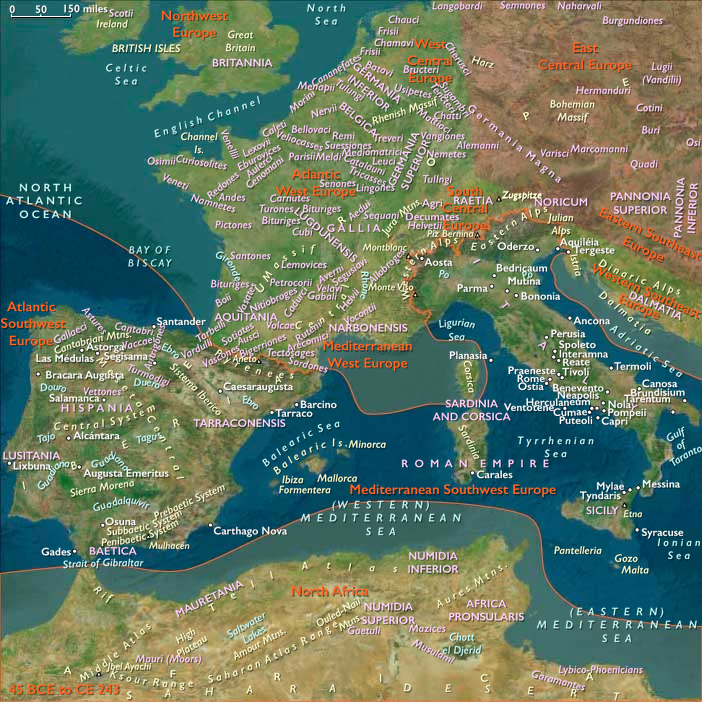
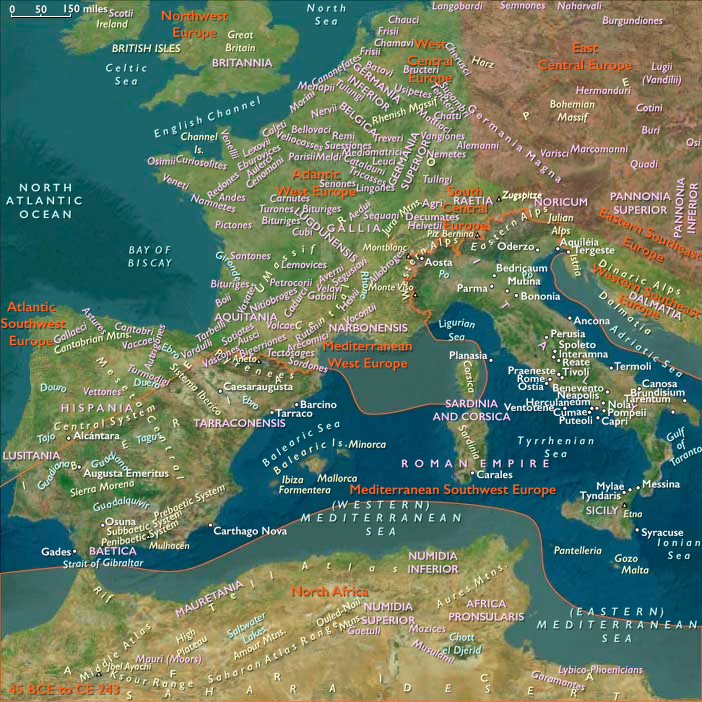
The town of Aosta, settled in proto-historic times, had become a center of the Salassi, of present Valle d'Aosta, a region in the Alps of northwestern Italy, bordering France and Switzerland.
At the lower end of their territory are gold mines, which the Roman Republic had taken in 143 BCE.
In 100 BCE, the city of Eporedia (modern Ivrea) had been founded in the basin at the bottom of the area.
Relations with the Romans have not been uniformly peaceful; Strabo mentions that the Salassi robbed Julius Caesar's treasury and threw rocks on his legions on the grounds that they were making roads and building bridges.
There may have been a Roman campaign against the Salassi in 35 or 34 BCE under Marcus Valerius Messalla Corvinus or Antistius Vetus.
For their last decade of freedom, the Salassi (with some other, mainly Alpine, tribes subjugated by 14 BCE) are almost the only remaining groups not under Roman control in the Mediterranean basin.
After the Battle of Actium in 31 BCE the Roman world has been united under one ruler, Augustus, who can concentrate Roman forces against remaining holdouts.
The end of independence for the Salassi comes in 25 BCE at the hands of Aulus Terentius Varro Murena, who founds a Roman colony in the territory of the Salassi, Augusta Praetoria Salassorum, a well-fortified city protected by two streams.
Strabo records that two thousand Salassi were killed and all the survivors, nearly forty thousand men, women, and children, were taken to Eporedia and sold into slavery.
However, some remain; an inscription found near the west gate of Augusta Praetoria Salassorum, founded as a colony housing three thousand retired veteran, is a dedication to Augustus dated 23 BCE of a statue (?)
by "the Salassi who had joined the colony from its beginning."
In the ensuing centuries of Roman peace, the Salassi disappear from history.
Marcus Vitruvius Pollio, sometime after 27 BCE, writes De architectura, an important treatise on ancient architectural theory and practice (the sole surviving such treatise on this subject).
Vitruvius takes a conservative approach to style and makes little reference to buildings of his own time.
The influential work consists of ten volumes: (1) the architect's training and aims, (2) materials, and the origin of architecture, (3) proportions, (4) the Greek orders and temples, (5) other civic structures, (6) domestic architecture, (7) stucco work and painting, (8) water and aqueducts, (9) astronomy, and (10) civil and military machines.
Vitruvius reveals, through his prefaces, that his expertise had brought him to the attention of Caesar; he later works for Augustus.
The Astur-Cantabrian Resistance and the Roman Campaign
As the Cantabrian Wars escalate, the Astures join the Cantabri in a unified defense against Roman expansion.
By the spring of 25 BCE, three Roman legions are positioned near the Astura River (modern Esla River), with additional forces from Tarraconensis.
According to Florus, a contemporary Roman historian, the Astures Transmontani descend from their snow-covered mountains—a plausible scenario in the Picos de Europa during spring—and settle near the Astura River, preparing to launch an attack on the three Roman winter camps.
However, the Brigaecini (Astures Cismontani) of the Benavente region betray their plans, informing Emperor Augustus of the impending assault. In gratitude for their loyalty, Augustus rewards them with Brigantum, the camp of Augustan Asturica, and grants them lands in the plains.
The Siege of Lancia and the Fall of the Astures
Following this intelligence, Augustus’ general Carisius launches a decisive attack against the Astur armies, likely commanded by Gausón. The Astures retreat to Lancia, described by Florus as the most important stronghold of the Astures Cismontani.
After Lancia is besieged, the remaining Astur forces flee to Mons Medullius, a heavily fortified mountain refuge. Some scholars identify this site as Las Médulas, based on Florus’ account in his Epitome of Roman History.
The Roman legions encircle Mons Medullius, constructing a 15-mile-long moat and ditch to cut off the defenders. According to Orosius, rather than surrender, the Astur warriors choose mass suicide, using their own weapons and yew tree poison to escape Roman subjugation.
The Roman Navy and the Final Encirclement of the Cantabri
In addition to ground forces, the Roman navy is deployed to the Cantabrian coast from Gallia Aquitania, playing a crucial role in the conflict's resolution. By securing the coastline, the navy completes the encirclement of the Cantabri, effectively cutting off their escape and supply routes.
Roman Army Strength and Variability in Estimates
It is estimated that Rome deployed approximately 70,000 troops for the campaign, though figures vary among historians. Traditional calculations are based on a standard five-thousand-man legion, but these numbers do not account for auxiliary forces, which significantly increased total troop strength.
In reality, the Roman army likely exceeded 80,000 men, including legionaries and auxiliaries.
- Under the military reforms of Gaius Marius, a full-strength legion contained approximately 6,000 soldiers, totaling about 60,000 men across ten legions.
- However, by Augustus' time, a Roman legion was officially composed of 6,200 men, though actual numbers fluctuated between 5,000 and 8,000 due to various logistical and operational factors.
The combination of land and naval forces, along with overwhelming manpower and strategic encirclement, ensured Rome’s eventual victory over the Cantabrian resistance.
Strabo belongs on his mother's side to a famous family, whose members had held important offices under Mithridates V (around 150–120 BCE), as well as under Mithridates the Great (132–63 BCE), the opponent of Rome.
His first teacher had been the master of rhetoric Aristodemus, a former tutor of the sons of Pompey (106–48 BCE) in Nysa (now Sultanhisar in Turkey) on the Maeander.
Strabo in 44 BCE had emigrated to Rome to study with Tyrannion, the former tutor of Cicero, and with Xenarchus, both of whom were members of the Aristotelian school of philosophy.
Under the influence of Athenodorus, former tutor of Octavius, who probably introduced him into the future emperor's circle, he had turned toward Stoical philosophy, the precepts of which include the view that one unique principle ceaselessly pervading the whole universe causes all phenomena.
Before leaving Rome in 31 BCE, he had completed the forty-seven-volume Historical Sketches, of which but a few quotations survive.
A vast and eclectic compilation, it is meant as a continuation of Polybius' Histories.
The Historical Sketches covers the history of the known world from 145 BCE to 31 BCE—that is, from the Roman conquest of Greece to the Battle of Actium.
Strabo has traveled between Armenia and Sardinia and from the Black Sea to Ethiopia, incorporating both his own observations and earlier sources in his great work-in-progress, the Geography.
Strabo in 29 BCE had visited the island of Gyaros (today known as Yiáros, or Nisós) in the Aegean Sea, on his way to Corinth, Greece, where Augustus was staying.
Together with Aelius Gallus, he sails up the Nile in 25 or 24 as far as Philae.
The expedition to Arabia Felix, of which an account is given by his friend Strabo, as well as by Cassius Dio and Pliny the Elder, has turned out to be a complete failure.
The burning heat of the sun, the bad water, and the want of every thing necessary to support life, has produced a disease among the soldiers that is altogether unknown to the Romans, and destroys the greater part of the army; so that the Arabs are not only not subdued, but succeed in driving the Romans even from those parts of the country which they had possessed before.
Aelius Gallus has spent six months on his march into the country, on account of his treacherous guide, while he effects his retreat in sixty days, obliged to return to Alexandria, having lost the greater part of his force.
Aelius Gallus is recalled by Augustus for failure to pacify the Kushites and is succeeded as prefect by Gaius Petronius, a military genius and close friend of Augustus.
Emerita Augusta (Mérida), in southern Hispania, is settled with the emeriti of the Legio V Alaudae and Legio X Gemina legions).
Years: 25BCE - 25BCE
Locations
People
- Augustus
- Julia the Elder
- Marcus Claudius Marcellus (Julio-Claudian dynasty)
- Marcus Vipsanius Agrippa
- Vitruvius
