
Marcus Porcius Cato, commonly known as Cato …
Years: 169BCE - 169BCE
Marcus Porcius Cato, commonly known as Cato the Elder, stimulates Roman rhetoric by publishing his own speeches.
A supporter of traditional Roman ways, Cato patronizes the poet Quintus Ennius, having brought the southern Italian native to Rome from Sardinia.
Ennius, whose eighteen-book epic historical poem, the Annales, glorifies the Roman state from its origins to his own time, writes in an astonishing variety of genres—comedy, tragedy, philosophy, satire, and even a work on food entitled The Delicatessen.
Annales is the first Latin poem to adopt the dactylic hexameter meter used in Greek epic and didactic poetry, leading it to become the standard meter for these genres in Latin poetry.
The Annals become a school text for Roman schoolchildren, eventually supplanted by Virgil's Aeneid.
About six hundred lines survive.
Held by some to be the father of Roman literature, Ennius dies in 169.
Cato’s highly original Origines ("Origins"), a historical work, is the first prose history in Latin, and among the very first Latin prose works in any genre.
At the time Cato publishes Origines, there were two existing historical works in Latin, by Naevius and Ennius, but they are in verse, not prose.
There are two existing prose histories by Romans, Q. Fabius Pictor and Lucius Cincius Alimentus, but they are written in Greek.
All four of these existing works focus on Rome throughout; moreover, the two poems weave Roman history inextricably into the adventures of the Graeco-Roman gods.
Cato evidently chose to do it differently in Origines, which no longer survives as a complete text, but substantial fragments are known because they were quoted by later Latin authors.)
According to Cato's biographer Cornelius Nepos, the Origines consisted of "seven books.
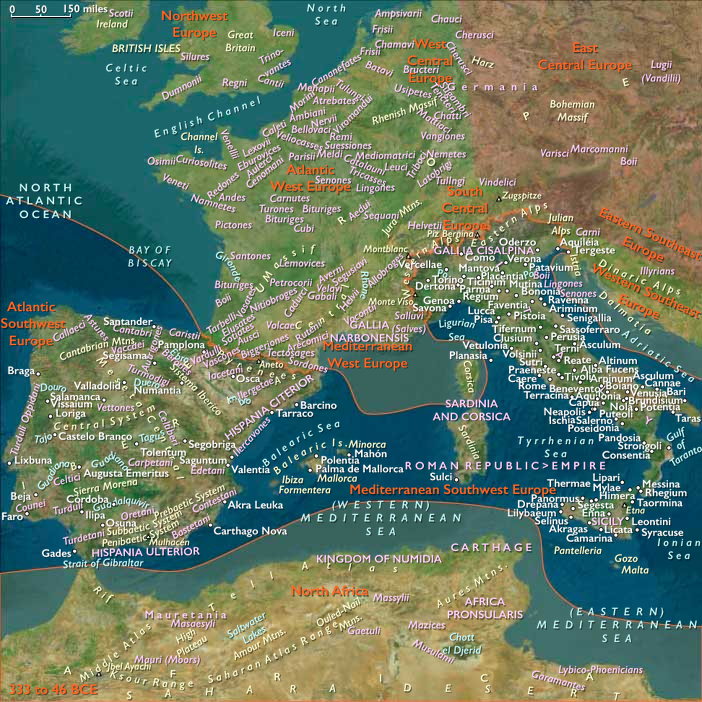
Book I is the history of the early kings of Rome; books II and III the beginnings of each Italian city.
This seems to be why the whole work is called Origines."
The city histories in books II and III of the work were apparently treated on an individual basis, drawing on their own local traditions.
The last four books dealt with Rome's later wars and the growth in the city's power; they "outweighed the rest", according to one later reader.
With this work, along with those by Livius Andronicus, Naevius, Ennius and Plautus, Cato helps to found a new literature.
Locations
People
Groups
Topics
Subjects
Regions
Subregions
Years: 169BCE - 169BCE
Locations
People
Groups
Topics
Subjects
Regions
Subregions