Marco Polo crosses Afghan Turkestan in 1273, …
Years: 1273 - 1273
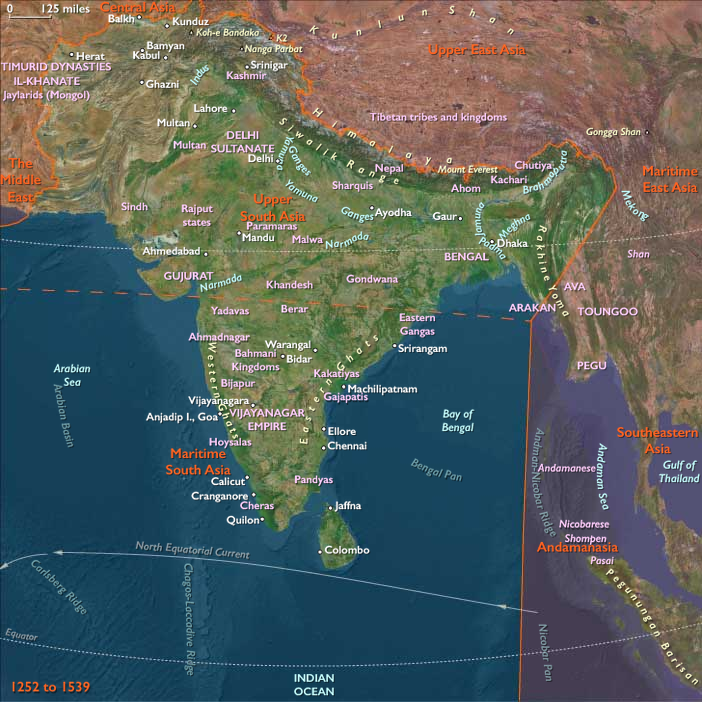
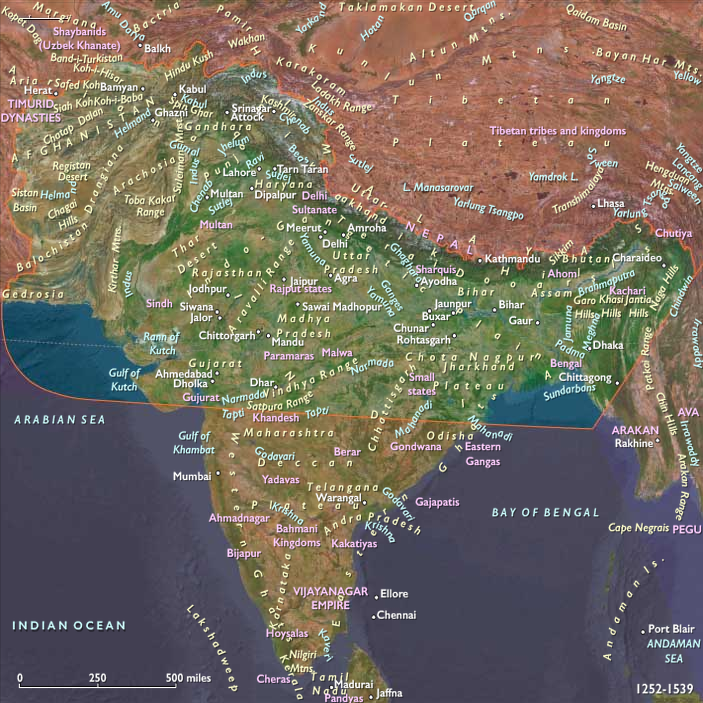
Marco Polo crosses Afghan Turkestan in 1273, eventually to arrive at the Chinese court of Kublai Khan, grandson of Genghis Khan.
Locations
People
Groups
- Mongols
- Venice, (Most Serene) Republic of
- Mongol Empire
- Kublai Khan, Empire of
- Chinese Empire, Yüan, or Mongol, Dynasty
Topics
Subjects
Regions
Subregions
Related Events
Filter results
Showing 10 events out of 45696 total
Kublai Khan attempts to extend Mongol suzerainty to Burma, but Narathihapate, the Burmese king of Bagan, or Pagan, refuses to accept Mongol vassalage, underscoring his position in 1273 with the execution of Kublai’s envoy sent to demand payment.
Bayan, grandson of the late renowned General Subedei, has won many battles, seizing many large cities.
The six-year long Battle of Xiangyang ends on January 31, 1268, when the commander of the Song Dynasty's forces surrenders to Kublai Khan's Yuan Dynasty.
The battle is the first in which firearms are used in combat.
The Order had retaliated against the Balts in Livonia by 1272, attacking Semigalia and building Dinaburga Castle in 1273 on lands in Latgalia, nominally controlled by Traidenis.
The fortunes of King Ottokar II of Bohemia had changed soon after the 1273 election of Rudoph, a son of Albert IV, Count of Habsburg, as German king at Frankfurt, hastened by the desire of the electors to exclude Ottokar, an increasingly powerful rival candidate of non-German birth.
Following his coronation as King of Germany on October 24, 1273, Rudolph launches a campaign to revive the monarchy's prestige and to recover alienated fiefs.
He claims Austrian territory as his imperial right, but Ottokar II has annexed much of it, including Austria, Styria, Carinthia, Carniola, and Istria, to Bohemia.
Emperor Michael VIII gives Pera, a suburb of Constantinople, to the Republic of Genoa in 1273 in return for Genoa's support of the Empire after the Fourth Crusade and the sacking of Constantinople in 1204.
Pera will soon become a flourishing trade colony, ruled by a podestà, and will gradually outstrip the Greek capital in economic development.
Jalal al-Din Muhammad Rumi comes under the influence of Shamsi Tabriz, an itinerant Sufi.
Rumi writes a poetical work, a collection of lyrical odes named for Tabriz.
Soon after his death on December 17, 1273 his followers establish the Sufi Mevlevi Order (known colloquially as the "Whirling Dervishes") in the city of Konya (in present-day Turkey).
The Treaty of Viterbo of 1267 had been signed after the Angevin forces in 1266 defeated the Hohenstaufen forces of Manfred of Sicily in the Battle of Benevento, with Charles of Anjou acquiring rights on Manfred's dominions in Albania, together with rights he gained in the Latin dominions in the Despotate of Epirus and in the Morea.
Michael II, upon hearing the news of Manfred's death in the battle of Benevento, had conspired and managed to kill Manfred's governor Philippe Chinard, with the help of Chinard's wife, but he could not capture Manfred's domains.
Local noblemen and commanders had refused to surrender Manfred's domains in Albania to Michael II.
They had given the same negative response to Charles' envoy, Gazo Chinard, in 1267, when following the articles of the Treaty of Viterbo, he had asked for them to surrender Manfred's dominions in Albania.
Charles had returned his attention to Albania after the failure of the Eighth Crusade He began contacting local Albanian leaders through local catholic clergy.
Two local catholic priests, namely John from Durrës and Nicola from Arbanon, had acted as negotiators between Charles of Anjou and the local noblemen, making several trips between Albania and Italy in 1271 and eventually succeeding in their mission.
A delegation of Albanian noblemen and citizens from Durrës had made their way to Charles' court on February 21, 1272.
Charles had signed a treaty with them and was proclaimed King of Albania "by common consent of the bishops, counts, barons, soldiers and citizens" promising to protect them and to honor the privileges they had from Constantinople.
The treaty declared the union between the Kingdom of Albania (Latin: Regnum Albanie) with the Kingdom of Sicily under King Charles of Anjou (Carolus I, dei gratia rex Siciliae et Albaniae).
He had appointed Gazzo Chinardo as his Vicar-General and hopes to take up his expedition against Constantinople again.
He sends huge provisions throughout 1272 and 1273 to the towns of Durrës and Vlorë.
This alarms the Eastern Emperor, who begins sending letters to local Albanian nobles, trying to convince them to stop their support for Charles of Anjou and to switch sides.
The Albanian nobles send those letter to Charles who praises them for their loyalty.
Now, Michael VIII's hopes of stopping the advance of Charles are laid on the influence of Pope Gregory X. Gregory has high hopes of reconciling Europe, unifying the Greek and Latin churches, and launching a new crusade: to that end, he announces the Council of Lyon, to be held in 1274, and works to arrange the election of an Emperor, so he orders Charles to stop his operations.

Charles imposes a military rule on Kingdom of Albania.
The autonomy and privileges promised in the treaty are de facto abolished and new taxes are imposed.
Lands are confiscated in favor of Angevin nobles and Albanian nobles are excluded from their governmental tasks.
Charles I takes as hostages the sons of local noblemen in an attempt to enforce his rule and local loyalty.
This creates a general discontent in the country and several Albanian noblemen begin contacting Emperor Michael VII, who promises to acknowledge their former privileges.
As Charles’s intentions for a new offensive have been stopped by the Pope and there is a general discontent within Albania, Michael VIII seizes the moment and begins a campaign in Albania in late 1274.
Imperial forces helped by local Albanian noblemen capture the important city of Berat and later on Butrint.
The local governor reports to Charles in November that the Albanian and imperial forces have besieged Durrës.
The imperial offensive continues and captures the port-city of Spinarizza.
Thus, Durrës, alongside the Krujë and Vlora regions, become the only domains in mainland Albania which are still under Charles I's control, but they are landlocked and isolated from each other.
They can communicate with each other only by sea but the imperial fleet based in Spinarizza and Butrint keeps them under constant pressure.
Charles also manages to keep the island of Corfu.
Alfonso X of Castile, having spent great sums vainly trying to gain recognition as Holy Roman Emperor, protests the election in 1273 of Rudolf of Habsburg as King of Germany.
Pope Gregory X convinces Alfonso to relinquish his claim in returns for Rudolf’s renunciation of his claims to Rome or the Papal States.
Baldwin II of Constantinople had been forced to mortgage his young son, Philip of Courtenay, to Venetian merchants to raise money for the support of his empire, which was lost to the Empire of Nicaea in 1261.
By the Treaty of Viterbo in 1267, his father had agreed to marry him to Beatrice of Sicily, daughter of Charles I of Sicily and Beatrice of Provence.
Her maternal grandparents are Ramon Berenguer IV, Count of Provence and Beatrice of Savoy.
The marriage is performed in October 1273 at Foggia; shortly thereafter, Baldwin dies, and Philip inherits his claims on Constantinople.
Although Philip is recognized as emperor by the Latin possessions in Greece, much of the actual authority will devolve on the Angevin kings of Naples and Sicily.
Years: 1273 - 1273
Locations
People
Groups
- Mongols
- Venice, (Most Serene) Republic of
- Mongol Empire
- Kublai Khan, Empire of
- Chinese Empire, Yüan, or Mongol, Dynasty