
George Maniakes transfers his troops into the …
Years: 1043 - 1043
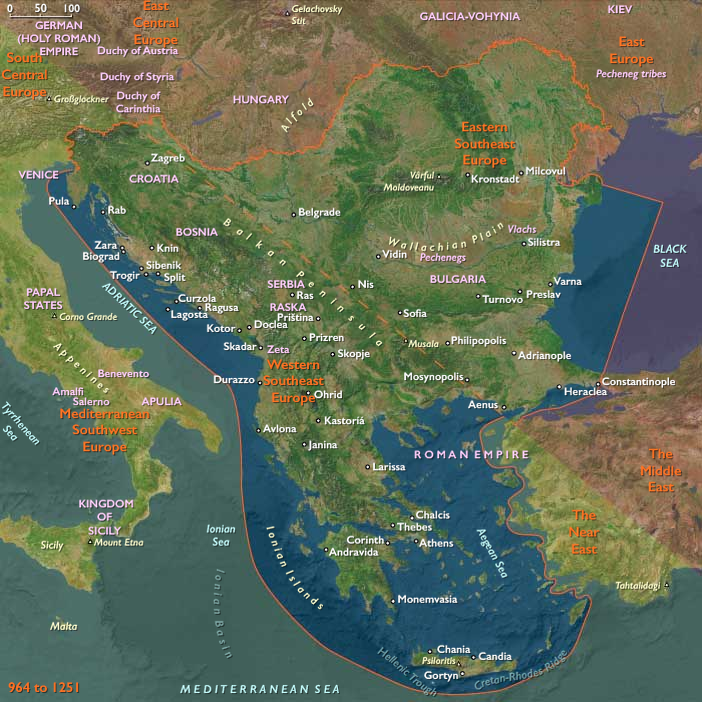
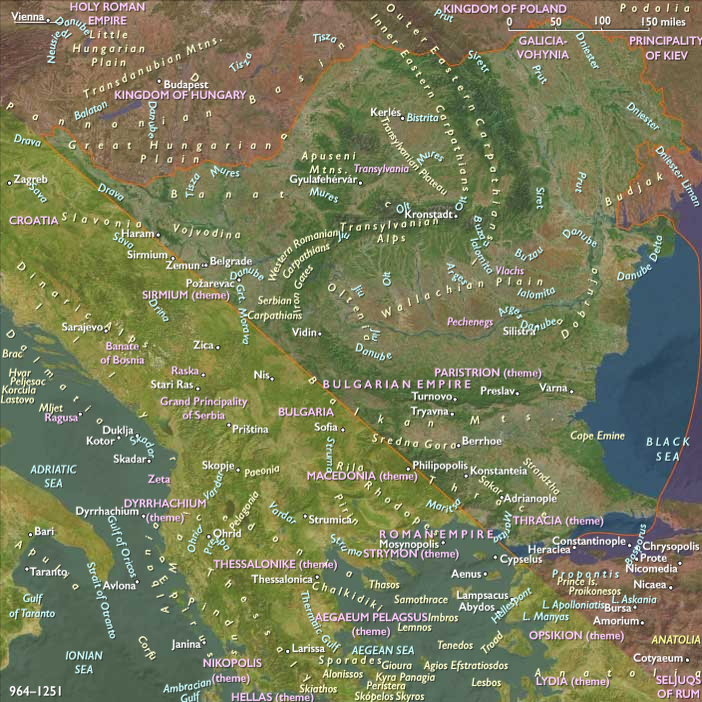
George Maniakes transfers his troops into the Balkans and is about to defeat Constantine's army in battle, when he is wounded and dies on the field near Thessaloniki, ending the crisis in 1043.
Constantine's extravagant punishment of the surviving rebels is to parade them in the Hippodrome, seated backwards on donkeys.
With his death, the rebellion ceases.
Harald Hardrada has become extremely rich during his time in the east, and had secured the wealth collected in Constantinople by shipments to Kievan Rus' for safekeeping (with Yaroslav the Wise acting as safekeeper for his fortune).
The sagas note that aside from the significant spoils of battle he had retained, he had participated three times in polutasvarf (loosely translated as "palace-plunder"), a term which implies either the pillaging of the palace exchequer on the death of the emperor, or perhaps the disbursement of funds to the Varangians by the new emperor in order to ensure their loyalty.
It is likely that the money Harald made while serving in Constantinople allowed him to fund his claim for the crown of Norway, which he will pursue in 1046.
If he participated in polutasvarf three times, these occasions must have been the deaths of Romanos III, Michael IV, and Michael V, in which Harald would have had opportunities, beyond his legitimate revenues, to carry off immense wealth.
After Zoe had been restored to the throne in June 1042 together with Constantine IX, Harald had requested to be allowed to return to Norway.
Although Zoe had refused to allow this, Harald had managed to escape into the Bosporus with two ships and some loyal followers.
Although the second ship had been destroyed by Constantinople’s cross-strait iron chains, Harald's ship had sailed safely into the Black Sea after successfully maneuvering over the barrier.
Despite this, Kekaumenos lauds the "loyalty and love" Harald had for the empire, which he reportedly maintained even after he returned to Norway and became king.
Following his escape from Constantinople, Harald had arrived back in Kievan Rus' later in 1042.
During his second stay there, he marries Elisabeth (referred to in Scandinavian sources as Ellisif), daughter of Yaroslav the Wise and granddaughter of the Swedish king Olof Skötkonung.
Shortly after Harald's arrival in Kiev,and immediately after Constantine’s victory over Maniakes, Yaroslav attacks Constantinople, and it is considered likely that Harald provided him with valuable information about the state of the empire.
The Rus' fleet is defeated with the help of Greek fire.
Locations
People
- Constantine IX Monomachos
- George Maniakes
- Harald Hardrada
- Ingegerd Olofsdotter of Sweden
- Vladimir of Novgorod
- Vsevolod I of Kiev
- Yaroslav I
- Zoe Porphyrogenita
Groups
- Greeks, Medieval (Byzantines)
- Varangians
- Roman Empire, Eastern: Macedonian dynasty
- Kievan Rus', or Kiev, Great Principality of
- Normans
- Italy, Catepanate of
- Norway, independent Kingdom of
Topics
Commodoties
Subjects
Regions
Subregions
Related Events
Showing 6 events out of 6 total
Years: 1043 - 1043
Locations
People
- Constantine IX Monomachos
- George Maniakes
- Harald Hardrada
- Ingegerd Olofsdotter of Sweden
- Vladimir of Novgorod
- Vsevolod I of Kiev
- Yaroslav I
- Zoe Porphyrogenita
Groups
- Greeks, Medieval (Byzantines)
- Varangians
- Roman Empire, Eastern: Macedonian dynasty
- Kievan Rus', or Kiev, Great Principality of
- Normans
- Italy, Catepanate of
- Norway, independent Kingdom of
Topics
Commodoties
Subjects
Regions
Subregions