
Mani, born near Seleucia-Ctesiphon, perhaps in the …
Years: 242 - 242
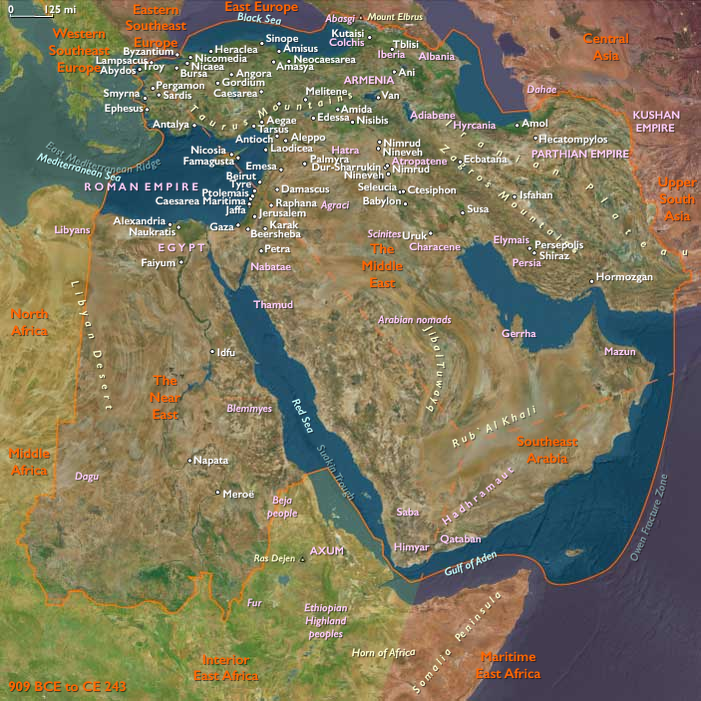
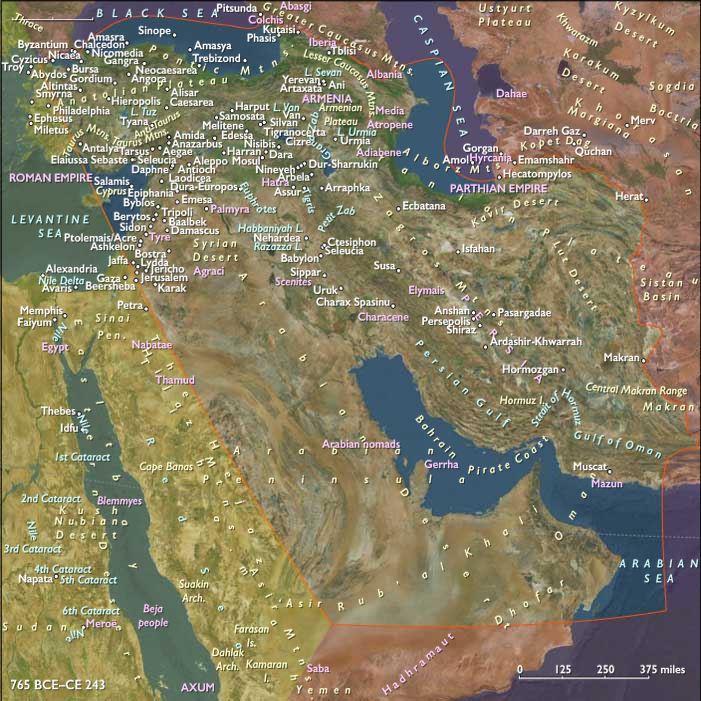
Mani, born near Seleucia-Ctesiphon, perhaps in the town Mardinu in the Babylonian district of Nahr Kutha, according to other accounts in the town Abrumya, is a Persian of noble descent and a Mithra initiate who has studied early Christian heresies.
Mani's father Pātik, a native of Ecbatana (modern Hamadan, Iran), is a member of the Jewish-Christian sect of the Elcesaites (a subgroup of the Gnostic Ebionites).
His mother, whose name is reported variously, among others Mariam, is of Parthian descent (from "the Armenian Arsacid family of Kamsarakan" (Sundermann, Werner (2009), Mani, the founder of the religion of Manicheism in the third century CE, "...his mother was from the house Jinsajian, explained by Henning as the Armenian Arsacid family of Kamsarakan".)
At ages twelve and twenty-four, Mani had visionary experiences of a heavenly twin of his, calling him to leave his father's sect and teach the true message of Christ.
In 240–41, Mani travels to "India" (i.e.
to the Sakhas, Hindu theological schools that specializes in learning certain Vedic texts, in modern-day Afghanistan), where he had probably been influenced by Greco-Buddhism.
Returning in 242, he joins the court of Shapur I, to whom he dedicates his only work written in Persian, known as the Shabuhragan.
Shapur is not converted to Manichaeanism and remains Zoroastrian.
Mani embarks on a career as an itinerant preacher, declaring himself the “Messenger of Truth,” the Paraclete promised by Jesus.
Traveling throughout the Persian empire, he teaches that salvation requires liberation of the seed of light, the soul, from the material darkness which envelops and binds it, and that this can be achieved through ascetic practices and strict celibacy.
Those who seek perfection must set three “seals” on their lives: on the mouth, to speak only truth and to abstain from meat or impure food of any kind; on the hands, to refrain from war, killing, or injuring life; on the breast, to render impossible the works of the flesh.
These rules apply only to the elect or pure; a less stringent code is described for hearers.
The destiny of the imperfect is continual rebirth in a world of material bodies.
The fifth-century Cologne Mani-Codex and other evidence discovered in the twentieth century establishes Mani as a historical individual.
Locations
People
Groups
- Hinduism
- Persian people
- Buddhism
- Greeks, Hellenistic
- Mithraic Mysteries
- Christians, Early
- Persian Empire, Sassanid, or Sasanid
- Manicheanism
Topics
Commodoties
Subjects
Regions
Subregions
Related Events
Showing 10 events out of 60519 total
Years: 242 - 242
Locations
People
Groups
- Hinduism
- Persian people
- Buddhism
- Greeks, Hellenistic
- Mithraic Mysteries
- Christians, Early
- Persian Empire, Sassanid, or Sasanid
- Manicheanism
Topics
Commodoties
Subjects
Regions
Subregions