Malik-Shah, having overcome the revolt of his …
Years: 1084 - 1084
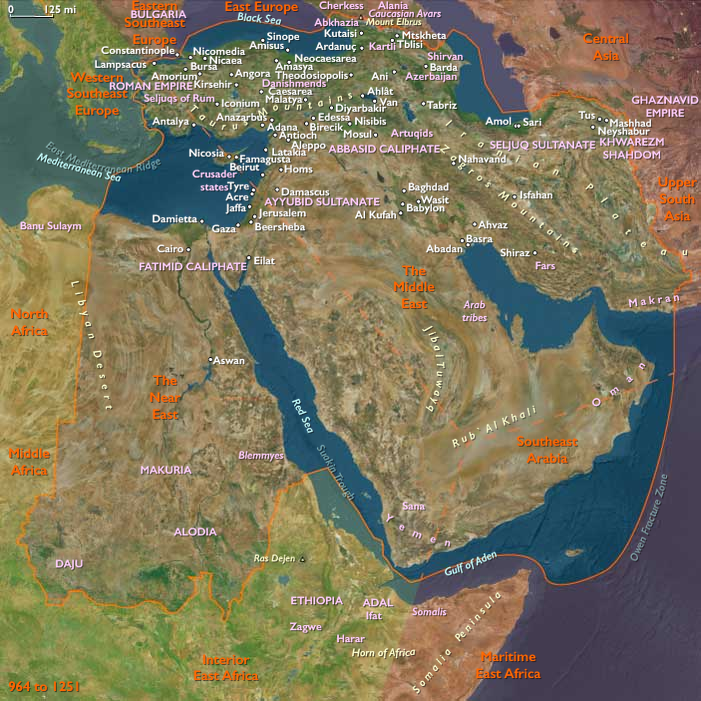
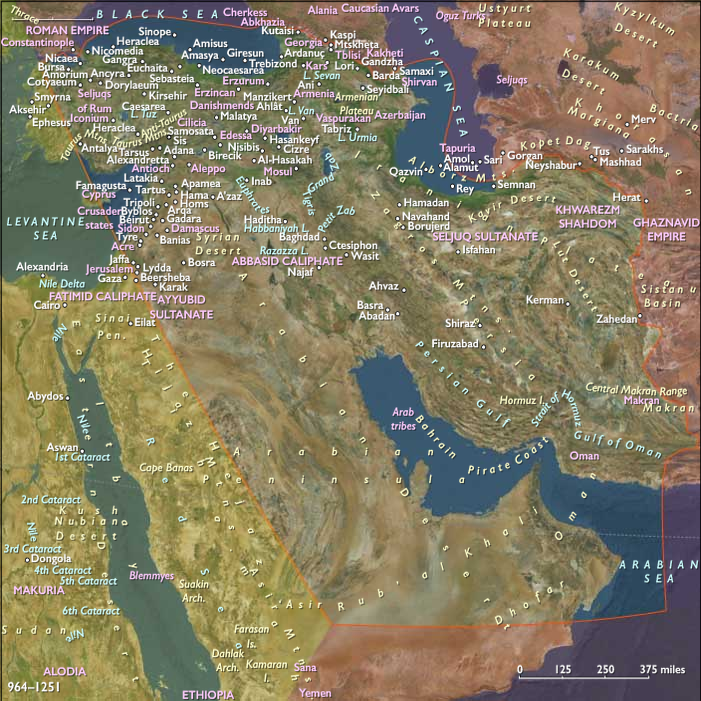
Malik-Shah, having overcome the revolt of his uncle Qawurd-Beg and an attack of the Kara-Khanids of Bukhara on Khorasan, has hereafter consolidated and extended his Great Seljuq empire more through diplomacy and the quarrels of his enemies than by actual warfare.
He has suppressed the former vassal principalities of upper Mesopotamia and Azerbaijan, acquired Syria and Palestine, and established a strong protectorate over the Kara-Khanids and a measure of control over Mecca and Medina, Yemen, and the Persian Gulf territories.
The Seljuq administration has imposes their influence on the Caucasus, fortifying Turkish Azerbaijan against Armenian and Georgian expansionism.
Malik-Shah has by the 1080s become less acquiescent to the policies of his Persian vizier, Nizam al-Mulk, who also antagonizes the sultan's favorite courtier, Taj al-Mulk, and has made an enemy of the sultan's wife Terkhen-Khatun by preferring the son of another wife for the succession.
Locations
People
Groups
- Arab people
- Persian people
- Kurdish people
- Khorasan, Greater
- Muslims, Sunni
- Muslims, Shi'a
- Kara-Khanid Khanate
- Abbasid Caliphate (Baghdad)
- Ghaznavids
- Turkmen people
- Fatimid Caliphate
- Georgia, (Bagratid) Kingdom of
- Seljuq Empire (Rayy)
- Roman Empire, Eastern: Doukid dynasty
Subjects
Regions
Subregions
Related Events
Filter results
Showing 10 events out of 50478 total
The forces of various branches of the Kiyohara clan fight forces of Minamoto no Yoshiie, the governor of Mutsu province on the Japanese island of Honshū, in the Gossanen War, or Later Three-Year War, of the late 1080s; the conflict ends with the disputes settled and order restored.
East Central Europe (1084–1095 CE): Royal Elevation in Bohemia, Crisis in Poland under Władysław I, and Hungarian Prosperity under Ladislaus I
Between 1084 and 1095 CE, East Central Europe—encompassing modern-day Poland, Czechia, Slovakia, Hungary, and eastern regions of Germany and Austria east of 10°E and north of the defined southeastern boundary—experienced significant political realignments, dynastic transitions, and cultural transformations. Vratislaus II was elevated to the royal dignity as the first King of Bohemia, Poland faced severe internal strife and dynastic upheaval following the dramatic fall of Bolesław II, and Hungary flourished culturally and politically under the stable and prosperous reign of King Ladislaus I.
Political and Military Developments
Bohemia’s Royal Elevation under Vratislaus II
-
In 1085, Vratislaus II of Bohemia was elevated to royal status by Emperor Henry IV, becoming the first Bohemian ruler formally recognized as King. His enhanced prestige strengthened Bohemian autonomy and regional influence, aligning Bohemia closely with imperial interests.
Crisis and Dynastic Conflict in Poland
-
After the deposition of Bolesław II "the Bold" in 1079, Poland experienced deep internal crises under his brother Władysław I Herman (r. 1079–1102). Internal dynastic struggles and aristocratic factionalism severely weakened royal authority, causing political fragmentation and regional instability.
Hungarian Stability and Prosperity under Ladislaus I
-
King Ladislaus I (r. 1077–1095) solidified Hungary’s internal stability, expanded Hungarian territory into neighboring regions (notably Croatia), and fortified royal administration. His successful military campaigns, legal reforms, and patronage of the Church established Hungary as a leading European kingdom.
Imperial Influence and the Investiture Controversy
-
Ongoing conflicts between Emperor Henry IV and the papacy during the Investiture Controversy deeply influenced regional diplomacy. Vratislaus II remained closely aligned with imperial interests, while Hungary and Poland navigated the complex diplomatic tensions between imperial and papal allegiances.
Economic and Technological Developments
Hungarian Economic Prosperity and Trade Expansion
-
Under Ladislaus I, Hungary experienced significant economic growth, benefiting from increased trade along routes connecting the Adriatic, Byzantium, and Central Europe. Economic stability and prosperity supported urban expansion and fortification projects.
Bohemian and Polish Urban Developments
-
Despite internal crises in Poland, key cities like Kraków and Gniezno continued to develop economically and administratively. In Bohemia, Prague flourished under royal patronage, enhancing its economic vitality and urban infrastructure.
Cultural and Artistic Developments
Hungarian Cultural Flourishing under Ladislaus I
-
Ladislaus I’s extensive patronage promoted ecclesiastical art, monastic foundations, and the establishment of religious institutions, greatly enriching Hungarian cultural life. His reign witnessed significant architectural and artistic achievements, reflecting Hungary’s deepening integration into European culture.
Bohemian Cultural Prestige under Vratislaus II
-
Vratislaus II’s elevation to kingship enhanced Prague’s cultural and religious prestige, spurring artistic patronage, cathedral construction, and monastic expansions. The period saw notable manuscript illumination, ecclesiastical architecture, and cultural activity.
Polish Cultural Continuity amid Dynastic Instability
-
Despite political upheaval, Polish ecclesiastical institutions and monasteries maintained cultural continuity, preserving religious traditions and scholarship, thereby providing foundations for future cultural and political revival.
Settlement and Urban Development
Hungarian Urban Expansion and Infrastructure
-
Ladislaus I fostered significant urban growth and administrative developments in Esztergom, Székesfehérvár, and Veszprém, reinforcing royal and ecclesiastical centers vital for Hungary’s governance and cultural identity.
Bohemian Urban Enhancement
-
Prague under Vratislaus II expanded considerably, strengthening its administrative, economic, and ecclesiastical infrastructures, consolidating Bohemia’s regional importance.
Polish Urban Resilience and Recovery
-
Despite internal strife, Polish urban centers like Kraków and Gniezno remained resilient, continuing incremental urban and economic recovery, setting the stage for future stabilization.
Social and Religious Developments
Strengthening of Christian Institutions
-
Christianity further consolidated its dominant role, especially under Ladislaus I in Hungary and Vratislaus II in Bohemia. Ecclesiastical institutions deepened their societal influence, governance roles, and cultural authority.
Dynastic Authority and Aristocratic Power
-
Ladislaus I firmly re-established royal and dynastic authority in Hungary, setting enduring patterns of governance. Meanwhile, Poland’s weakened royal authority allowed aristocratic factions to gain power, shaping future political structures.
Long-Term Consequences and Historical Significance
The era 1084–1095 CE proved crucial in shaping East Central Europe’s medieval trajectory. Bohemia’s royal elevation strengthened Přemyslid authority, Hungary’s prosperity and stability under Ladislaus I reinforced its leading regional position, and Poland’s internal strife dramatically weakened royal power, altering its political course. These developments significantly reshaped regional alignments, cultural identities, and societal structures, leaving lasting impacts on the subsequent medieval history of East Central Europe.
The Norman danger to Constantinople ends for the time being with the death of Robert Guiscard in 1085, which, combined with an imperial victory and crucial Venetian aid, allows the East Romans to retake the Balkans.
In the lands remaining to Constantinople, the empire is menaced by Seljuq Turks on the east and south, and by heretical Bogomils and nomadic Pecheneg and Cuman marauders to the north and west, to the point that Emperor Alexios requests military aid from the papacy and the West.
The West’s exaggerated response is the formation of the first crusade for the liberation of the Holy Land from the infidel.
Eastern Southeast Europe (1084–1095 CE): Recovery, External Threats, and the First Crusade
Settlement and Migration Patterns
Stability Amidst External Pressures
Between 1084 and 1095 CE, Eastern Southeast Europe continued to experience relative demographic stability, even as external threats and geopolitical pressures intensified.
Political and Military Developments
End of Norman Threat
The Norman threat to Constantinople subsided temporarily following the death of Robert Guiscard in 1085. This event, combined with a critical Byzantine victory and decisive Venetian assistance, allowed the Byzantine Empire to regain control of the Balkans and stabilize its immediate western territories.
Persistent External Threats
Despite this regional stabilization, the empire faced ongoing threats on multiple fronts. To the east and south, the Seljuq Turks continued to pressure remaining Byzantine territories. Simultaneously, heretical Bogomils and nomadic groups like the Pechenegs and Cumans posed significant threats from the north and west.
Introduction and Impact of the Cumans
The Cumans, also known as Polovtsians or Kipchaks, were a nomadic Turkic people originating from the Eurasian steppes. Known for their exceptional horsemanship and military prowess, they frequently raided into Eastern Southeast Europe, significantly disrupting regional stability. Their presence added complexity to the already volatile political landscape, threatening Byzantine control over territories north of the Danube and engaging in alliances or rivalries with various regional powers, including the Pechenegs and local Bulgarian factions.
Request for Western Military Aid
Faced with overwhelming external pressures, Emperor Alexios I Komnenos sought military assistance from the Papacy and the Western European powers. This request, initially aimed at alleviating direct regional threats, inadvertently prompted a dramatic Western response that exceeded Byzantine expectations.
Initiation of the First Crusade
The West's exaggerated response culminated in the formation of the First Crusade, aiming not merely at defending Byzantine territories, but also the ambitious objective of liberating the Holy Land from Muslim control. This marked the beginning of a complex and long-lasting interaction between Byzantine and Western forces.
Economic and Technological Developments
Economic Pressures and Limited Recovery
Although the Norman threat's temporary abatement allowed some economic recovery, the Byzantine Empire continued to experience economic strain due to ongoing conflicts and external pressures, restricting full restoration of prior economic stability.
Strategic Military Infrastructure
The Byzantine Empire continued strategic fortification efforts, improving defensive infrastructure to manage continued threats from Turks, Pechenegs, Cumans, and other hostile forces. Military logistics and fortifications remained a high priority.
Cultural and Artistic Developments
Cultural Continuity and Patronage
Despite ongoing conflicts, Byzantine cultural and artistic production continued, supported by imperial and ecclesiastical patronage. Intellectual activities remained vibrant, contributing to the broader resilience of Byzantine culture.
Social and Religious Developments
Continued Centrality of Orthodox Christianity
Orthodox Christianity remained a core stabilizing element, playing a significant role in societal cohesion and cultural identity amidst persistent geopolitical instability.
Bogomil Movement's Persistent Influence
The Bogomil movement maintained its influence, particularly in rural and peripheral areas, continuing to provide a significant alternative religious perspective to official Orthodox Christianity.
Long-Term Consequences and Historical Significance
The period from 1084 to 1095 CE was crucial, marking a temporary stabilization in the Balkans and a strategic recovery from Norman aggression. However, the external threats, particularly from the newly influential Cumans, and Emperor Alexios' plea for Western aid unintentionally sparked the First Crusade, dramatically reshaping the geopolitical and religious landscape of Eastern Southeast Europe and the broader Mediterranean world.

The Seljuqs meanwhile wrest Syria, Palestine and the Hejaz from the Fatimids, who, having in the 960s lost both Crete and Cyprus to Constantinople, now hold only Egypt.
The eminent Sufi theologian Khwaja Abdullah Ansari has written numerous works on Islamic mysticism and philosophy in Persian and Arabic.
His influential Munajat Namah (literally 'Litanies or dialogues with God') a collection of mystical prayers in rhymed prose, gains the greatest renown as a masterpiece of Persian literature.
After his death in 1088, many of his sayings that had been transmitted by his students along with others that were in his written works will be included in the Tafsir of Maybudi, Kashf al-Asrar (’The Unveiling of Secrets’).
This is among the earliest complete Sufi Tafsirs of Quran and will been published several times in ten volumes.
An attack on the North African town of Mahdia by armed ships from Genoa and Pisa in northern Italy is prompted by the actions of its ruler Tamim ibn Muizz as a pirate in waters off the Italian peninsula, along with his involvement in Sicily fighting the Norman invasion.
The attack is led by Hugh of Pisa, with military aid from Rome; the nobleman Pantaleone from Amalfi is also involved, and the whole endeavor has the backing of Countess Matilda of Tuscany.
The attackers succeed in capturing the city, but they cannot hold it; the money from the plunder is spent on the cathedral at Pisa and to build a new church.
The attack plays a critical role in the Christians' seizure of control of the Western Mediterranean, which will allow the First Crusade to be supplied by sea.
Mediterranean Southwest Europe (1084–1095 CE): Turmoil in Rome, Toledo’s Cultural Synthesis, and Classical Transmission
The era 1084–1095 CE in Mediterranean Southwest Europe is marked by significant upheaval and destruction in Rome, the cultural and economic flourishing of Toledo under Christian rule, and important advances in scholarly transmission to Western Europe.
Turmoil in Rome: German and Norman Assaults
Rome faces devastating turmoil during this era, enduring repeated invasions and destruction. The city is invaded by German forces and subsequently sacked by the Normans, resulting in extensive damage and widespread fires. These invasions severely undermine Rome's stability and further weaken the papacy's temporal authority, exacerbating political tensions in central Italy and underscoring the fragility of papal power.
Toledo’s Cultural and Economic Flourishing under Christian Rule
In Iberia, Toledo, once a prominent Muslim emirate, continues to flourish culturally and economically under Christian rule following its reconquest in 1085 CE by Alfonso VI of Castile and León. The city becomes a vibrant hub of multicultural integration, blending Arab, Jewish, and Christian traditions into a uniquely dynamic social fabric. Toledo’s significance grows as its economic prosperity persists, further enhancing its status as a vital cultural crossroads.
Toledo as a Gateway for Classical Learning
Toledo emerges prominently as a crucial center for translating classical Greek and Arabic works into Latin, becoming instrumental in transmitting ancient knowledge to Western Europe. Scholars, including Mozarabic Christians, Jews, and visiting European intellectuals, collaborate in translating essential texts in philosophy, science, and medicine. This translation movement profoundly impacts European intellectual history, laying essential foundations for the Renaissance centuries later.
Norman Consolidation in Southern Italy and Sicily
Concurrently, the Normans further solidify their dominance in southern Italy and Sicily. Their aggressive territorial expansion continues to challenge and reshape existing political dynamics, with Sicily emerging as a significant Norman stronghold and cultural bridge between Europe, North Africa, and the Eastern Mediterranean.
Continued Scholarly and Cultural Vitality
Despite regional turmoil, Mediterranean Southwest Europe maintains robust cultural and intellectual exchanges, with Jewish and Mozarab communities continuing as vital agents of intercultural scholarship and commerce. This cultural vitality ensures ongoing regional stability and prosperity amid broader political uncertainties.
Legacy of the Era
The era 1084–1095 CE significantly influences Mediterranean Southwest Europe through Rome’s destructive upheaval, Toledo’s intellectual and cultural synthesis, and the critical role in transmitting classical learning. Collectively, these developments foreshadow broader transformations in the European medieval intellectual landscape, setting the stage for the profound cultural and scholarly revival of subsequent centuries.
Rome is invaded by the Germans, sacked by the Normans, and burned by both.
Toledo’s cultural and economic preeminence under Muslim rule continues under the Christians; the city’s Arab and Jewish culture blends with the Christian, and, as Latin scholars translate basic works from Greek or Arabic sources, aids in the transmission of classical learning to western Europe.
Years: 1084 - 1084
Locations
People
Groups
- Arab people
- Persian people
- Kurdish people
- Khorasan, Greater
- Muslims, Sunni
- Muslims, Shi'a
- Kara-Khanid Khanate
- Abbasid Caliphate (Baghdad)
- Ghaznavids
- Turkmen people
- Fatimid Caliphate
- Georgia, (Bagratid) Kingdom of
- Seljuq Empire (Rayy)
- Roman Empire, Eastern: Doukid dynasty