
Forty-year-old Genoese navigator Cristóbal Colón (anglicized as …
Years: 1492 - 1492
An agreement between the Spanish crown and Columbus sets the terms for the planned three-ship expedition.
The Pinta, the Niña, and the Santa Maria are outfitted in the minor port of Palos.
Juan de la Cosa is the owner and master of the Santa Maria, Columbus's flagship.
Two brothers—Martin Alonzo Pinzon, who receives command of the Pinta, and his younger brother Vicente Yanez Pinzon, who captains the Niña—aid Columbus in recruiting a crew.
The elder Pinzon is probably part owner of both the Pinta and the Niña.
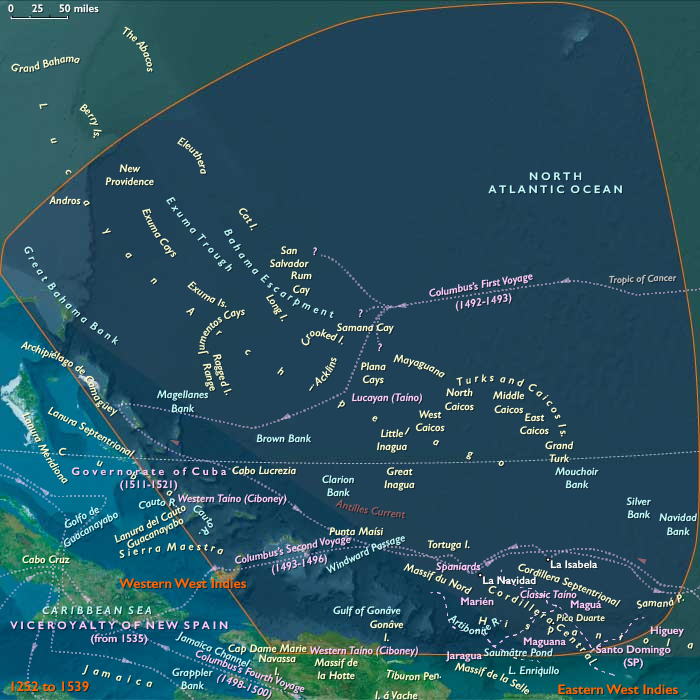
They leave Palos on August 3, 1492, re-rig the Niña in the Canaries, and sail to the west on favorable winds.
Columbus had underestimated the distance; he thought it was about three thousand miles (forty-eight hundred kilometers).
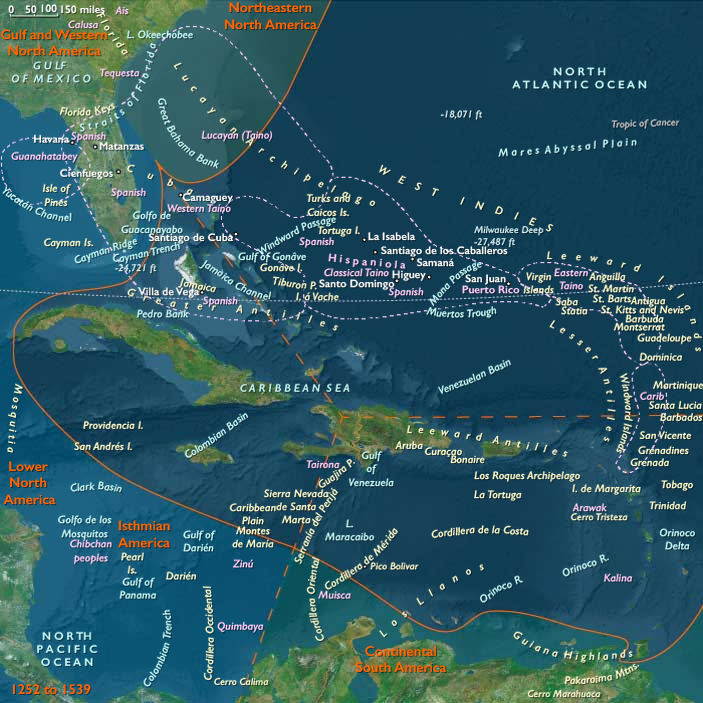
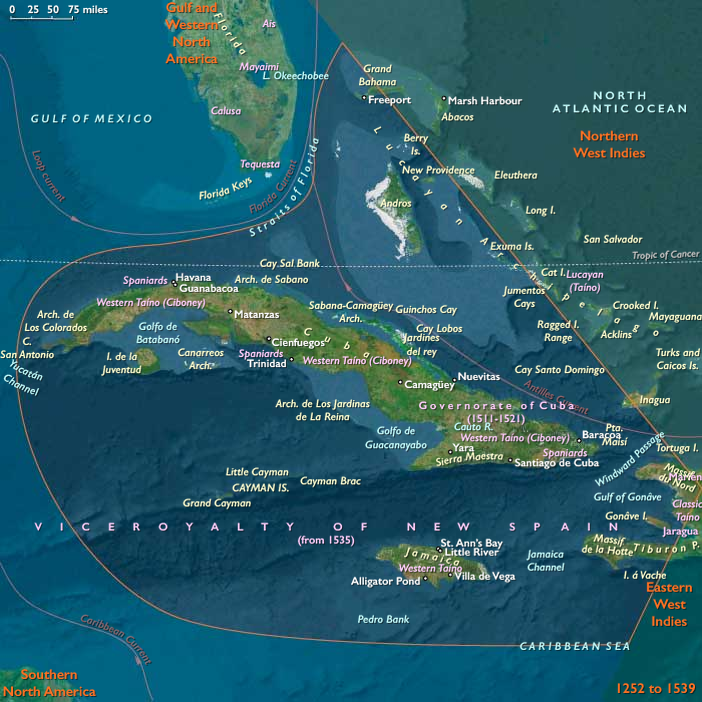
After landing in the Bahamas on October 12, 1492, the three ships take on a number of locals, then make their way to Cuba, the largest island in the Antilles archipelago, with some fifty thousand inhabitants.
Reaching the island in two weeks, Columbus lands delegations to seek the court of the emperor of China and gold.
Columbus apparently believes that he has reached the East Indies.
Consequently, he calls the inhabitants of the island Indians, a misnomer still generally used today in labeling the indigenous peoples of North, Central, and South America.
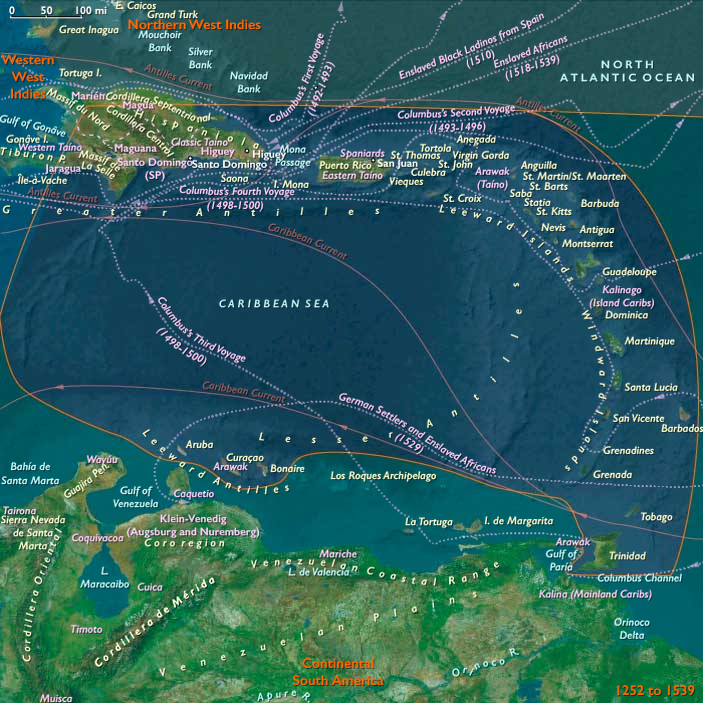
After six weeks in Cuba, Columbus’s expedition sails east to Hispaniola, the most populous of the Antilles, where, at Christmas, the Santa Maria is wrecked near Cap-Haïtien.
Columbus gets his men ashore.
The native Arawaks appear friendly and the Europeans exchange their trade goods for gold.
The Magua, with Guarionex as cacique, is in the farther northeast.
The Xaragua, with Bohechio as cacique, occupies the western plains of present Haiti.
The Higuey, with Cotubanama or Cayacoa as cacique, occupies the easternmost peninsula, Rico.
Columbus finds the Tainos occupied with fighting against the warlike Caribs, who have invaded the eastern part of Hispaniola.
As he will report to his royal sponsors, Columbus takes possession of a large town and names it the City of Navidad.
Pinzon meanwhile abandons Columbus in the Antilles for six weeks, probably to explore Hispaniola for gold and spices.
On Pinzon’s return, Columbus censures him for disobeying orders.
Leaving a garrison of thirty-nine (or twenty-one) men behind in an unfinished fort built from the timbers of his wrecked flagship, Columbus sails for home on the Niña to reveal the New World to the inhabitants of the Old.
As he will write some months later, he takes "by force some of the natives, that from them we might gain some information of what there was in these parts; and so it was that we immediately understood each other, either by words or signs."
He reports cotton growing in the Bahamas.
He also finds the Arawak Indians of the Caribbean smoking tobacco in loosely rolled cigars (a practice documented in the Mayan culture more than two thousand years ago).
Encountering Caribs in eastern Hispaniola, observes the inhabitants using the dried, elastic sap of a wild climbing vine to make soft, resilient playballs; they call this material “cachuchu, ““the wood that weeps.” (The French will later corrupt the name of the material to “caoutchoc”.)
People
Groups
Topics
Commodoties
- Weapons
- Gem materials
- Grains and produce
- Fibers
- Strategic metals
- Slaves
- Sweeteners
- Poisons
- Narcotics
- Land
- Stimulants
- Rubber
- Tobacco
Subjects
Regions
Subregions
Years: 1492 - 1492
People
Groups
Topics
Commodoties
- Weapons
- Gem materials
- Grains and produce
- Fibers
- Strategic metals
- Slaves
- Sweeteners
- Poisons
- Narcotics
- Land
- Stimulants
- Rubber
- Tobacco
Subjects
Regions
Subregions