
Magyar raiders, who have terrorized Europe for …
Years: 952 - 963
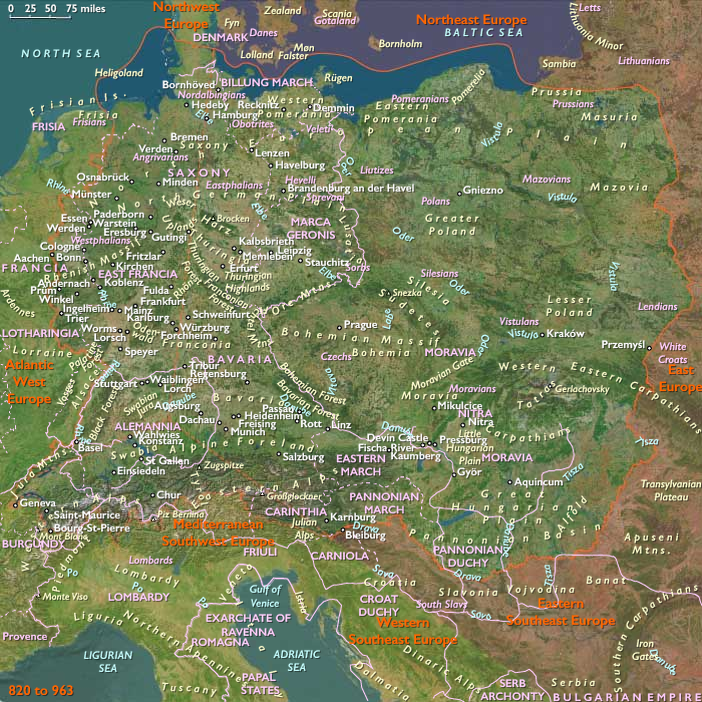
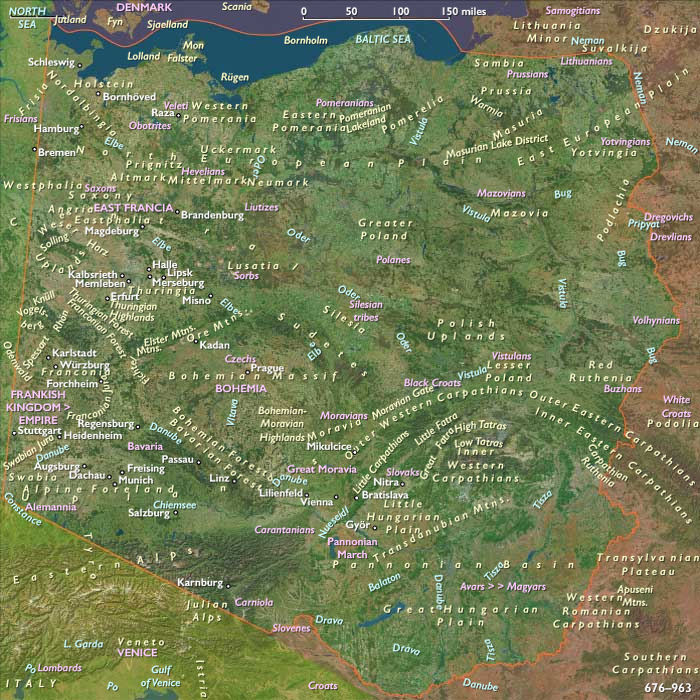
Magyar raiders, who have terrorized Europe for the past fifty years, now settle down within the confines of the Principality of Hungary after their defeat by the German Empire at the Battle of Lechfeld.
Groups
Topics
Commodoties
Subjects
Regions
Subregions
Related Events
Filter results
Showing 10 events out of 52909 total
The Tiger Hill Pagoda, more officially the Yunyan Pagoda, also sometimes translated as Huqiu Tower, is a Chinese pagoda situated on Tiger Hill in Suzhou City, Jiangsu Province.
It is nicknamed the 'Leaning Tower of China'.
It is the pagoda of the former Yunyan Temple.
Construction had begun in 907, during the later period of the Five Dynasties period, at a time when Suzhou is ruled by the Wuyue Kingdom.
The pagoda rises to a height of forty-seven meters (one hundred and fifty-four feet).
The pagoda has seven stories and is octagonal in cross-section.
It is built with a masonry structure designed to imitate wooden-structured pagodas prevalent at this time.
Construction is completed in 961.
The Later Zhou Dynasty strikes at Liao Dynasty positions in the Sixteen Prefectures, but is defeated.
Princess Olga, the widow of Igor I, Grand Prince of Kiev, who had been assassinated in 945 by his subjects while attempting to extort excessive tribute, had become regent (for their son, Sviatoslav) of the grand principality of Kiev.
She had soon had Igor's murderers scalded to death and hundreds of their followers killed.
Olga is the first Rus' ruler to convert to Christianity, either in 945 or in 957.
The ceremonies of her formal reception in Constantinople are minutely described by Emperor Constantine VII in his book De Ceremoniis.
Following her baptism, she takes the Christian name Yelena, after the reigning Empress Helena Lekapena.
The Slavonic chronicles add apocryphal details to the account of her baptism, such as the story how she charmed and "outwitted" Constantine and how she spurned his matrimonial proposals.
In truth, at the time of her baptism, Olga was an old woman, while Constantine had a wife.
East Central Europe (952–963 CE): Ottonian Imperial Ambitions, Magyar Stabilization, and Formation of Early Polish Polities
Between 952 and 963 CE, East Central Europe—encompassing modern-day Poland, Czechia, Slovakia, Hungary, and eastern regions of Germany and Austria east of 10°E and north of a line from approximately 48.2°N at 10°E to the Austro-Slovenian border near 46.7°N, 15.4°E—underwent significant political consolidation marked by Otto I’s imperial ambitions, the continued stabilization of the Magyar principality, and the emergence of early Polish political structures under the Piast dynasty. These transformative developments solidified medieval political frameworks, clearly defined cultural identities, and laid critical foundations for the region’s subsequent historical trajectory.
Political and Military Developments
Ottonian Imperial Consolidation
-
Otto I the Great (r. 936–973) significantly extended Saxon political and military authority, culminating in his imperial coronation as Holy Roman Emperor in 962 CE. His reign strengthened German dominance across Saxony, Bavaria, Thuringia, and significantly influenced Bohemian and Polish territories.
Magyar Transition from Raiding to Statehood
-
The Magyar principality continued its transition from aggressive raiding to stable state formation, building fortified towns, improving internal governance, and stabilizing frontiers, preparing the foundations for the later medieval Kingdom of Hungary.
Formation of Early Polish States under the Piast Dynasty
-
In the territories of modern-day Poland, the Piast dynasty began consolidating smaller Slavic tribal entities under leaders such as Mieszko I (c. 960–992), marking the early stages of organized Polish statehood and political centralization.
Economic and Technological Developments
Expanded Economic Stability and Trade
-
Regional political stability fostered by Ottonian dominance, Magyar settlement, and emergent Polish entities facilitated expanding trade routes, leading to increased commerce in textiles, metals, agricultural products, and luxury goods, significantly boosting regional economies.
Development of Defensive Infrastructure and Urbanization
-
Otto’s reign led to the expansion of fortified urban centers along Saxony’s eastern frontiers and in Bavarian territories. Similarly, Magyar and early Polish polities invested in fortified settlements, enhancing security and economic vitality across the region.
Cultural and Artistic Developments
Ottonian Cultural and Ecclesiastical Flourishing
-
Otto I’s imperial court fostered significant cultural achievements through ecclesiastical patronage, artistic innovations, manuscript illumination, and architectural projects, solidifying Saxon cultural influence throughout East Central Europe.
Magyar Cultural Synthesis and Christian Influence
-
Magyar rulers increasingly adopted cultural and religious influences from neighboring Christian polities, initiating gradual Christianization and integration into broader European cultural traditions, setting crucial foundations for Hungarian medieval culture.
Early Polish Cultural Identity and Piast Patronage
-
Under the emerging Piast dynasty, early Polish polities fostered distinct cultural and artistic traditions, including Slavic-Christian syncretism, settlement organization, and artisanal production, which established enduring foundations for medieval Polish identity.
Settlement and Urban Development
Saxon and Bavarian Fortified Towns
-
Otto significantly expanded and improved fortified towns along Saxony’s eastern frontier and within Bavaria, creating critical administrative and economic centers that became integral to medieval urban life.
Magyar Administrative Centers and Settlements
-
Magyar urban centers like Esztergom, Székesfehérvár, and other fortified towns continued expanding, becoming focal points of administration, commerce, and emerging Hungarian cultural identity.
Early Polish Tribal Centers and Settlement Growth
-
Tribal centers associated with the Piast dynasty began consolidating into early urban settlements, notably around Gniezno and Poznań, laying critical foundations for future Polish urban and administrative development.
Social and Religious Developments
Expansion and Consolidation of Christianity
-
Christianity continued to expand under Ottonian influence, profoundly shaping Saxon, Magyar, and Polish social structures. Ecclesiastical institutions became increasingly integral to governance and cultural life, defining regional identities and societal norms.
Formation of Dynastic and Aristocratic Structures
-
Saxony under the Ottonians, Magyar Hungary, and early Piast Poland witnessed the strengthening of hierarchical aristocratic and dynastic structures, defining patterns of medieval governance, administration, and social cohesion.
Long-Term Consequences and Historical Significance
The era 952–963 CE decisively influenced East Central Europe's historical trajectory, characterized by Otto I’s imperial ascension, the solidification of Magyar state structures, and the emergence of organized Polish political entities. These significant developments established foundational medieval political and cultural frameworks, profoundly shaping regional identities, state formations, and geopolitical dynamics that endured throughout the subsequent medieval period.
Eastern Southeast Europe (952–963 CE): Fragmentation of Bulgarian Power
Settlement and Migration Patterns
Demographic Continuity Amid Political Instability
Between 952 and 963 CE, Eastern Southeast Europe continued to experience demographic stability, despite the growing political instability and territorial fragmentation resulting from the declining Bulgarian Empire.
Political and Military Developments
Disintegration of the Bulgarian Empire
Following the prosperous and influential reign of Tsar Simeon, the Bulgarian Empire entered a phase of rapid disintegration under his successor, Tsar Peter. The central authority weakened considerably, leading to internal divisions, loss of territorial control, and diminished regional influence, significantly altering the political landscape.
Byzantine Exploitation of Bulgarian Weakness
The declining Bulgarian state provided opportunities for the Byzantine Empire to strengthen its regional position. Byzantine diplomatic and military initiatives took advantage of the fragmented Bulgarian political structure, expanding influence into previously contested territories.
Economic and Technological Developments
Economic Challenges Amid Political Instability
The economic stability of the region was somewhat strained due to the weakening central authority in Bulgaria. Trade and agricultural activities persisted, but the political fragmentation disrupted previously secure economic networks.
Fortification and Defense Strategies
Military fortifications and defensive strategies were reinforced, especially in Byzantine-controlled territories, to secure borders and protect economic interests amid regional instability and changing power dynamics.
Cultural and Artistic Developments
Continued Cultural Resilience
Despite political instability, cultural and artistic activities continued to thrive. Local centers maintained their craftsmanship traditions, especially in ceramics and metalwork, preserving regional cultural identities.
Scholarly Activity
Educational and scholarly institutions continued producing manuscripts and preserving classical and theological knowledge, ensuring cultural continuity and intellectual resilience during this turbulent period.
Social and Religious Developments
Persistence of Religious Movements
Paulician and Bogomil movements continued influencing rural populations and significantly shaped religious practices and social dynamics. These movements remained important, especially as centralized authority declined.
Dominance of Orthodox Christianity
Orthodox Christianity persisted as the predominant religious institution, offering societal stability and cultural cohesion even amidst political fragmentation and uncertainty.
Long-Term Consequences and Historical Significance
The period from 952 to 963 CE was marked by the rapid decline and fragmentation of Bulgarian power, dramatically altering regional political dynamics. The resulting political instability reshaped territorial control, allowed Byzantine reconsolidation, and underscored the resilience of cultural and religious institutions in Eastern Southeast Europe.
The formerly powerful Bulgarian Empire disintegrates under Tsar Simeon’s successor Peter.
Arab corsair power in Crete, which has terrorized the eastern Mediterranean throughout the age, ends in 961 with its takeover by the forces of Constantinople.
The German emperor annexes the two hundred-year-old Slovenian tribal duchy in Carinthia.
North Africa (952–963 CE)
Fatimid Preparations for Eastern Expansion and Continued Western Autonomy
Between 952 and 963 CE, North Africa sees the Fatimid Caliphate consolidating its regional dominance and preparing for ambitious expansion eastward, while the western Maghreb maintains its characteristic autonomy and diverse political landscape.
In Ifriqiya, the Fatimid Caliphate, under the vigorous leadership of Caliph al-Mu'izz li-Din Allah (953–975 CE), intensifies its preparations for the historic conquest of Egypt. Although the invasion and eventual conquest occur slightly later (in 969 CE), these crucial years are marked by significant economic growth, strategic military preparations, and increased political centralization from the Fatimid capital at al-Mahdiyya. Al-Mu'izz notably supports the rise of the Zirid Dynasty, loyal Berber governors appointed to administer Ifriqiya, ensuring stable governance and allowing the Fatimid leadership to focus on broader strategic objectives.
In Morocco and the western Maghreb, political decentralization continues, marked by a mosaic of autonomous Berber states and tribal entities. The once-powerful Idrisid Dynasty further fragments, ceding influence to emerging Berber tribal confederations such as the Miknasa, Maghrawa, and other Zenata groups. Fez (Fès), though reduced in political prominence, remains a crucial center of commerce and scholarship.
The independent Emirate of Nekor in the Rif region maintains its prosperous maritime trade, continuing its strong links with Umayyad al-Andalus. Along the Atlantic coast, the Barghawata confederation retains its distinct cultural and religious identity, preserving its political autonomy and economic vitality.
Further south, the Saharan city-state of Sijilmasa, strategically governed by influential Tuareg tribes, remains a pivotal trans-Saharan trade center, reinforcing its importance in regional commerce connecting North Africa with sub-Saharan markets.
By the conclusion of 963 CE, North Africa stands strategically poised. The Fatimid Caliphate is firmly established and ready to project its influence into Egypt and the broader Islamic world, while the western Maghreb retains its distinct political fragmentation, characterized by resilient Berber autonomy and vibrant regional commerce. These developments set the stage for transformative changes that will shape the region profoundly in subsequent decades.
Atlantic Southwest Europe (952–963 CE): Dynastic Tensions, Frontier Stability, and Cultural Resilience
Between 952 and 963 CE, Atlantic Southwest Europe—including Galicia, northern and central Portugal, Asturias, Cantabria, and northern Spain south of the Franco-Spanish border (43.05548° N, 1.22924° W)—experienced a complex era marked by internal dynastic tensions and changing leadership, yet maintained frontier stability, economic prosperity, and cultural vitality. After the death of King Ramiro II of León (931–951 CE), the region endured brief periods of political uncertainty under his sons, Ordoño III (951–956 CE) and Sancho I "the Fat" (956–958 CE), followed by stability under Ordoño IV (958–960 CE) and ultimately the more lasting reign of Sancho I (restored, 960–966 CE). Meanwhile, the Basques, under García Sánchez I of Pamplona (925–970 CE), continued their political autonomy and stability. Despite internal challenges, economic and cultural institutions, particularly ecclesiastical centers and the pilgrimage to Santiago de Compostela, remained robust.
Political and Military Developments
Dynastic Instability and Succession Struggles
The death of Ramiro II in 951 CE triggered dynastic uncertainty. His son Ordoño III ruled briefly and competently (951–956 CE) but faced persistent internal rivalries. His brother, Sancho I "the Fat," assumed power in 956 CE but was quickly displaced by a noble-led rebellion supporting his cousin, Ordoño IV (958–960 CE). Sancho, aided by Córdoba’s military support, regained power by 960 CE, initiating a period of relative stability. Despite these internal disputes, the regional administrative framework and frontier defenses remained intact.
Stable Frontier and Defensive Continuity
Throughout these internal struggles, frontier defenses along the Duero River against al-Andalus remained stable, maintaining the territorial integrity and regional security established by Ramiro II. Local aristocracies and regional military commanders ensured continuous vigilance, preventing major territorial incursions.
Basque Autonomy under García Sánchez I
Under García Sánchez I, the Basque Kingdom of Pamplona preserved stable autonomy, successfully navigating diplomatic interactions with León, al-Andalus, and neighboring Frankish territories. The Basques’ political independence significantly shaped broader Iberian dynamics during this period.
Economic Developments
Continued Economic Resilience and Prosperity
Despite political tensions, regional economies remained robust. Villa-based agriculture (grain, vineyards, olives), livestock farming, artisanal industries, and mining—particularly gold and silver extraction in Galicia and Asturias—continued to flourish, underpinning regional wealth and economic stability.
Steady Maritime and Regional Commerce
Coastal settlements such as Bracara Augusta (Braga) and smaller ports along Galicia and northern Portugal sustained resilient maritime trade networks. Reliable economic connections with broader Atlantic and Mediterranean markets supported consistent regional prosperity.
Cultural and Religious Developments
Persistent Importance of Santiago de Compostela
The pilgrimage tradition to Santiago de Compostela maintained its central cultural and religious prominence, steadily attracting pilgrims from across Europe. This ongoing influx reinforced economic prosperity, religious devotion, and cultural exchange, firmly embedding Santiago’s pilgrimage into regional identity.
Ecclesiastical Stability Amid Dynastic Uncertainty
Influential bishoprics—particularly Braga, Lugo, Asturica Augusta, and Santiago de Compostela—continued providing crucial moral leadership, education, and local governance. Ecclesiastical institutions remained vital sources of community cohesion, ensuring cultural continuity and stability during periods of political turbulence.
Monastic Continuity and Scholarly Activity
Monastic communities maintained vibrancy, continuing their roles as centers of manuscript preservation, scholarship, education, agricultural innovation, and social welfare. Their persistent cultural vitality significantly reinforced regional heritage and historical continuity.
Enduring Cultural Syncretism
The longstanding integration of orthodox Christianity with indigenous Celtic and Iberian traditions persisted robustly, particularly in rural Galicia, Asturias, and northern Portugal, reinforcing regional identity, social cohesion, and cultural resilience.
Civic Identity and Governance
Local Autonomy and Civic Stability Amid Dynastic Turmoil
Despite temporary dynastic instability, regional governance and civic identities remained resilient, anchored in strong local aristocracies, ecclesiastical leadership, and traditional institutions. Civic structures effectively absorbed and mitigated disruptions, ensuring continued regional stability.
Stable Basque Civic Autonomy
The Basques, under García Sánchez I, maintained their distinct political autonomy, territorial independence, and civic identity through Pamplona, decisively influencing Iberian regional politics.
Notable Tribal Groups and Settlements
-
Astures and Cantabri: Continued providing essential political stability, military leadership, and cohesive regional identity amid dynastic challenges.
-
Galicians and Lusitanians: Maintained resilient local governance, economic prosperity, and cultural autonomy, cooperating pragmatically during political uncertainties.
-
Basques: Firmly established politically and culturally, maintained distinct territorial independence and governance under Pamplona, actively shaping regional dynamics.
Long-Term Significance and Legacy
Between 952 and 963 CE, Atlantic Southwest Europe:
-
Navigated significant dynastic tensions yet preserved territorial stability, effective frontier defenses, and robust regional institutions.
-
Sustained economic prosperity, ecclesiastical leadership, and cultural vitality, significantly shaping the region’s historical continuity and medieval identity.
-
Maintained and reinforced Basque autonomy, influencing subsequent Iberian regional dynamics and political developments.
Despite internal challenges, this era preserved core regional stability and cultural resilience, significantly shaping Atlantic Southwest Europe's enduring medieval trajectory and historical legacy
Years: 952 - 963
Groups
Topics
Commodoties
Subjects
Regions
Subregions