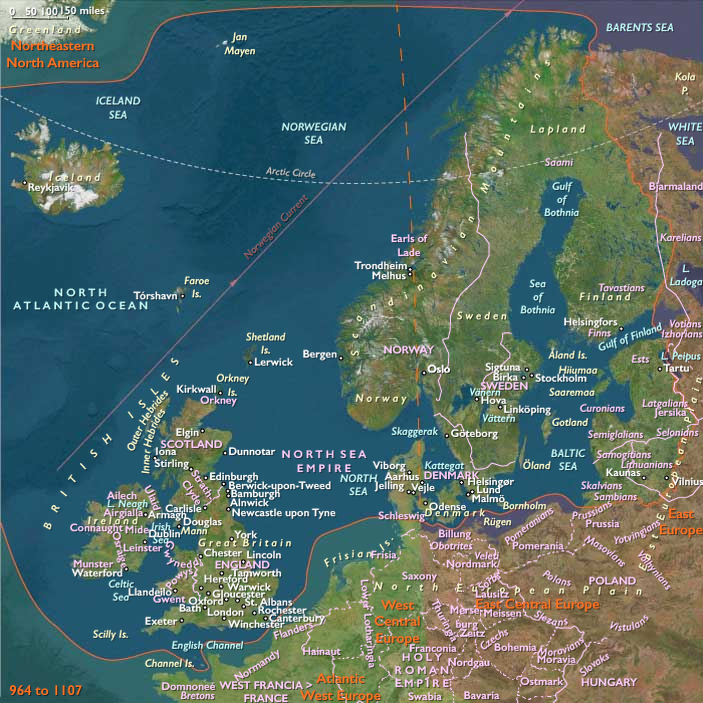
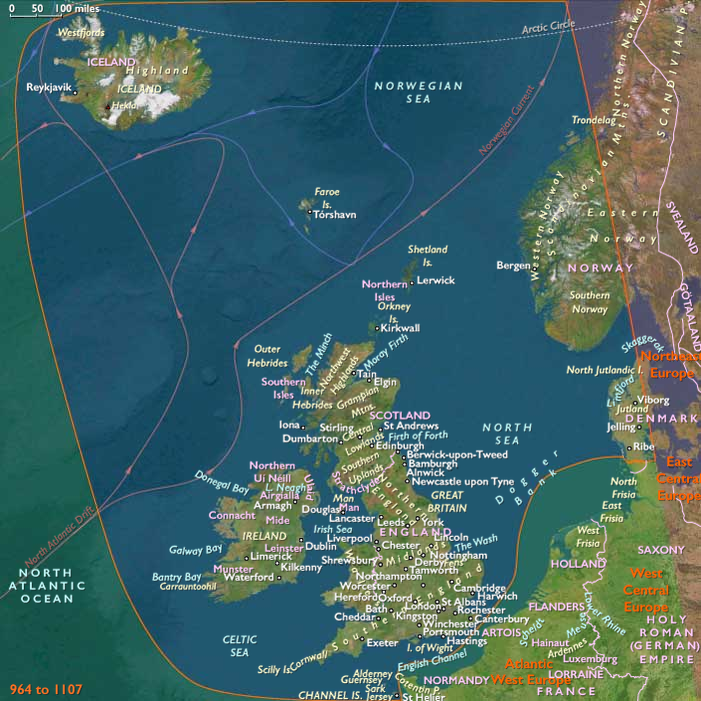
Magnus also conquers the Isle of Man, …
Years: 1098 - 1098
Magnus also conquers the Isle of Man, …
Locations
People
Groups
- Gwynedd, Welsh Kingdom of
- Welsh people
- Danes (Scandinavians)
- Dublin, Kingdom of
- Orkney, Earldom of
- Alba (Scotland), Scots Kingdom of
- Normans
- Norway, independent Kingdom of
- England, (Norman) Kingdom of
- Mann and the Isles, Kingdom of
Topics
Commodoties
Subjects
Regions
Subregions
Related Events
Filter results
Showing 10 events out of 50129 total
Álmos, taking advantage of Coloman's absence in the south, begins to conspire against the king and musters his armies.
Coloman returns from Croatia and marches towards his brother's duchy with his troops in 1098.
The two armies encounter one another at Tiszavárkony, with only the river Tisza separating them.
However, the commanders of the two troops start negotiations and decide not to fight against each other, compelling the king and the duke to make a peace.
The Founding of Cîteaux Abbey and the Birth of the Cistercian Order (1098)
In 1098, a group of monks from the Cluniac Abbey of Molesme, dissatisfied with the worldly entanglements of Cluniac monasticism, founded Cîteaux Abbey in Burgundy, near Dijon. Their goal was to return to a stricter, more austere interpretation of the Rule of St. Benedict, rejecting the growing wealth and ceremonial grandeur of Cluny in favor of simplicity, poverty, and manual labor.
Key Founders and Leadership
- Robert of Molesme – The first abbot of Cîteaux, he led the group of reformist monks in breaking away from Molesme Abbey.
- Alberic – Robert’s successor, who further developed the new order.
- Saint Stephen Harding – The third abbot, responsible for writing the Carta Caritatis and formalizing the structure of the Cistercian Order.
The Carta Caritatis and the Structure of the Cistercian Order
- The Carta Caritatis ("Charter of Love") became the founding document of the Cistercian Order.
- It laid out a system of centralized governance, where all Cistercian abbeys remained united under a common rule, yet with some degree of local autonomy.
- Unlike the Cluniacs, who emphasized large-scale liturgical devotion, the Cistercians focused on:
- Literal observance of the Rule of St. Benedict.
- Seclusion from feudal society and avoidance of secular responsibilities.
- Simplicity in architecture and daily life, rejecting the elaborate decorations of Cluny.
- Manual labor, especially agriculture, which became a hallmark of Cistercian economic self-sufficiency.
A Return to Monastic Simplicity
- The Cistercians sought to model themselves after the Desert Fathers, living a life of contemplation, strict discipline, and hard labor.
- Their monasteries were built in remote, isolated locations, emphasizing withdrawal from the world.
- The movement would later attract Bernard of Clairvaux (1115), who expanded the order and increased its influence across Europe.
Significance and Influence
- Cîteaux Abbey became the center of the Cistercian reform movement, which spread rapidly across France, England, and the Holy Roman Empire.
- The Cistercians played a major role in medieval agriculture, introducing new farming techniques and land management strategies.
- Their emphasis on strict observance and poverty inspired other monastic reforms and influenced later religious movements.
The foundation of Cîteaux Abbey in 1098 marked one of the most important monastic reforms of the Middle Ages, laying the groundwork for the rise of the Cistercian Order, which would challenge Cluniac dominance and redefine monastic life in medieval Europe.
The Normans, following their invasion of England in 1066, and the subsequent conquest of large parts of Wales, had proceeded towards North Wales in the late eleventh century.
While the Normans had experienced a setback in 1094, the Norman earls Hugh of Montgomery and Hugh d'Avranches finally manage to conquer North Wales and Anglesey in 1098, forcing Gruffudd ap Cynan, King of Gwynedd, to flee to Ireland.
The Norwegian king Magnus Barefoot goes on an expedition with a large fleet into the Irish Sea early in 1098, seeking to assert Norwegian rule over the Kingdom of the Isles.
After he has subdued most of the Isles and set up his base on Mann, he goes further south and appears with six ships (according to the English chronicler Orderic Vitalis), off the coast of Anglesey, only a few days after the Norman capture.
According to Orderic Vitalis, Magnus enters the Menai Strait with a red shield on the mast, which is the usual sign to signal peace and trade.
While Magnus may have sought trade, or to get provisions for his ships, he may also have intended to take possession of the island as a base for further operations.
When Magnus approaches Anglesey in June or July, the Normans do not permit him to land.
The fighting starts with the two sides shooting arrows at each other, the Norwegians while still onboard their ships, and the Normans while standing on the shore.
As the Normans prepare to attack the Norwegians, Hugh of Montgomery, who is fully armored except for an opening for his eyes, is shot through one eye with an arrow and dies instantly.
Contemporary non-Norse sources all agree that Magnus Barefoot himself was responsible for the shot, while the Norse sagas are somewhat less inclined to attribute the decisive shot to Magnus alone, noting that his shot hit Hugh almost simultaneously with that of another of his men.
Since some sources indicates that Magnus regretted the deed when he realized who he had killed, Magnus may originally have been interested in alliances with the Normans.
The Normans retreated from Anglesey to England following the defeat.
…the Hebrides, and …
…the Orkney Islands in 1098.
The Norse jarls from this point forward twill owe allegiance both to Norway for Orkney and to the Scottish crown through their holdings as Mormaers of Caithness.
The opening weeks of 1098 weeks see such unseasonably bad rain and cold weather that Duqaq has to return home without further engaging the crusaders.
The crusaders fear that the rain and earthquake are signs they have lost God's favor, and to atone for their sins, such as pillaging, Adhemar of Le Puy orders that a three-day fast should be observed.
In any case, supplies are running dangerously low, and soon after, one in seven men is dying of starvation.
Although local Christians bring food to the crusaders they charge extortionate prices.
The famine also affects the horses, and soon only seven hundred remain.
The extent to which the crusader army is affected is difficult to gauge, but according to Matthew of Edessa one in five crusaders die from starvation during the siege and the poorer members are probably worse off.
The famine damages morale and some knights and soldiers begin to desert in January 1098, including Peter the Hermit and William the Carpenter.
On hearing of the desertion of such prominent figures, Bohemond dispatches a force to bring them back.
Peter is pardoned while William is berated and made to swear he will remain with the crusade.
The arrival of spring in February sees the food situation improve for the crusaders.
This month, Tatikios repeats his earlier advice to resort to a long-distance blockade but his suggestion is ignored; he then leaves the army and returns home.
Tatikios explains to Emperor Alexios that Bohemond had informed him that there is a plan to kill him, as they believe Alexios is secretly encouraging the Turks.
Those close to Bohemond claim that this is treachery or cowardice, reason enough to break any obligations to return Antioch to the Empire.
News arrives that a Turkish army is approaching and Bohemond uses the situation to his advantage.
He declares that unless he is allowed to keep Antioch for himself when it is captured, he will leave.
Knowing full well that Bohemond has designs on taking the city for himself, and that he had probably engineered Tatikios' departure in order to facilitate this, Godfrey and Raymond do not give into his blackmail, but the minor knights and soldiers want to recognize his demands and he gains their sympathies.
Yaghi-Siyan has reconciled with Ridwan of Aleppo and the advancing army is under his command.
In early February, news reaches the besiegers that Ridwan has taken nearby Harim, where he is preparing to advance on Antioch.
At Bohemond's suggestion, the crusaders send all their cavalry (numbering about seven hundred knights) to meet the advancing army while the infantry remains behind in case Antioch's defenders decide to attack.
On the morning of February 9, Ridwan moves towards the Iron Bridge.
The crusaders had moved into position the previous night and charge the advancing army before it reaches the bridge.
The first charge causes few casualties, but Ridwan's army follows the crusaders to a narrow battlefield.
With the river on one side and the Lake of Antioch on the other, Ridwan is unable to outflank the crusaders and exploit his superior numbers.
A second charge has more impact and the Turkish army withdraws in disorder.
At the same time, Yaghi-Siyan leads his garrison out of Antioch and attacks the crusader infantry.
His offensive forces the besiegers back until the knights return.
Realizing that Ridwan had been defeated, Yaghi-Siyan retreats inside the city.
As Ridwan's army passes through Harim, panic spreads to the garrison he had installed there and they abandon the town, which is retaken by the Christians.
An English fleet led by Edgar Atheling, the exiled King of England, arrives at St. Symeon on March 4 carrying supplies from Constantinople, According to Orderic Vitalis.
Historian Steven Runciman repeats the assertion, however it is unknown where the fleet originated and it is doubtful that it would have been under Edgar's command.
Regardless, the fleet, known as the "Saxon Crusade", brings raw materials for constructing siege engines, but these are almost lost on the journey from the port to Antioch when part of the garrison sallies out.
Bohemond and Raymond escort the material, and after losing some of the materials and one hundred people, they fall back to the crusader camp outside Antioch.
Rumors that Bohemond and Raymond had been killed reach Godfrey before they return, and he readies his men to rescue the survivors of the escort.
However, his attention is diverted when another force sallies from the city to provide cover for the men returning from the ambush.
Godfrey is able to hold off the attack until Bohemond and Raymond come to his aid.
The reorganized army then catches up with the garrison before it reaches the safety of Antioch's walls.
The counterattack is a success for the crusaders and results in the death of between twelve hundred and fifteen hundred of Antioch's defenders.
The crusaders set to work building siege engines, as well as a fort, called La Mahomerie, to block the Bridge Gate and prevent Yaghi-Siyan attacking the crusader supply line from the ports of St. Symeon and Alexandretta, while also repairing the abandoned monastery to the west of the Gate of Saint George, which is still being used to deliver food to the city.
Tancred garrisons the monastery, referred to in the chronicles as Tancred's Fort, for four hundred silver marks, while Count Raymond of Toulouse takes control of La Mahomerie.
Finally, the crusader siege is able to have some effect on the well-defended city.
Food conditions improve for the crusaders as spring approaches and the city is sealed off from raiders.
"Thoros son of Hethum", according to the Chronicle of Matthew of Edessa, had been installed as governor of Edessa by the Seljuq emir of Damascus, Tutush I, who had defeated and killed emir Bouzan in the year 543 of the Armenia era (26 Feb. 1094 - 25 Feb. 1095).
According to Sturdza, Hethum [I] was descended from the Pahlavouni, an important family in Caucasian Armenia.
He conquered land to the east of that conquered by his fellow Armenian Rupen.
Steven Runciman calls Thoros the "son-in-law" of Gabriel of Melitene.
Tutush had captured Edessa around 1094 and established Thoros as governor.
Thoros had immediately tried to take control of the city for himself; when Yaghi-Siyan, emir of Antioch, and Ridwan, emir of Aleppo, took refuge in Edessa after being defeated by Malik Shah I, Thoros had tried to take them captive and ransom them.
The other Edessan nobles did not agree with this and they were freed.
Thoros had then fortified Edessa and cut off the citadel, garrisoned by Turkish and Armenian troops.
The Turks and Artuqids had then besieged the city for two months, but were unable to capture it even after breaking through the walls.
The Turks had withdrawn and Thoros had been recognized as lord of the city.
As a Greek Orthodox Christian, he is not well loved by his Armenian subjects in Edessa.
Thoros has resisted attacks from the Seljuqs, but in early 1098 had had to ask for help from the crusaders, who are occupied at the siege of Antioch.
Baldwin of Boulogne had come to Edessa rather than participate in the siege, probably looking to carve out some territory for himself, and had captured Turbessel.
Thoros had invited him to Edessa and made an alliance with him in February 1098.
Baldwin had gradually convinced Thoros to adopt him as his son and heir, but having done this, Baldwin attacks Thoros' officers and besieges him in the citadel.
Thoros agrees to let him have the city and makes plans to flee with his family to Melitene, but shortly afterwards, on March 9, Thoros is assassinated by the Armenian inhabitants of the city, possibly at Baldwin's command, and Baldwin becomes the new ruler, thus creating the County of Edessa, the first of the crusader states.

Years: 1098 - 1098
Locations
People
Groups
- Gwynedd, Welsh Kingdom of
- Welsh people
- Danes (Scandinavians)
- Dublin, Kingdom of
- Orkney, Earldom of
- Alba (Scotland), Scots Kingdom of
- Normans
- Norway, independent Kingdom of
- England, (Norman) Kingdom of
- Mann and the Isles, Kingdom of