
Macbeth, who probably has a personal claim …
Years: 1040 - 1040
Macbeth, who probably has a personal claim to the crown of Scotland through royal descent, in about 1031 had succeeded his father, Finlay, as moarmaer (provincial governor) of Moray.
His marriage to As the grandson of King Malcolm II, Macbeth is thus a cousin to Duncan I whom he succeeds, and probably also a cousin to Thorfinn the Mighty, Earl of Orkney and Caithness.
Some historians claim, however, that Macbeth was Thorfinn's half-brother rather than his cousin.
Much depends on whether Malcolm had three daughters or only two (one of whom married twice) - a point which is likely to remain uncertain.
When Cnut the Great came north in 1031 to accept the submission of King Malcolm II, Macbeth too submitted to him.
Some have seen this as a sign of Macbeth's power; others have seen his presence, together with Iehmarc, who may be Echmarcach mac Ragnaill, as proof that Malcolm II was overlord of Moray and of the Kingdom of the Isles.
Whatever the true state of affairs in the early 1030s, it seems more probable that Macbeth was subject to the king of Alba, Malcolm II, who died on November 24, 1034 at Glamis.
The Prophecy of Berchan, apparently alone in near contemporary sources, says Malcolm died a violent death, calling it a "kinslaying" without actually naming his killers.
Malcolm II's grandson Duncan (Donnchad mac Crínáin), later King Duncan I, had been acclaimed as king of Alba on November 30, 1034, apparently without opposition.
Duncan appears to have been tánaise ríg, the king in waiting, so that far from being an abandonment of tanistry, as has sometimes been argued, his kingship was a vindication of the practice.
Previous successions had involved strife between various rígdomna – men of royal blood.
Far from being the aged King Duncan of Shakespeare's play, the real King Duncan was a young man in 1034, and even at his death in 1040 his youthfulness is remarked upon.
Because of his youth, Duncan's early reign was apparently uneventful.
His later reign, in line with his description as "the man of many sorrows" in the Prophecy of Berchán, was not successful.
Strathclyde had been attacked in 1039 by the Northumbrians, and a retaliatory raid led by Duncan against Durham in 1040 turns into a disaster.
Later this year Duncan, leads an army into Moray, where he is killed by Macbeth on August 15, 1040, at Pitgaveny (at this time called Bothnagowan) near Elgin.
On Duncan's death, Macbeth becomes king.
No resistance is known at this time, but it would have been entirely normal if his reign were not universally accepted.
Locations
People
- Donald III of Scotland
- Duncan I of Scotland
- Echmarcach mac Ragnaill
- Macbeth
- Malcolm III of Scotland
- Thorfinn the Mighty
Groups
Subjects
Regions
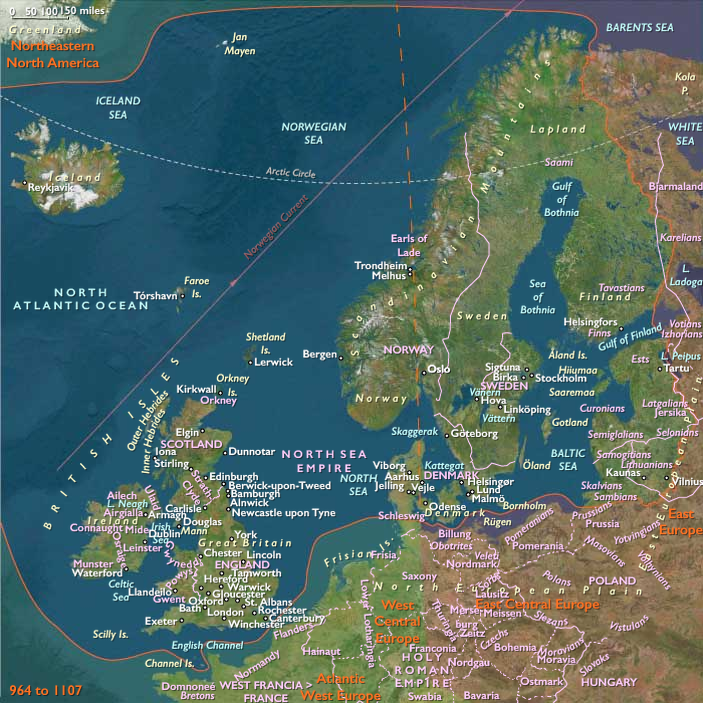
Subregions
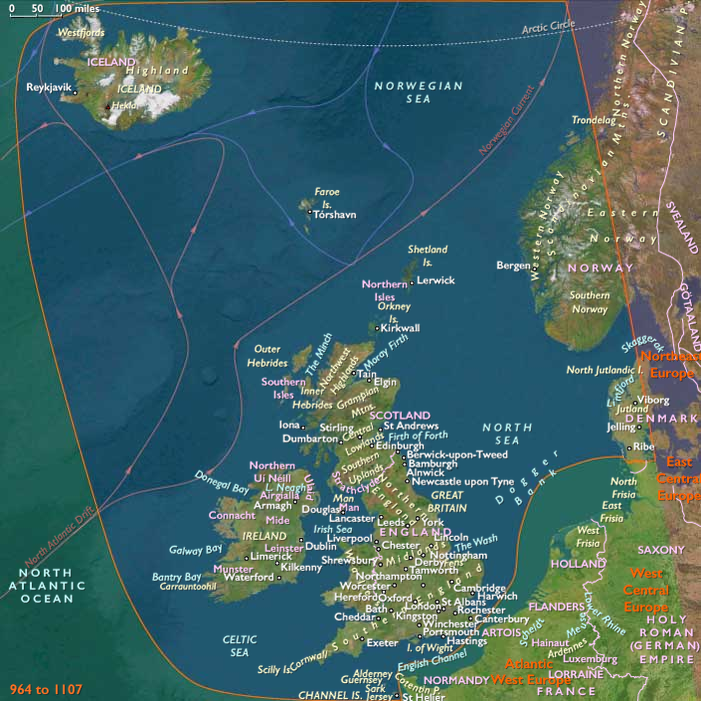
Related Events
Showing 10 events out of 51398 total
Years: 1040 - 1040
Locations
People
- Donald III of Scotland
- Duncan I of Scotland
- Echmarcach mac Ragnaill
- Macbeth
- Malcolm III of Scotland
- Thorfinn the Mighty
Groups
Subjects
Regions
Subregions