
The Paris revolution of February 1848 precipitates …
Years: 1840 - 1851
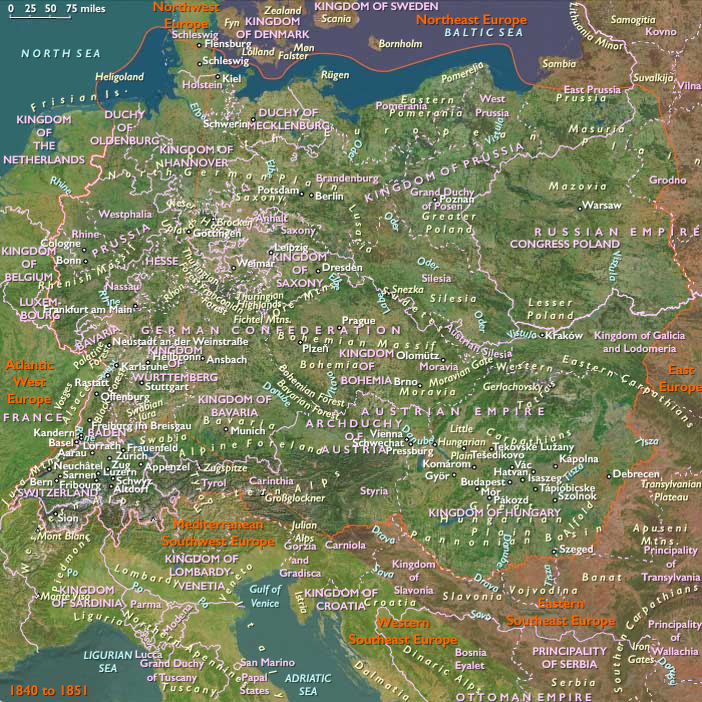
The Paris revolution of February 1848 precipitates a succession of liberal and national revolts against autocratic governments.
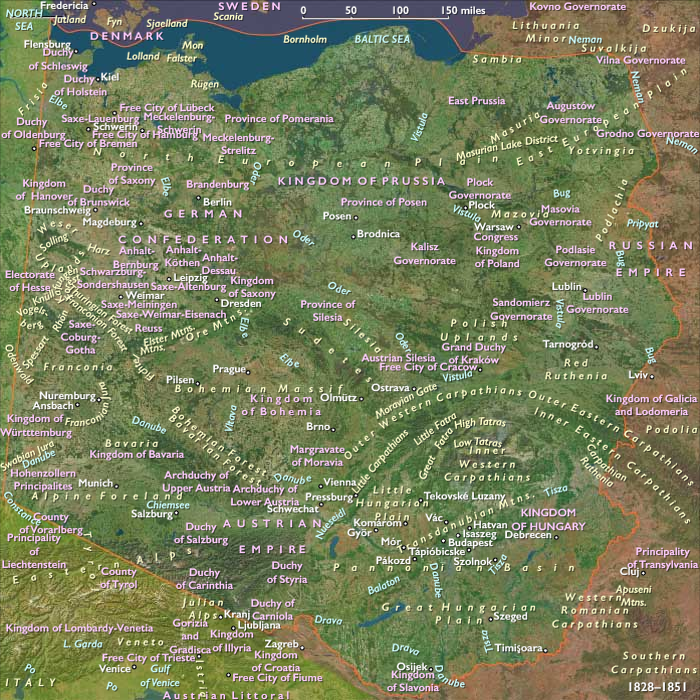
Revolutionary disturbances pervade the territories of the Austrian Empire, and Emperor Ferdinand I (1835-48) promises to reorganize the empire on a constitutional, parliamentary basis.
In the Bohemian Kingdom, a national committee is formed that includes Germans and Czechs, but Bohemian Germans favor creating a Greater Germany out of various German-speaking territories.
The Bohemian Germans soon withdraw from the committee, signaling the Czech-German conflict that will characterize subsequent history.
František Palacký proposes Austro-Slavism as the creed of the Czech national movement.
He advocates the preservation of the Austrian Empire as a buffer against both German and Russian expansionism.
He also proposes the federalization of the empire on an ethnographic basis to unite the Bohemian
Germans with Austria in one province and Czechs and Slovaks in another.
Palacký further suggests that the various Slavic peoples of the empire, together constituting a majority, should form a political unit to defend their common interests.
In June 1848 the Czechs convene the first Slavic Congress to discuss the possibility of political consolidation of Austrian Slavs, including Czechs, Slovaks, Poles, Ruthenians (Ukrainians), Slovenes, Croats, and Serbs.
Locations
People
Groups
- Germans
- Croats (South Slavs)
- Serbs (South Slavs)
- Poles (West Slavs)
- Czechs [formerly Bohemians] (West Slavs)
- Slovaks (West Slavs)
- Christians, Roman Catholic
- Moravian Margravate
- Bohemia, Kingdom of
- Slovenes (South Slavs)
- Ukrainians (East Slavs)
- Russian Empire
- Austrian Empire
Topics
- German Revolutions: 1840-1851
- Austrian Revolution & Reaction: 1840-51
- 1848, Revolutions of
- French Revolutions of 1848 and 1851
- Austrian Revolution of 1848-49
- German Revolution of 1848
- French Revolution of 1848 (February Revolution)
Subjects
Regions
Subregions
Years: 1840 - 1851
Locations
People
Groups
- Germans
- Croats (South Slavs)
- Serbs (South Slavs)
- Poles (West Slavs)
- Czechs [formerly Bohemians] (West Slavs)
- Slovaks (West Slavs)
- Christians, Roman Catholic
- Moravian Margravate
- Bohemia, Kingdom of
- Slovenes (South Slavs)
- Ukrainians (East Slavs)
- Russian Empire
- Austrian Empire
Topics
- German Revolutions: 1840-1851
- Austrian Revolution & Reaction: 1840-51
- 1848, Revolutions of
- French Revolutions of 1848 and 1851
- Austrian Revolution of 1848-49
- German Revolution of 1848
- French Revolution of 1848 (February Revolution)
Subjects
Regions
Subregions