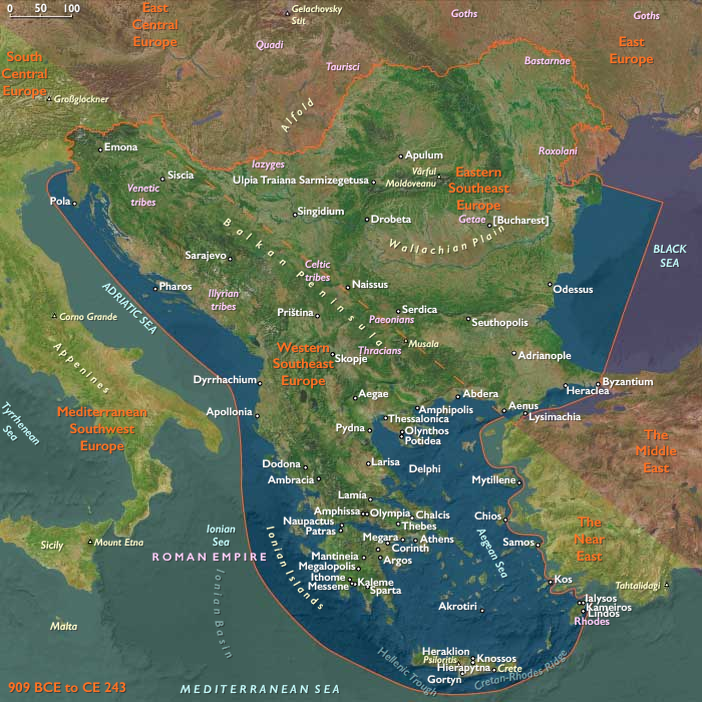
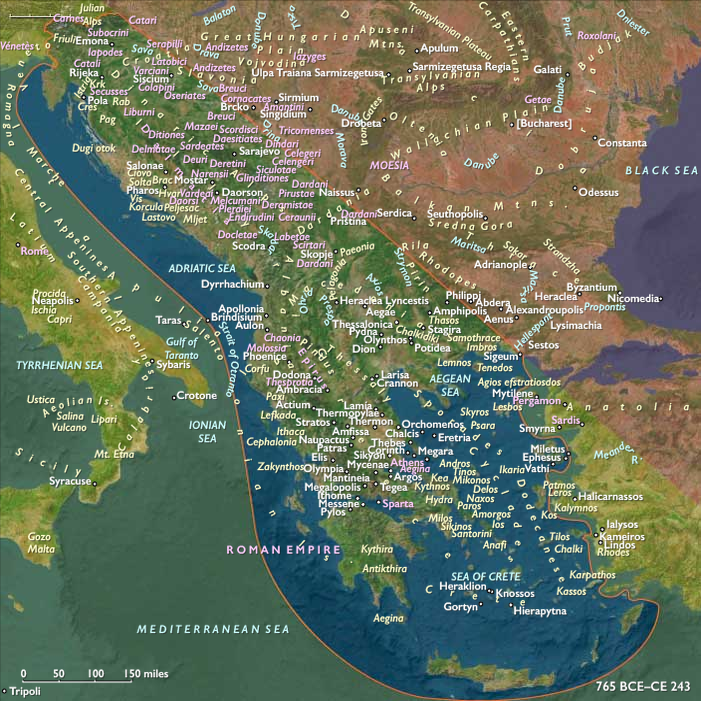
Lucius Cornelius Sulla lands at Dyrrachium in …
Years: 87BCE - 87BCE
Lucius Cornelius Sulla lands at Dyrrachium in Illyria in the spring of 87 BCE.
Asia is occupied by the forces of Mithridates VI of Pontus under the command of Archelaus.
Sulla’s first target is Athens, ruled by a Mithridatic puppet; the tyrant Aristion.
Locations
People
Groups
Topics
Commodoties
Subjects
Regions
Subregions
Related Events
Filter results
Showing 10 events out of 62795 total
Sulla moves southeast, picking up supplies and reinforcements as he goes.
His chief of staff is Lucullus, who has gone ahead of him to scout the way and negotiate with Bruttius Sura, the existing Roman commander in Greece.
Sura after speaking with Lucullus hands over the command of his troops to Sulla.
Ambassadors from all the major cities of Greece (except Athens) meet at Chaeronea with Sulla, who impresses on them Rome's determination to drive Mithridates from Greece and Asia Province.
Sulla now advances on Athens.
En route to Athens, Sulla sacks the famous Asclepian healing sanctuary at Epidaurus.
Most of Greece is in Sulla's power by the spring of 87 iBCE.
On arrival to Attica, Sulla throws up siege works encompassing not only Athens but also the port of Piraeus.
Archelaus at this time has command of the sea, so Sulla sends Lucullus to raise a fleet from the remaining Roman allies in the eastern Mediterranean.
His first objective is Piraeus, as without it Athens cannot be resupplied.
Huge earthworks are raised, isolating Athens and its port from the land side.
Sulla needs wood, so he cuts down everything, including the sacred groves of Greece, up to one hundred miles from Athens.
When more money is needed he “borrows” from temples and Sibyls alike.
The currency minted from this treasure is to remain in circulation for centuries and prized for its quality.
Despite the complete encirclement of Athens and its port, and several attempts by Archelaus to raise the siege, a stalemate seems to have developed.
Sulla, however, patiently bides his time.
Soon Sulla's camp is to fill with refugees from Rome, fleeing the massacres of Marius and Cinna.
These also include his wife and children, as well as those of the Optimate party who had not been killed.
Athens is by now starving, and the grain price is at famine levels.
The population inside the city is reduced to eating shoe leather and grass.
A delegation from Athens is sent to treat with Sulla, but instead of serious negotiations they expound on the glory of their city.
Sulla sends them away saying: “I was sent to Athens, not to take lessons, but to reduce rebels to obedience.”
Marius, with Sulla out of Rome, had plotted his own return.
During his period of exile Marius had become determined that he would hold a seventh consulship, as foretold by the Sibyl decades earlier.
Quintus Sertorius, after acquiring some reputation in Rome as a jurist and an orator, had begun a military career.
His first recorded campaign was under Quintus Servilius Caepio at the Battle of Arausio, where he showed unusual courage.
Serving under Gaius Marius in 102 BCE, Sertorius had succeeded in spying on the wandering German tribes that had defeated Caepio.
After this success, he had fought at the great Battle of Aquae Sextiae, in which the Teutons were decisively defeated.
In 97 BCE, he had served in Hispania as a military tribune under Titus Didius, winning the Grass Crown.
He had served in 91 as quaestor in Cisalpine Gaul, where he was in charge of recruiting and training legions for the Social War.
During this time he sustained a wound that cost him the use of one of his eyes.
Upon his return to Rome he ran for tribune, but Sulla had thwarted his efforts (for reasons unknown), causing Sertorius to oppose him.
After Sulla forced Marius into exile, and Sulla left Rome to fight Mithridates, violence erupted between the Optimates, led by the consul Gnaeus Octavius, and the Populares, led by the consul Lucius Cornelius Cinna.
Sertorius now declares for Cinna and the Populares.
Though he has a very bad opinion of Marius, he consents to Marius' return upon understanding that Marius comes at Cinna's request and not of his own accord.
By the end of 87 BCE, Marius returns to Rome with the support of Cinna and, in Sulla's absence, takes control of the city.
Marius declares Sulla's reforms and laws invalid and officially exiles Sulla.
After Octavius surrenders Rome to the forces of Marius, Cinna, and Sertorius in 87, Sertorius abstains from the proscriptions his fellow commanders engage in.
Sertorius goes so far as to rebuke Marius, and moves Cinna to moderation, while annihilating Marius' slave army, which had participated in his atrocities.

the leniency shown by Mithridates toward the Greeks changes to severity as the war in Greece turns against him.
He now resorts to every kind of intimidation—deportations, murders, freeing of slaves—but this reign of terror cannot prevent the cities from deserting to the victorious side.
The Seleucid ruler Antiochus XII Dionysus had initially gained support from Ptolemaic forces.
The last Seleucid ruler of any military reputation, even if it is on a local scale, he has made several raids into the territories of the Jewish Hasmonean kings, and has tried to check the rise of the Nabataean Arabs.
A battle against the latter turns out to be initially successful, until the young king is caught in a melee and killed by an Arab soldier.
Upon his death the Syrian army flees and mostly perishes in the desert.
Obodas is killed also; he is worshiped as a deity after his death.
He is buried in the Negev, at a seasonal camping ground for Nabataean caravans traveling along the early Petra-Gaza road (Darb es-Sultan) in the third-to-late second century BCE.
The place is renamed in the slain king’s honor, Avdat, where a temple platform (the acropolis) is soon created along the western edge of the plateau; it is to become the most important historic city on the Incense Route after Petra.
Obodas is succeeded by his brother Aretas III.
Sulla, informed by his spies that Aristion is neglecting the Heptachalcum (part of the city wall), immediately sends sappers to undermine the wall.
Nine hundred feet of wall is brought down between the Sacred and Piraeic gates on the southwest side of the city.
A midnight sack of Athens begins, and Sulla, after the taunts of Aristion, is not in a mood to be magnanimous.
Blood is said to have literally flowed in the streets; it is only after the entreaties of a couple of his Greek friends (Midias and Calliphon) and the pleas of the Roman Senators in his camp that Sulla decides enough is enough.
The capture is accompanied by great slaughter and much destruction of private houses, but the only public building to be destroyed is the Odeum of Pericles, burned by the defenders lest the enemy use its timbers.
Sulla now concentrates his forces on the Port of Piraeus, and Archelaus, seeing his hopeless situation, withdraws to the citadel and then abandons the port to join up with his forces under the command of Taxiles.
Sulla, not yet having a fleet, is powerless to prevent Archelaus’ escape.
Before leaving Athens, Sulla burns the port to the ground, then advances into Boeotia to take on Archelaus's armies and remove them from Greece.
The Pontic commander Archelaus in 86 BCE lands in Boeotia and is met by Sulla near Chaeronea.
Appian tells us Archelaus had Thracian, Pontic, Scythian, Cappadocian, Bithynian, Galatian, and Phrygian troops, numbering near one hundred and twenty thousand.
Each nationality is commanded by their own general, all of whom answer to Archelaus as commander-in-chief.
Sulla's forces consists of several legions of Roman troops, as well as Greeks who have defected to the Roman side.
They number about forty thousand.
Archelaus is defeated by Sulla in the ensuing battle.
The Mithridatic forces fleeing back towards their cam, completely disordered by the uneven terrain of their path of retreat are easily slain.
Appian claims that Archelaus blocked his soldiers' entry into the camp and forced them to turn and face the Romans.
They did so, but could not withstand the Roman impetus.
Appian and Plutarch claim that only ten thousand of the enemy forces survived and escaped to the nearby town.
They add that fourteen Romans were not accounted for at the end of the battle, two of which returned at nightfall, making the Roman casualty count an unbelievable twelve soldiers.
While these figures are obviously inaccurate, as the close range nature of fighting between the infantry forces must have caused heavier Roman losses, the Pontic forces undoubtedly suffered disproportionately heavier casualties.
Sulla sets out for Thessaly after his victory over Archelaus at Chaeronea to meet the consul Flaccus coming from Italy (although Sulla is unaware he had been sent to attack him, not to join with him).
On the way, he hears reports that Dorylaeus has landed at Chalcis with a sizable fleet transporting eighty thousand of Mithridates' best troops to reinforce Archelaus.
Dorylaeus wants to tempt Sulla to fight as soon as possible, and Sulla cooperates by abruptly turning around to meet this new threat.
After a skirmish with Sulla's troops, Dorylaeus begins to rethink the idea of giving battle and instead promotes a strategy to wear the enemy down.
On the other hand, Archelaus' confidence is raised by the flat terrain around their camp at Orchomenos, which favors their superior cavalry.