
Lucas Cranach the Elder, whose earlier paintings—for …
Years: 1526 - 1526
Lucas Cranach the Elder, whose earlier paintings—for example, the Torgau Altarpiece and Reclining Nymph—display influences of Quentin Massys and Jan Gossaert, as well as of Flemish and Italian Renaissance artists, in 1520 adopts a delicate, curvilinear style, derived form late Gothic Mannerism.
Cranach is the court painter to the electors of Saxony in Wittenberg, an area in the heart of the emerging Protestant faith.
His patrons are powerful supporters of Martin Luther, and Cranach uses his art as a symbol of the new faith.
Cranach makes numerous portraits of Luther, and provides woodcut illustrations for Luther's German translation of the Bible.
Somewhat later the duke confers on him the monopoly of the sale of medicines at Wittenberg, and a printer's patent with exclusive privileges as to copyright in Bibles.
Cranach's presses are used by Martin Luther.
His apothecary shop will be open for centuries, and will only be lost by fire in 1871.
Apparently a champion of the Reformation, Cranach creates woodcuts attacking the papacy, such as “The Pope in Hell,’ a caricature executed in 1521.
Like his patron, Cranach is friendly with the Protestant Reformers at a very early stage; yet it is difficult to fix the time of his first meeting with Martin Luther.
The oldest reference to Cranach in Luther's correspondence dates from 1520.
In a letter written from Worms in 1521, Luther calls him his "gossip", warmly alluding to his "Gevatterin", the artist's wife.
Cranach first made an engraving of Luther in 1520, when Luther was an Augustinian friar; five years later, Luther renounced his religious vows, and Cranach had been present as a witness at the betrothal festival of Luther and Katharina von Bora.
He is also godfather to their first child, Johannes "Hans" Luther, born 1526.
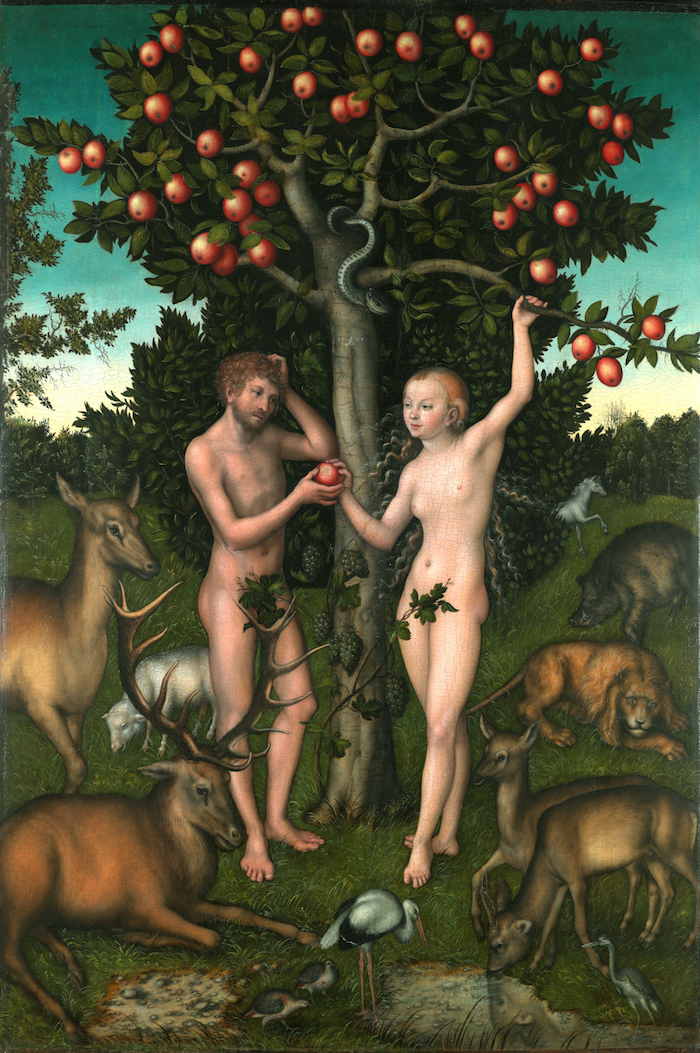
Adam and Eve Lucas Cranach the Elder (1472-1553), Adam and Eve, 1526, The Samuel Courtauld Trust, The Courtauld Gallery, London
Locations
People
Groups
Topics
- Renaissance, German
- Renaissance in the Low Countries
- Western Art: 1516 to 1528
- Protestant Reformation
Subjects
Regions
Subregions
Related Events
Showing 10 events out of 38363 total
Years: 1526 - 1526
Adam and Eve Lucas Cranach the Elder (1472-1553), Adam and Eve, 1526, The Samuel Courtauld Trust, The Courtauld Gallery, London
Locations
People
Groups
Topics
- Renaissance, German
- Renaissance in the Low Countries
- Western Art: 1516 to 1528
- Protestant Reformation
Subjects
Regions
Subregions