
Lübeck, having developed as an important economic …
Years: 1358 - 1358
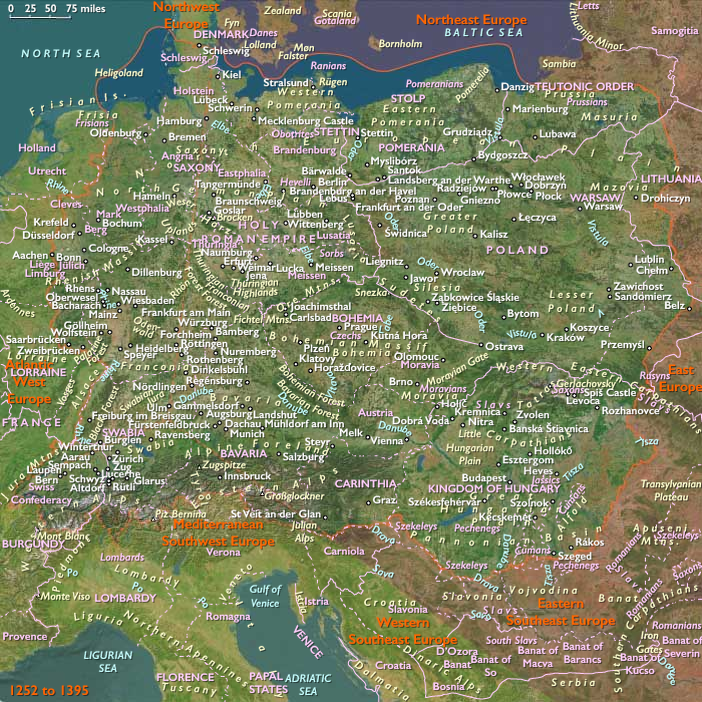
Lübeck, having developed as an important economic and cultural center for the entire Baltic area, is chosen in 1358 as the administrative headquarters for the Hanseatic League.
Locations
Groups
Subjects
Regions
Subregions
Related Events
Filter results
Showing 10 events out of 85 total
West Europe (1396–1539 CE)
Dynastic Struggles, Maritime Republics, and Reformation Currents
Geography & Environmental Context
West Europe in this age bridged the Mediterranean and the Atlantic through two intertwined spheres.
Mediterranean West Europe encompassed southern France (Languedoc, Provence, the Rhône valley, the French Pyrenees), Monaco, and Corsica—a frontier of mountain uplands, terraced coasts, and river plains tied to Italian and Iberian seas.
Atlantic West Europe ran along the Atlantic and Channel coasts of France, the Loire Valley Burgundy, northern France (including Paris), and the Low Countries (Belgium, the Netherlands, Luxembourg)—fertile basins and estuaries linked to Europe’s commercial cores.
From Marseille and Nice to Antwerp, Rouen, and Bordeaux, ports, riverways, and passes bound inland grainlands to sealanes and mercantile emporia.
Climate & Environmental Shifts
The Little Ice Age brought cooler winters, late frosts, and erratic rains.
-
Languedoc–Provence & Corsica: Vine and olive belts suffered frost damage in severe winters; storms battered harbors.
-
Rhône & Loire valleys; Paris Basin; Burgundy: Alternating floods, droughts, and cold snaps reshaped grain and grape yields.
-
Low Countries & Channel coasts: North Sea surges and wetter fields demanded relentless dike upkeep; fisheries endured rougher seas yet remained staples.
Subsistence & Settlement
-
Mediterranean sphere: Mixed farming of wheat, barley, rye, and legumes in valleys; vines and olives on coastal terraces; chestnuts in Corsican uplands. Sheep–goat transhumance linked Pyrenean and island pastures to town markets. Marseille, Avignon, Montpellier, Nice, and Ajaccio thrived as fortified, trade-facing towns.
-
Atlantic sphere: Wheat, rye, oats, and barley dominated; Burgundy’s vineyards and the Loire’s orchards supported regional exchange; flax and hemp in Flanders; dairy and cattle in the Low Countries. Paris, Rouen, Dieppe, Bordeaux, Bruges, Antwerp, Ghent, and Brussels anchored urban craft and export economies. Fisheries for herring and cod—salted and barreled—fed towns and long-distance trade.
Technology & Material Culture
-
Agriculture: Three-field rotations; water- and windmills; hillside terracing across Provence and Corsica.
-
Shipbuilding & seamanship: Mediterranean galleys and Atlantic cogs evolved toward caravels and larger ocean-going hulls; coastal shipyards provisioned fleets from Marseille to Rouen and Antwerp.
-
Architecture: Flamboyant Gothic cathedrals in Narbonne and Montpellier; papal complexes at Avignon; Genoese towers on Corsica; Burgundian ducal palaces; Flemish belfries and town halls; early Renaissance idioms appeared in Loire châteaux.
-
Print & craft: Lyon, Paris, and Antwerp emerged as printing hubs; Flemish woolens and tapestries, Burgundian wines, and Parisian luxury metalwork set European tastes.
Movement & Interaction Corridors
-
Mediterranean sealanes: Marseille and Monaco linked to Genoa, Naples, and Barcelona; Corsica sat astride Italy–Iberia–Maghreb routes.
-
Rhône corridor: Carried salt, wine, and grain north to Lyon and beyond.
-
Atlantic & Channel arteries: Bruges (declining by 1500), Antwerp (rising), and Rouen tied northern Europe to Iberia and the Mediterranean; Bordeaux connected the Loire–Garonne basins to the ocean.
-
Overland networks: Burgundian roads knit Dijon and Brussels to the Empire and France; pilgrimage roads joined Roussillon, Provence, and the Loire to Santiago de Compostela and Rome.
Cultural & Symbolic Expressions
-
Catholic orthodoxy & humanism: Monastic houses and cathedrals structured devotion; Avignon’s papal legacy lingered. Lyon and Avignon sustained humanist circles; Montpellier’s medical school gained renown.
-
Burgundian court culture: Under the Valois dukes (Philip the Good, Charles the Bold), Dijon and Brussels patronized Jan van Eyck, Rogier van der Weyden, and civic pageantry.
-
French monarchy & Renaissance: Post–Hundred Years’ War recovery culminated in Francis I’s embrace of Italianate forms and royal patronage along the Loire.
-
Netherlandish art: Early Netherlandish painters pioneered oil technique; civic commissions in Ghent, Bruges, and Antwerp flourished. Troubadour legacies survived in lyric verse across Provence; confraternities staged processions and charity in town parishes.
Environmental Adaptation & Resilience
-
Diversified ecologies: Mixed cereals, vines, olives, flax, and livestock spread climatic risk.
-
Water & earth works: Terraces and dikes stabilized fragile slopes and polders; flood embankments guarded the Rhône, Loire, and Low Country coasts.
-
Storage & exchange: Communal barns, urban granaries, and salt trade mitigated shortfalls; guild aid, hospitals, and beguinages provided social buffers.
Technology & Power Shifts (Conflict Dynamics)
-
Hundred Years’ War (to 1453): Though major battles lay north, raids and instability touched Languedoc and Provence. French resurgence culminated in Joan of Arc’s campaigns (1429) and Castillon (1453).
-
Aragon–French rivalry: Roussillon oscillated between crowns; Pyrenean frontiers remained militarized.
-
Burgundian Wars (1474–1477): Charles the Bold fell at Nancy; his inheritance split—parts to France, the rest to the Habsburgs—reshaping Low Country sovereignty.
-
Italian Wars (1494–1559): Drew Provence and Corsica into Valois–Habsburg struggles; Fornovo (1495) and Pavia (1525, capture of Francis I) reverberated through Provençal ports.
-
Corsica: Fought over by Genoa and Aragon; Genoa reasserted control, fortifying coasts against Barbary corsairs.
-
Naval theaters: Mediterranean galley wars and Adriatic–Aegean rivalries impacted Marseille and Monaco; the Low Countries pivoted toward Habsburg naval finance and Atlantic networks.
Transition (to 1539 CE)
By 1539, West Europe stood as a frontier of empires and a laboratory of recovery and renaissance.
In the Mediterranean, France had consolidated Provence and Roussillon yet suffered reverses in Italy; Genoa controlled Corsica, bracing against French and Ottoman pressure; Marseille and Monaco thrived as naval–mercantile hubs under the shadow of corsair raids.
Across the Atlantic sphere, Burgundy was partitioned between Valois and Habsburg realms; the Low Countries emerged as Europe’s commercial heart, with Antwerp surpassing Bruges as entrepôt to Iberian spice and silver trades.
Humanism animated Lyon and Avignon; Gothic and early Renaissance forms stood side by side; confessional tensions gathered on the horizon.
Poised between the Mediterranean and the Atlantic, West Europe entered the mid-16th century as both battlefield and marketplace—its rivers and ports set to channel the coming storms of Reformation and Habsburg–Valois rivalry.
Atlantic West Europe (1396–1539 CE): Burgundian Prestige, French Recovery, and Netherlandish Flourishing
Geographic & Environmental Context
The subregion of Atlantic West Europe includes the Atlantic and Channel coasts of France, the Loire Valley, Burgundy, northern France (including Paris), and the Low Countries (Belgium, the Netherlands, Luxembourg). Anchors included the Channel ports (Calais, Rouen, Dieppe, Antwerp, Bruges, Amsterdam), the Loire valley (Orléans, Tours, Nantes), the Burgundian heartlands (Dijon, Beaune), and the Paris Basin. This zone blended coastal trade hubs, fertile river valleys, and political cores, linking France, England, and the Holy Roman Empire.
Climate & Environmental Shifts
The Little Ice Age imposed cooler winters and erratic harvests:
-
Paris Basin & Burgundy: Periodic frosts reduced wheat and grape harvests.
-
Loire valley: Vineyards and orchards remained productive in most decades but saw occasional setbacks from floods and cold snaps.
-
Low Countries: Waterlogged fields required dike maintenance; storm surges (notably 15th-century North Sea floods) devastated coastal settlements.
-
Atlantic coasts: Rough seas complicated fishing and shipping; herring and cod fisheries persisted, anchoring diets.
Subsistence & Settlement
-
Agriculture: Wheat, rye, oats, and barley; vineyards in Burgundy and the Loire; flax and hemp in Flanders; dairy and cattle in the Low Countries.
-
Fishing: Channel and North Sea fisheries for herring, cod, and flatfish; salted and barrelled for trade.
-
Urban centers: Paris as royal capital; Bruges, Antwerp, Ghent, and Brussels as mercantile and craft hubs; Rouen, Dieppe, and Bordeaux on the Atlantic coast.
-
Craft production: Flemish cloth, Burgundian wines, and Parisian luxury goods (illuminated manuscripts, metalwork).
Technology & Material Culture
-
Agrarian systems: Three-field rotation, water- and windmills, improved plows in northern France and the Low Countries.
-
Textiles: Flemish woolens, later outpaced by English cloth but still dominant; silk and luxury fabrics in Lyon by early 16th century.
-
Architecture: Gothic cathedrals (Rouen, Chartres), Burgundian ducal palaces, Flemish town halls, and belfries; early Renaissance style appeared in royal châteaux along the Loire.
-
Print: Presses in Paris, Lyon, Antwerp; humanist works circulated widely.
Movement & Interaction Corridors
-
Channel & Atlantic ports: Bruges (declining), Antwerp (rising after c.1500), and Rouen tied northern Europe to Iberia and the Mediterranean.
-
Loire River corridor: Linked Atlantic ports to Paris and Burgundy.
-
Burgundian roads: Connected Dijon and Brussels to the Empire and France.
-
Pilgrimage routes: To Chartres, Mont-Saint-Michel, and Santiago via Atlantic ports.
Cultural & Symbolic Expressions
-
Burgundian court culture: Centered at Dijon and Brussels under the Valois dukes (Philip the Good, Charles the Bold); patronized Jan van Eyck, Rogier van der Weyden, and courtly pageantry.
-
French monarchy: Reasserted authority after the Hundred Years’ War; patronage of the arts flourished under Francis I, who embraced the Renaissance.
-
Netherlandish art: Early Netherlandish painters pioneered oil painting; civic patronage in Ghent, Bruges, and Antwerp thrived.
-
Religious life: Catholic piety remained dominant; confraternities, processions, and urban guild altars structured devotion. Reformist murmurs appeared by early 16th century.
Environmental Adaptation & Resilience
-
Dike building & poldering: Secured farmland in the Low Countries; towns rebuilt after floods.
-
Diversification: Farmers planted grains, vines, flax, and maintained cattle to spread risk.
-
Grain storage & trade: Surpluses from fertile regions like Artois and Flanders mitigated poor harvests elsewhere.
-
Urban resilience: Guild charities, hospitals, and beguinages provided relief in lean years.
Technology & Power Shifts (Conflict Dynamics)
-
Hundred Years’ War (1337–1453): Culminated in Joan of Arc’s campaigns (1429) and the Battle of Castillon (1453), restoring French control of most territory.
-
Burgundian Wars (1474–1477): Charles the Bold fell at the Battle of Nancy (1477); his lands were split between France and the Habsburgs.
-
French monarchy: Consolidated Loire valley as a royal heartland; launched the Italian Wars (1494–1559)under Charles VIII, Louis XII, and Francis I, drawing Burgundy and French Atlantic ports into continental conflict.
-
Low Countries: Fell under Habsburg rule after the Burgundian inheritance (1477–1482); Antwerp rose as a Habsburg entrepôt, drawing Iberian spice and silver trades by 1500.
-
Franco-Imperial rivalry: Battle of Pavia (1525) saw Francis I captured by Charles V, marking Habsburg predominance; northern France became a frontier of war finance and recruitment.
Transition
By 1539 CE, Atlantic West Europe had shifted from Hundred Years’ War devastation to Renaissance resurgence and early global entanglement. France’s Loire valley glittered with Renaissance châteaux; Burgundy had been absorbed into Valois and Habsburg spheres; the Low Countries emerged as Europe’s commercial heart, with Antwerp surpassing Bruges. Coastal fisheries and Channel ports endured climatic strain, but shipping and finance tied the region ever more tightly to Iberian Atlantic empires. Rivalries between Valois France and Habsburg Spain–Netherlands shaped a region poised at the forefront of European conflict and global expansion.
In an attempt to forge peace, he marries a French noblewoman, Margaret of Anjou, in 1445, as provided in the Treaty of Tours.
Hostilities resume with France in 1449.
When England loses the Hundred Years' War in August 1453, Henry falls into a period of mental breakdown that lasts until Christmas 1454.
With his inability to control the feuding nobles, civil war begins in 1455.
The conflicts are known as the Wars of the Roses (1455–1485), and although the fighting was very sporadic and small, there is a general breakdown in the authority and power of the Crown.
The royal court and Parliament move to Coventry, in the Lancastrian heartlands, which effectively becomes the capital of England until 1461.
Henry's cousin, who deposes Henry in 1461 and becomes Edward IV, goes a little way to restoring the power of the Crown.
Edward defeats the Lancastrians at the Battle of Mortimer's Cross.
He is briefly expelled from the throne in 1470–1471 when Richard Neville, Earl of Warwick, brings Henry back to power.
Six months later, Edward defeats and kills Warwick in battle and reclaims the throne.
Henry is imprisoned in the Tower of London and dies there.
His reign is to be marked by constant turmoil due to his political weaknesses.
While he is growing up, England is ruled by the Regency government.
The Regency Council attempts to install Henry VI as the King of France, as provided by the Treaty of Troyes signed by his father Henry V, and leads English forces to take over areas of France.
It appears they might succeed due to the poor political position of the son of King Charles VI, who has claimed to be the rightful king as King Charles VII of France.
However, in 1429, Joan of Arc begins to lead a military effort by the French to prevent the English from gaining control of France.
With her help, the French forces are able to push the English forces back and to regain control of French territory.
Atlantic West Europe: Dynastic Struggles and Shifting Alliances (1420–1431)
The period 1420–1431 of the Upper Late Medieval Age (1396–1539) in Atlantic West Europe is dominated by intensified warfare, shifting political alliances, and deepening economic disruption. Yet, amid these crises, cultural and technological innovation continue, reflecting both resilience and adaptation within the region.
Political and Military Developments
The years 1420–1431 witness some of the most severe phases of the Hundred Years' War and the ongoing Armagnac–Burgundian Civil War. The Treaty of Troyes (1420) drastically alters the political landscape, designating Henry V of England as heir to the French crown, and effectively disinheriting the Dauphin Charles (later Charles VII). This agreement escalates conflict, solidifying English dominance over northern France, including Paris. The pivotal event is the rise of Joan of Arc (1429), whose intervention at the Siege of Orléans significantly shifts momentum back to the French side. Joan’s capture (1430) and subsequent execution (1431) by pro-English authorities further inflame the conflict but also galvanize French national sentiment.
Economic Developments
Continuous warfare severely disrupts economic stability, with trade routes frequently obstructed and agricultural productivity hampered by conflict. Nevertheless, the Atlantic coastal cities—particularly Bruges, Ghent, and increasingly, Antwerp—adapt to wartime conditions by diversifying trade and strengthening their local markets. Efforts to circumvent the economic impact of war lead merchants to seek alternate trade networks, notably deepening relations with Italian city-states and northern German towns within the Hanseatic League.
Cultural and Artistic Trends
Despite political turmoil, the region experiences significant cultural growth. Burgundian patronage remains robust, further enriching court life and stimulating artistic innovations. Flemish masters, such as Jan van Eyck, elevate panel painting to new artistic heights, exemplified by masterpieces like the Ghent Altarpiece (1432, begun earlier), which introduces unprecedented realism and technical mastery. Simultaneously, literary culture continues to flourish, with notable advances in chronicles and historical writing, capturing the era's complex political narratives.
Technological and Societal Changes
Technological innovation in this period centers primarily around warfare, including advancements in artillery and fortifications. Such military developments significantly alter siege warfare strategies. Meanwhile, society grows increasingly stratified between urban elites—who consolidate wealth and political influence—and rural populations who disproportionately bear the hardships of prolonged conflict. Yet, the struggles also encourage the growth of civic governance in cities such as Ghent and Bruges, further solidifying urban autonomy.
Long-term Consequences and Significance
This era solidifies critical shifts in the power dynamics of Atlantic West Europe. Joan of Arc’s brief yet impactful intervention dramatically reorients French national identity and morale, while English ambitions reach their territorial high point before beginning a gradual decline. The cultural and artistic achievements of the Burgundian Netherlands, exemplified by Jan van Eyck, set the stage for a flourishing Flemish Renaissance.
Ultimately, 1420–1431 underscores Atlantic West Europe's resilience amid profound dynastic and military struggles, laying foundations for future political, cultural, and economic recovery and advancement.
Scottish Reinforcements Arrive in France: Buchan and Douglas Strengthen the Dauphin’s Cause (1424)
At the beginning of 1424, John Stewart, Earl of Buchan, returned to France with 6,500 additional Scottish troops to bolster the French Dauphin Charles VII’s forces against the Anglo-Burgundian alliance. Accompanying him was Archibald Douglas, 4th Earl of Douglas, one of Scotland’s most powerful noblemen, bringing military expertise and political weight to the Scottish intervention in France.
I. Composition of the Scottish Reinforcements
- The army totaled 6,500 men, consisting of:
- 2,500 men-at-arms (heavily armored cavalry and foot soldiers).
- 4,000 longbowmen, renowned for their skill in warfare.
- This was a significant reinforcement, as the Scottish-French alliance had already been pivotal at the Battle of Baugé (1421), where the Scots inflicted England’s first major defeat since Agincourt.
II. Arrival at Bourges and the Boost to the Dauphin’s Cause (April 24, 1424)
- On April 24, 1424, the Scottish army entered Bourges, where they were received at the Dauphin’s court.
- Their arrival raised the spirits of Charles VII, who had been struggling to maintain resistance against the English forces led by John of Lancaster, Duke of Bedford.
- The reinforcements gave Charles VII renewed confidence, reinforcing the Franco-Scottish military cooperation.
III. The Importance of Buchan and Douglas in the War
- John Stewart, Earl of Buchan, had already proven himself a capable leader at Baugé, and his return signaled Scotland’s ongoing commitment to the French cause.
- Archibald Douglas, 4th Earl of Douglas, was among the most influential nobles in Scotland, lending prestige and leadership to the campaign.
- Their presence strengthened Franco-Scottish military operations, paving the way for further engagements against the English.
IV. Consequences and the Next Phase of the War
- The Scottish troops would soon engage the English again, leading to the Battle of Verneuil (August 17, 1424)—a brutal confrontation that would test the resilience of the Franco-Scottish alliance.
- The Dauphin’s forces were now reinforced, making him more capable of resisting the English advance.
The arrival of Buchan and Douglas in France in 1424 reinforced Scotland’s commitment to the French cause, giving Charles VII the military support needed to continue his struggle against the English occupation of France.
Jean Gerson, former chancellor of the University of Paris, after returning in 1419 from the Tyrol to France, had gone to Lyon, where his brother was prior of the Celestine monastery.
Although Gerson is retired from active university life, the past decade at Lyon has been a time of great literary productivity.
He has produced a harmony of the gospels (the Monotesseron), works on the poems of the bible climaxing in a massive collection of twelve treatises on the Magnificat (Lk. 1:46-55), a commentary on the Song of Songs, as well as an extensive literary correspondence with members of the Carthusian order and others on mysticism and other issues of spiritual life.
Shortly before his death at sixty-five on July 12, 1429, he produces a tract in support of Joan of Arc.
The Siege of Orléans (1428–1429) and Joan of Arc’s Triumph
In 1428, John, Duke of Bedford, the English regent of France, ordered an unrelenting siege of Orléans, a key stronghold of the Dauphin Charles (the future Charles VII of France). At the time, Charles, Duke of Orléans, the city's rightful ruler, was a prisoner in England, leaving his territory vulnerable.
The French garrison held out for eight months, enduring continuous assaults and severe deprivation. However, in May 1429, the arrival of Joan of Arc, a deeply religious peasant girl claiming divine guidance, transformed the battle.
In just eight days, her forces lifted the siege, securing one of the most decisive victories in the Hundred Years’ War. This triumph earned her the legendary title “The Maid of Orléans.”
I. The English Siege and French Resistance (1428–1429)
- The English, led by Thomas Montacute, Earl of Salisbury, laid siege to Orléans in October 1428, aiming to cut off the Dauphin’s last major stronghold on the Loire River.
- The city's rightful ruler, Charles, Duke of Orléans, was a prisoner, weakening French morale.
- The French defenders, outnumbered and undersupplied, held out for eight months, hoping for reinforcements.
II. The Arrival of Joan of Arc (April–May 1429)
- In early 1429, Joan of Arc convinced Charles VII** that she was divinely chosen to save France.
- Granted command of an army, she marched to Orléans in April 1429, bringing fresh troops and renewed morale.
- On May 4, 1429, Joan led an attack on the English fortifications, and by May 8, the siege was broken.
- Her unexpected success shattered English confidence and turned the tide of the war in favor of Charles VII.
III. Jean de Dunois, “The Bastard of Orléans”
- Among Joan’s key commanders was Jean, Comte de Dunois, an illegitimate son of the murdered Louis, Duke of Orléans.
- A loyal supporter of the Dauphin, Dunois helped organize and execute the counteroffensive that drove out the English.
- His bravery at Orléans earned him the title “The Bastard of Orléans,” and he would go on to become one of Charles VII’s most important generals.
IV. Consequences: A Turning Point in the Hundred Years’ War
- The lifting of the siege marked the beginning of the French resurgence, shifting momentum away from English domination.
- Joan of Arc’s victory at Orléans revitalized French morale, paving the way for Charles VII’s coronation in Reims (1429).
- Dunois continued to play a key role in France’s military successes, ultimately helping to drive the English out of France.
The Siege of Orléans (1428–1429) was one of the most defining moments of the Hundred Years’ War, as Joan of Arc’s leadership and Dunois’ military prowess turned the tide in favor of the Dauphin Charles VII, ensuring the survival of the French monarchy.
The Creation of the Order of the Golden Fleece (1429): Burgundy’s Chivalric Legacy
In 1429, Philip the Good, Duke of Burgundy, renowned for his patronage of chivalry, culture, and the arts, established the Order of the Golden Fleece, one of the most prestigious secular chivalric orders in European history.
Designed to promote knightly ideals and strengthen Burgundian power, the order was first awarded in 1429 and quickly became a symbol of prestige and loyalty within the Burgundian court.
I. The Founding of the Order
- Philip the Good founded the Order of the Golden Fleece on January 10, 1429, in Bruges, during his marriage to Isabella of Portugal.
- The order was intended to rival other European chivalric institutions, such as the English Order of the Garter and the French Order of Saint Michael.
- Originally, membership was limited to 24 knights, but this number was later expanded as the order grew in prestige.
II. Symbolism and Purpose
- The Golden Fleece was chosen as the symbol of the order, referencing:
- The mythological fleece sought by Jason and the Argonauts, symbolizing glory and heroism.
- The flourishing wool trade in Burgundy and Flanders, representing economic power.
- The order reinforced Burgundian authority, binding Philip’s most loyal vassals and nobles to his rule.
- It also promoted knightly values, including piety, loyalty, and martial excellence.
III. The Order’s Legacy
- The Order of the Golden Fleece became one of the most prestigious orders of knighthood in Europe, surviving the fall of the Burgundian state.
- After the Habsburgs inherited Burgundy, the order was passed down through the Spanish and Austrian branches of the Habsburg dynasty, maintaining its elite status.
- Even today, the order exists in both Austrian and Spanish branches, continuing its tradition of exclusivity and prestige.
IV. Conclusion: A Lasting Symbol of Burgundian Chivalry
Philip the Good’s creation of the Order of the Golden Fleece in 1429 was both a political and cultural achievement, strengthening Burgundian influence while celebrating the ideals of medieval knighthood. The order’s survival across centuries is a testament to its enduring legacy as one of the highest honors of European chivalry.
Joan of Arc’s Early Life and Her Journey to the French Court (1429)
By early 1429, nearly all of northern France and parts of the southwest were under Anglo-Burgundian control. The English controlled Paris and Rouen, while the Burgundians held Reims, the traditional coronation site of French kings since 816.
Neither Henry VI of England nor Charles VII of France had yet been officially crowned, making Reims a key symbolic and political objective. Meanwhile, the English siege of Orléans, begun in 1428, threatened one of the last strongholds still loyal to Charles VII.
As the French cause appeared increasingly desperate, a peasant girl from Domrémy, Joan of Arc, began her journey into history, claiming she was sent by God to liberate France and bring the Dauphin to Reims for his coronation.
I. Joan of Arc’s Early Life and Divine Visions
- Joan was born in Domrémy, a loyalist French village within the Duchy of Bar, to Jacques d’Arc and Isabelle Romée.
- Her family owned around fifty acres (twenty hectares) of land, and her father also served as a village official, collecting taxes and leading the local watch.
- Despite being surrounded by pro-Burgundian lands, Domrémy remained loyal to Charles VII, suffering occasional raids and at least one instance where the village was burned.
- At age thirteen, Joan began hearing "voices", which she later identified as Saint Catherine, Saint Margaret, and Saint Michael.
- These voices charged her with a divine mission:
- Liberate France from English rule.
- Ensure the Dauphin’s coronation at Reims.
- She kept these messages secret for several years before attempting to act upon them.
II. Joan’s First Attempts to Reach Charles VII
- At sixteen, Joan sought permission to visit the royal court at Chinon, believing she was destined to help Charles VII reclaim his kingdom.
- She asked her relative, Durand Lassois, to take her to Vaucouleurs, a nearby town where she met the garrison commander, Robert de Baudricourt.
- Baudricourt mocked her request and dismissed her.
- Joan persisted, returning in January 1429, where she gained the support of two of Baudricourt’s soldiers:
- Jean de Metz.
- Bertrand de Poulengy.
- These men helped arrange a second meeting with Baudricourt, where Joan made a stunning claim:
- She predicted a French military defeat near Orléans days before messengers confirmed the news.
III. Baudricourt Grants Joan an Escort to Chinon
- Baudricourt, now convinced that Joan’s knowledge was divinely inspired, decided to support her mission.
- After confirmation of the French defeat at Orléans, he granted her an armed escort to travel to Chinon, where Charles VII resided.
IV. The Path to Reims Begins
- Joan’s journey to Chinon was the first step toward her legendary role in the Hundred Years’ War.
- Her arrival at the Dauphin’s court would soon lead to her recognition as a divinely guided leader, culminating in her decisive role in lifting the Siege of Orléans in May 1429.
Joan of Arc’s persistent faith and determination in early 1429 set in motion events that would change the course of the war, transforming her from an unknown peasant girl into France’s most iconic military heroine.
Years: 1358 - 1358
Locations
Groups
Subjects
Regions
Subregions