
Maritime East Asia (1108 – 1251 CE): …
Years: 1108 - 1251
Maritime East Asia (1108 – 1251 CE): Song Prosperity, Goryeo Flourishing, and Heian Decline
Geographic and Environmental Context
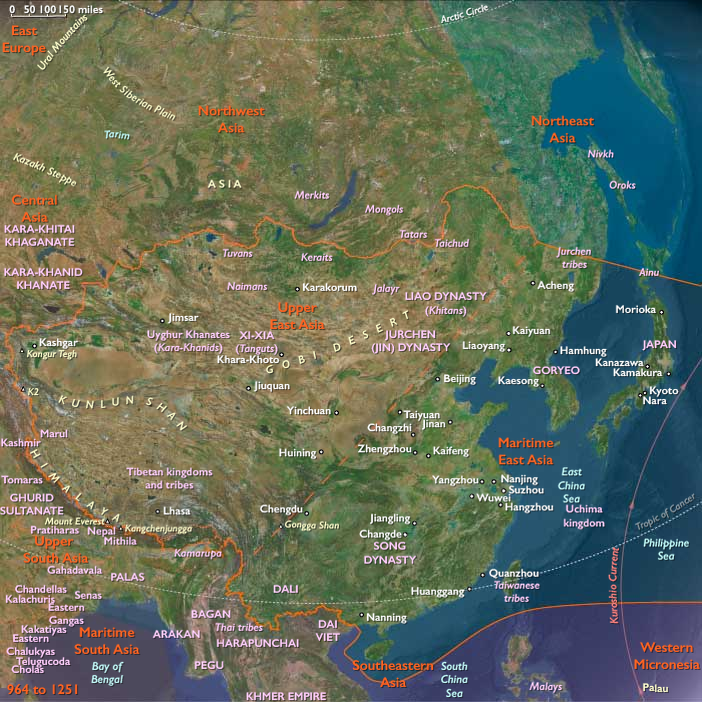
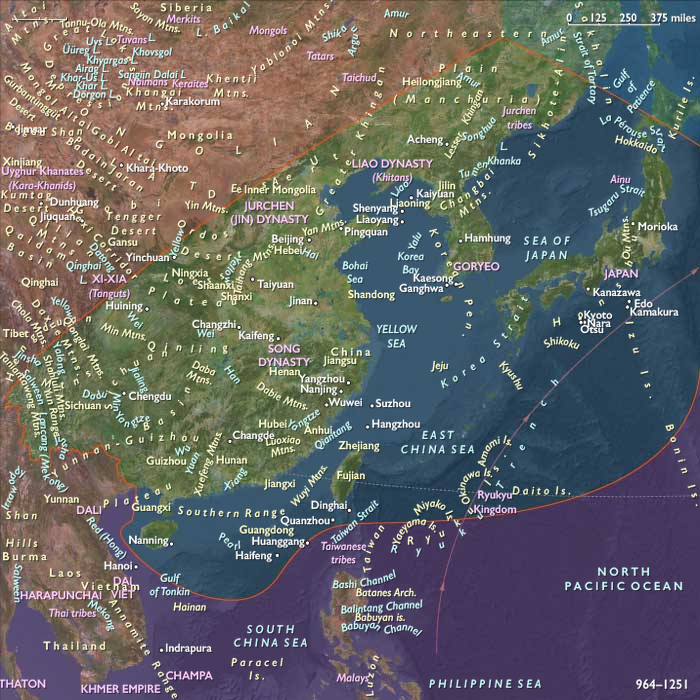
Maritime East Asia includes eastern China, Taiwan, the Korean Peninsula, and Japan.
-
China’s Yangtze basin and southern provinces were the agricultural and commercial heartlands of the Song dynasty.
-
The Korean Peninsula was unified under the Goryeo dynasty, centered on Gaegyeong.
-
Japan’s Heian court ruled from Kyoto, though power increasingly shifted to provincial warrior clans.
-
Taiwan remained home to Austronesian-speaking Indigenous communities with strong maritime traditions.
Climate and Environmental Shifts
-
The Medieval Warm Period provided longer growing seasons in southern China, boosting rice cultivation.
-
The Yellow River basin remained prone to flooding and course changes, challenging northern Chinese agriculture.
-
Korea’s temperate climate supported agriculture and population growth.
-
Taiwan’s tropical climate underpinned mixed horticulture and coastal foraging.
Societies and Political Developments
-
Song China (960–1279): Between 1108 and 1251, the Northern Song fell to the Jurchen Jin dynasty in 1127, forcing the court to retreat south to Hangzhou and inaugurate the Southern Song dynasty (1127–1279). Despite territorial losses, the Southern Song presided over an age of economic prosperity, urban growth, and cultural flourishing.
-
Goryeo Korea (918–1392): Maintained centralized monarchy supported by aristocratic families. Buddhism flourished, with monumental works such as the Tripitaka Koreana begun in this period. Goryeo resisted Khitan and Jurchen invasions but remained resilient.
-
Heian Japan (794–1185): Aristocratic dominance peaked, but political power slipped toward provincial samurai clans. By the late 12th century, the Genpei War (1180–1185) ended Heian rule and established the Kamakura shogunate (1185–1333), inaugurating samurai governance.
-
Taiwan: Austronesian-speaking peoples lived in decentralized chiefdoms, oriented to fishing, horticulture, and regional exchange.
Economy and Trade
-
Song China: Champa rice imports from Vietnam revolutionized agriculture, doubling yields. Urban markets flourished; Hangzhou and Kaifeng became among the largest cities in the world. Song coinage and paper money circulated widely.
-
Goryeo: Produced fine celadon ceramics, exported to China and Japan. Agricultural surpluses supported Buddhist institutions.
-
Japan: Rice agriculture expanded, though aristocratic estates (shōen) weakened central authority. Trade with Song China brought ceramics, silks, and copper coins.
-
Taiwan: Exchange involved forest products, fish, and prestige items traded with Fujian and the Philippines.
Subsistence and Technology
-
Song innovations: printing (movable type), gunpowder weaponry, and advanced shipbuilding. Water-control projects improved rice yields.
-
Goryeo: Mastery of celadon glazes reflected technical and artistic sophistication.
-
Japan: Architectural and artistic achievements flourished at Kyoto, while samurai advanced military technologies (lamellar armor, swords).
-
Taiwanese Austronesians: Maintained canoe-building, fishing gear, and horticultural tools adapted to island environments.
Movement and Interaction Corridors
-
The Grand Canal and Yangtze River facilitated internal Chinese trade and troop movement.
-
Maritime trade expanded from Guangzhou, Quanzhou, and Ningbo, connecting China to Southeast Asia, India, and beyond.
-
Korean envoys traveled regularly to Song China, while Chinese merchants visited Goryeo and Japan.
-
Japanese and Taiwanese seafarers maintained smaller-scale trade with southern China and the Philippines.
Belief and Symbolism
-
Song China: Neo-Confucianism (Zhu Xi) became the dominant intellectual current, while Buddhism and Daoism remained influential.
-
Goryeo: Buddhism was central, with temples and monasteries as cultural and economic hubs.
-
Japan: Shinto and Buddhism blended; Pure Land Buddhism gained popularity among the populace.
-
Taiwan: Animist traditions emphasized ancestor spirits, land deities, and sea gods.
Adaptation and Resilience
-
Song resilience was found in economic adaptation: the loss of the north spurred southern intensification and maritime commerce.
-
Goryeo’s resilience lay in Buddhist cultural unity and aristocratic networks that stabilized society after invasions.
-
Japan adapted through the emergence of warrior governance, balancing aristocratic decline with samurai consolidation.
-
Taiwan’s Indigenous societies remained resilient by blending horticulture, fishing, and inter-island voyaging.
Long-Term Significance
By 1251 CE, Maritime East Asia had undergone profound transformation. The Song dynasty shifted south but oversaw an economic golden age; Goryeo Korea flourished as a Buddhist kingdom; Japan transitioned from aristocratic Heian rule to samurai-led shogunate; and Taiwanese Austronesians sustained maritime lifeways. The subregion’s mixture of political upheaval, economic innovation, and cultural resilience shaped its enduring place in the medieval world.

Lower East Asia (with civilization) ©2024-25 Electric Prism, Inc. All rights reserved.
People
Groups
- Aborigines, Taiwanese
- Buddhism
- Confucianists
- Shinto
- Taoism
- Khitan people
- Buddhists, Zen or Chán
- Japan, Heian Period
- Neo-Confucianism
- Jurchens
- Liao Dynasty, or Khitan Empire
- Goryeo
- Chinese Empire, Pei (Northern) Song Dynasty
- Dai Viet, Kingdom of
- Buddhism, Pure Land
- Jin Dynasty (Chin Empire), Jurchen
- Chinese Empire, Nan (Southern) Song Dynasty
- Jin Dynasty (Chin Empire), Jurchen
- Japan, Kamakura Period
- Jin Dynasty (Chin Empire), Jurchen
Topics
Commodoties
Subjects
- Writing
- Watercraft
- Engineering
- Painting and Drawing
- Labor and Service
- Decorative arts
- Conflict
- Faith
- Government
- Custom and Law
- Technology
- Invention
Regions
Subregions
Years: 1108 - 1251
Lower East Asia (with civilization) ©2024-25 Electric Prism, Inc. All rights reserved.
People
Groups
- Aborigines, Taiwanese
- Buddhism
- Confucianists
- Shinto
- Taoism
- Khitan people
- Buddhists, Zen or Chán
- Japan, Heian Period
- Neo-Confucianism
- Jurchens
- Liao Dynasty, or Khitan Empire
- Goryeo
- Chinese Empire, Pei (Northern) Song Dynasty
- Dai Viet, Kingdom of
- Buddhism, Pure Land
- Jin Dynasty (Chin Empire), Jurchen
- Chinese Empire, Nan (Southern) Song Dynasty
- Jin Dynasty (Chin Empire), Jurchen
- Japan, Kamakura Period
- Jin Dynasty (Chin Empire), Jurchen
Topics
Commodoties
Subjects
- Writing
- Watercraft
- Engineering
- Painting and Drawing
- Labor and Service
- Decorative arts
- Conflict
- Faith
- Government
- Custom and Law
- Technology
- Invention
Regions
Subregions