
Maritime East Asia (765–622 BCE): Cultural Prosperity …
Years: 765BCE - 622BCE
Maritime East Asia (765–622 BCE): Cultural Prosperity Amid Political Fragmentation
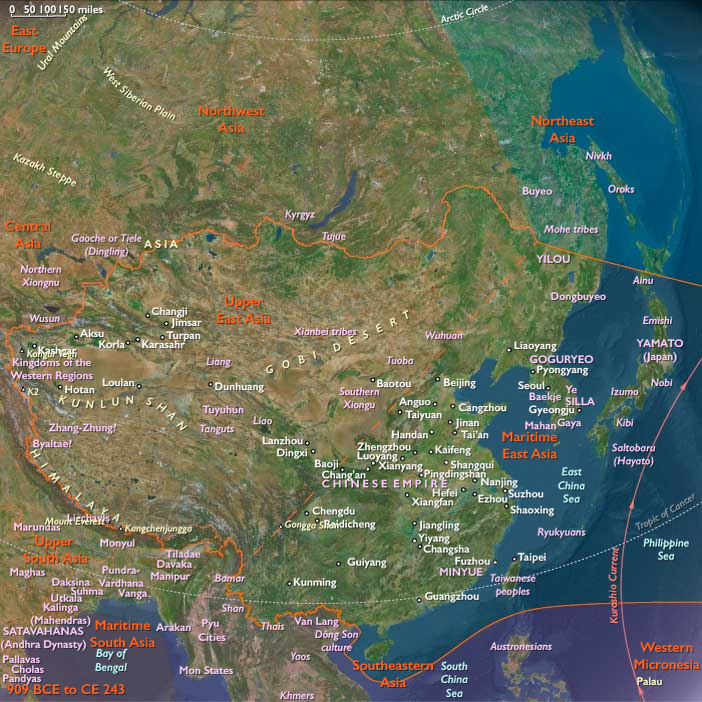
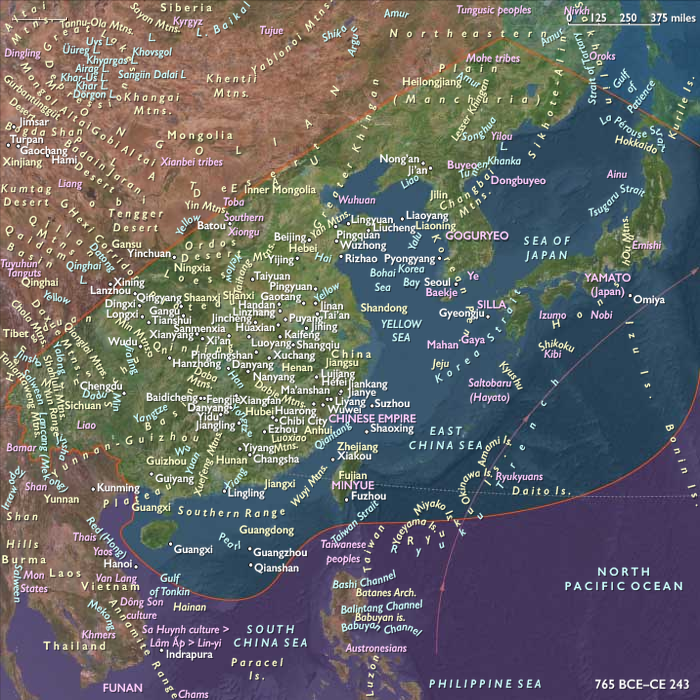
Between 765 BCE and 622 BCE, Maritime East Asia—comprising lower Primorsky Krai, the Korean Peninsula, the Japanese Archipelago below northern Hokkaido, Taiwan, and southern, central, and northeastern China—experiences a paradoxical age marked by political disunity and extraordinary cultural and economic advancements. Known historically as the early Spring and Autumn Period, this era sets the stage for significant cultural and technological growth despite ongoing regional conflicts and decentralized rule.
Emergence of Political Competition and Fragmentation
As central authority under the Eastern Zhou Dynasty further weakens, regional lords become increasingly independent and compete fiercely to strengthen their domains. This intense rivalry necessitates robust military capabilities, effective governance, and economic innovation. The frequent conferences among feudal lords, characteristic of the previous age, evolve into competitive rather than cooperative interactions, intensifying internal strife and decentralization.
Economic Innovations and Technological Advancements
This age witnesses substantial economic growth, driven by increased commerce and critical technological advancements. Coinage is introduced, significantly facilitating trade and economic interaction across regions. The widespread adoption of iron metallurgy revolutionizes both agriculture and warfare, with iron weapons and farm implements enhancing military efficiency and agricultural productivity.
Large-scale infrastructure projects emerge, including sophisticated flood control systems, irrigation networks, and canal construction, reflecting regional lords' ambition to improve productivity and sustain population growth. Additionally, enormous fortification projects, including expansive city walls and frontier barriers along the northern boundary, underscore the strategic importance of defense in this period of persistent regional rivalry.
Intellectual and Cultural Flourishing
The era from 765 to 622 BCE marks the beginning of a remarkable intellectual and cultural flowering in China, often referred to as the age of the Hundred Schools of Thought. Although formal education remains limited to the aristocracy, the demand for knowledgeable, literate administrators leads to significant intellectual developments. Various philosophical traditions begin to emerge, laying critical foundations for later influential Chinese philosophies.
Historiography also sees considerable advancements. Early historical texts such as the Classic of History and the annalistic chronicle Spring and Autumn Annals, traditionally attributed to Confucius, appear during this era. These works reflect a growing conviction in China that historical understanding constitutes a vital source of wisdom for governance and societal harmony.
Ritual and Cultural Continuity
Despite political fragmentation, established cultural practices such as ritual ancestor worship and divination continue to thrive. The cryptic oracle text known as the I Ching (Book of Changes), dating back to the early first millennium BCE, gains prominence as a foundational text of Chinese culture. Additionally, the pentatonic musical scale, symbolic of cosmic harmony and extensively used in ritual ceremonies, becomes the dominant musical form throughout the region.
Legacy of the Age: Foundations for China's Golden Age
Thus, the age from 765 to 622 BCE in Maritime East Asia represents a paradoxical yet profoundly influential period. Amid ongoing political fragmentation and military competition, unprecedented cultural, economic, and intellectual developments set crucial precedents for the vibrant and diverse cultural landscape that will characterize subsequent periods, including the flourishing of classical Chinese civilization.
Groups
Topics
Commodoties
Subjects
Regions
Subregions
Years: 765BCE - 622BCE
Groups
Topics
Commodoties
Subjects
Regions
Subregions