
Maritime East Asia (909 BCE – CE …
Years: 909BCE - 819
Maritime East Asia (909 BCE – CE 819): Imperial Centers, Maritime Trade, and Cultural Flourishing
Geographic and Environmental Context
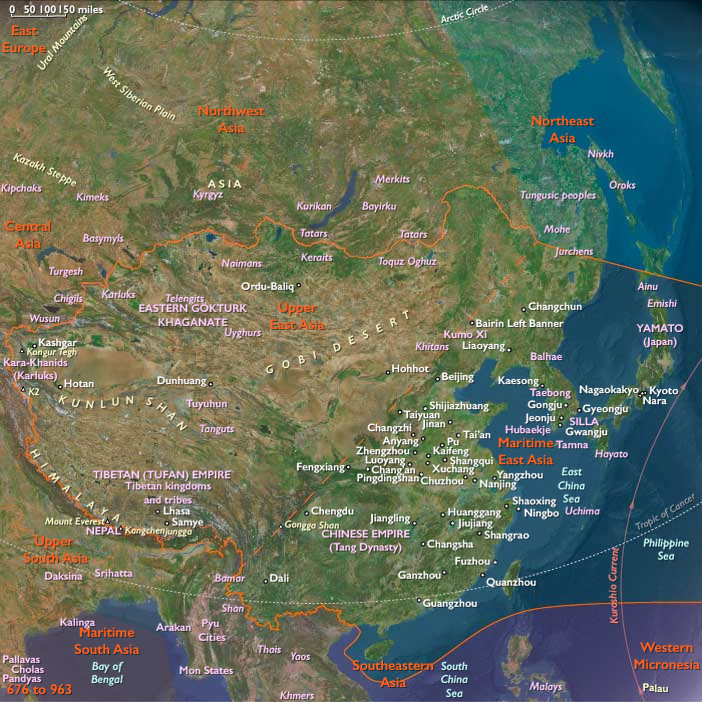
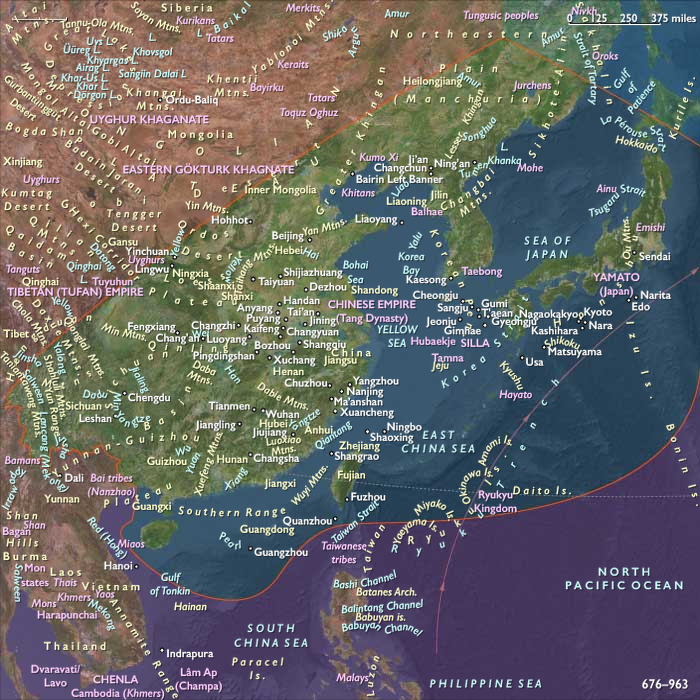
Maritime East Asia includes eastern China, Taiwan, the Korean Peninsula, and Japan.
-
The subregion spans fertile river valleys such as the Yangtze and Yellow River basins, mountainous interiors, and extensive coastal plains.
-
Offshore, the East China Sea, Yellow Sea, and Sea of Japan connect the mainland to island territories, while major straits such as the Tsushima and Taiwan Straits serve as maritime gateways.
Climate and Environmental Shifts
-
The East Asian monsoon dominates the seasonal cycle, bringing wet summers and cold, dry winters to the mainland and peninsulas.
-
Periodic climatic fluctuations, including colder intervals in the early first millennium CE, influenced agricultural productivity and population distribution.
-
Typhoons posed recurring threats to coastal settlements and maritime activity.
Societies and Political Developments
-
In China, this period encompassed the Eastern Zhou, Qin, and Han dynasties, followed by the Three Kingdoms, Jin, and the Northern and Southern Dynasties, leading into the Tang dynasty by the early 8th century CE.
-
Korea saw the emergence and consolidation of the Three Kingdoms—Goguryeo, Baekje, and Silla—followed by Silla’s unification of most of the peninsula in the late 7th century CE.
-
Japan transitioned from the Yayoi agricultural period to the Kofun and Asuka periods, with increasing state centralization and cultural borrowing from the mainland.
-
Taiwan was home to Austronesian-speaking societies linked to maritime networks extending into Southeast Asia and the Pacific.
Economy and Trade
-
Agriculture, especially rice cultivation in paddy fields, formed the economic base, supplemented by wheat, millet, and barley in northern zones.
-
Silk, lacquerware, ceramics, and metal goods were major exports from China to Central Asia, Southeast Asia, and beyond.
-
Maritime trade linked the Chinese and Korean coasts to Japan, Taiwan, and Southeast Asia, moving goods such as textiles, tools, salt, and luxury items.
-
Urban markets in capitals like Chang’an and Luoyang became hubs of domestic and international commerce.
Subsistence and Technology
-
Advanced irrigation systems supported high-yield rice agriculture.
-
Iron and steel production expanded, improving agricultural tools, weapons, and construction.
-
Shipbuilding technology progressed, with larger ocean-going vessels facilitating long-distance trade.
-
Written scripts, including Chinese characters, were adopted or adapted in Korea and Japan.
Movement and Interaction Corridors
-
Overland routes connected Lower East Asia to Central Asia via the Silk Road, facilitating exchange of goods, ideas, and technologies.
-
Maritime routes across the Yellow and East China Seas enabled diplomatic, cultural, and economic ties between China, Korea, and Japan.
-
Coastal navigation linked Taiwan to the Fujian and Guangdong coasts, forming part of a broader Austronesian maritime sphere.
Belief and Symbolism
-
Confucianism, Daoism, and Buddhism shaped governance, art, and daily life, with Buddhism spreading from China into Korea and Japan.
-
Monumental architecture, including palace complexes, pagodas, and tomb mounds, reflected political authority and religious devotion.
-
Decorative arts often carried symbolic motifs representing prosperity, protection, and cosmic order.
Adaptation and Resilience
-
Regional specialization in crops and crafts reduced dependence on any single resource.
-
State-managed granaries and transportation networks helped buffer against famine.
-
Cross-cultural diplomacy maintained stability and trade even during periods of political fragmentation.
Long-Term Significance
By CE 819, Maritime East Asia had become a dynamic nexus of political power, cultural innovation, and maritime exchange, influencing the economic and intellectual life of much of Eurasia.
Groups
- Gojoseon (Choson)
- Austronesian peoples
- Chinese Kingdom, Zhou, or Chou, Western, Dynasty
- Japan, Final Jomon Period
- Qin, (Chinese) state of
- Chinese Kingdom, Zhou, or Chou, Eastern Dynasty
- Confucianists
- Buddhism
- Han, Chinese state of
- Gojoseon (Choson)
- Taoism
- Japan, Yayoi Period
- Qin Dynasty
- Han Dynasty (Western)
- Silla, Kingdom of
- Goguryeo (Koguryo), Kingdom of
- Baekje (or Paekche), Kingdom of
- Goguryeo (Koguryo), Kingdom of
- Japan, Yamato Kofun Period
- Buddhists, Zen or Chán
- Japan, Yamato Early Asuka Period
- Sui Dynasty (Imperial Chinese dynasty)
- Chinese Empire, Tang Dynasty
- Japan, Yamato Hakuho (Late Asuka) Period
- Silla, Unified or Later
- Balhae (Bohai, or Pohai), Kingdom of
- Japan, Nara Period
- Japan, Heian Period
Topics
- Bronze Age China
- Spring and Autumn Period in China
- Iron Age China
- Migration Period
- Migration Period Pessimum
Commodoties
Subjects
- Commerce
- Symbols
- Architecture
- Watercraft
- Painting and Drawing
- Decorative arts
- Conflict
- Faith
- Government
- Custom and Law
- Technology
Regions
Subregions
Years: 909BCE - 819
Groups
- Gojoseon (Choson)
- Austronesian peoples
- Chinese Kingdom, Zhou, or Chou, Western, Dynasty
- Japan, Final Jomon Period
- Qin, (Chinese) state of
- Chinese Kingdom, Zhou, or Chou, Eastern Dynasty
- Confucianists
- Buddhism
- Han, Chinese state of
- Gojoseon (Choson)
- Taoism
- Japan, Yayoi Period
- Qin Dynasty
- Han Dynasty (Western)
- Silla, Kingdom of
- Goguryeo (Koguryo), Kingdom of
- Baekje (or Paekche), Kingdom of
- Goguryeo (Koguryo), Kingdom of
- Japan, Yamato Kofun Period
- Buddhists, Zen or Chán
- Japan, Yamato Early Asuka Period
- Sui Dynasty (Imperial Chinese dynasty)
- Chinese Empire, Tang Dynasty
- Japan, Yamato Hakuho (Late Asuka) Period
- Silla, Unified or Later
- Balhae (Bohai, or Pohai), Kingdom of
- Japan, Nara Period
- Japan, Heian Period
Topics
- Bronze Age China
- Spring and Autumn Period in China
- Iron Age China
- Migration Period
- Migration Period Pessimum
Commodoties
Subjects
- Commerce
- Symbols
- Architecture
- Watercraft
- Painting and Drawing
- Decorative arts
- Conflict
- Faith
- Government
- Custom and Law
- Technology
Regions
Subregions