
Maritime East Asia (477–334 BCE): Warring States …
Years: 477BCE - 334BCE
Maritime East Asia (477–334 BCE): Warring States and Intellectual Flourishing
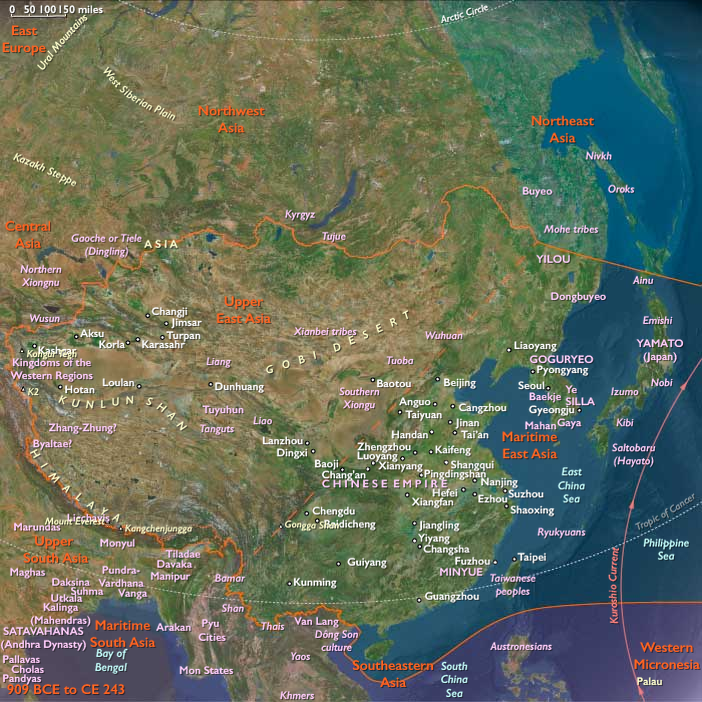
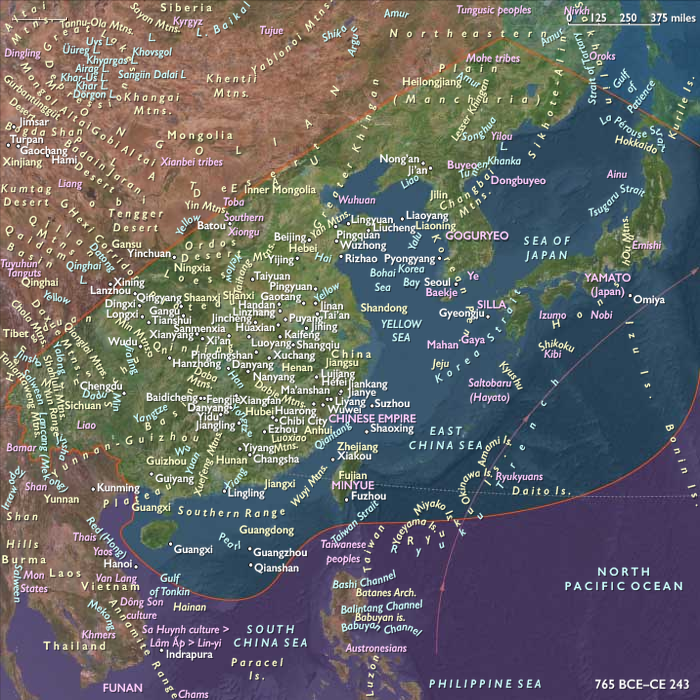
Between 477 BCE and 334 BCE, Maritime East Asia—comprising lower Primorsky Krai, the Korean Peninsula, the Japanese Archipelago below northern Hokkaido, Taiwan, and southern, central, and northeastern China—enters the intense Warring States Period, characterized by continuous warfare among competing regional kingdoms. This age, however, simultaneously represents a profound era of intellectual and technological advancement.
Rise of Confucian Humanism: Mencius
During this turbulent time, Confucianism is further developed by Mencius (372–289 BCE), or Meng Zi, who becomes one of Confucius's most influential disciples. Mencius elaborates on Confucian humanism, asserting the inherent goodness of human nature and emphasizing the ruler's obligation to govern with the people's consent. According to Mencius, despotic rulers risk losing the Mandate of Heaven, thus morally justifying rebellion and change in leadership.
Military Evolution and The Art of War
Ironworking becomes widespread, transforming military practices. Armies increasingly rely on iron weaponry rather than bronze, and warfare tactics shift significantly, moving from chariot-based combat toward combined infantry and cavalry strategies. The use of dagger-axes and notably long iron pikes by kingdoms like the Qin underscores technological advances in warfare.
This period also witnesses the production of pivotal military treatises. The legendary strategist Sun Tzu writes The Art of War, the oldest and most influential military strategy text, emphasizing positioning, adaptability, and intelligence gathering. Alongside this seminal work, other significant military texts, collectively known as the Seven Military Classics, are compiled, profoundly influencing military thinking for centuries.
Intellectual Dynamism: Hundred Schools of Thought
The Hundred Schools of Thought flourish, encompassing diverse philosophical traditions such as:
-
Confucianism, further enriched by Mencius's teachings.
-
Taoism, articulated by Lao Zi and expanded by Zhuang Zi, promoting harmony with nature and simplicity.
-
Mohism, established by Mozi, advocating universal love, pacifism, and logical reasoning.
-
Legalism, emerging in the late Warring States period, emphasizing strict laws and state control as articulated by Han Feizi.
The interplay among these schools shapes the ethical, social, and political landscape of East Asia profoundly, impacting education and governance for generations.
Economic Expansion and Technological Innovations
Trade flourishes, enabling merchants to wield considerable economic and political influence. Notable technological innovations include the practical harnessing of natural gas, conveyed through bamboo pipes from natural seeps, for salt production via evaporation.
Despite advancements, Chinese cast iron production remains hindered by brittleness due to high phosphorus content, a unique feature allowing melting but reducing quality. Furthermore, Chinese understanding of music theory deepens, particularly regarding the cycle of fifths and the chromatic scale, although their practical musical tradition remains rooted primarily in pentatonic scales.
Cultural and Religious Developments
In Japan, significant religious and cultural developments occur, exemplified by the establishment of the Hikawa Shrine in 473 BCE at Omiya, near modern Saitama. This shrine, dedicated to kami—animistic spirits worshiped in Shinto, Japan’s indigenous religion—marks the earliest known evidence of formal Shinto practices. The shrine's influence extends widely, spawning numerous daughter shrines across Japan, reinforcing Shinto's central role in Japanese cultural identity.
Legacy of the Age: Foundation of Classical East Asian Civilization
Thus, the age from 477 to 334 BCE encapsulates the dynamic contrast of destructive warfare and extraordinary intellectual, technological, and cultural achievements. The era's philosophical debates, military innovations, economic growth, and religious expressions lay foundational elements for subsequent classical East Asian civilizations.
People
Groups
- Japan, Final Jomon Period
- Chinese Kingdom, Zhou, or Chou, Eastern Dynasty
- Confucianists
- Shinto
- Mohism
- Taoism
Topics
Commodoties
Subjects
- Commerce
- Decorative arts
- Faith
- Government
- Custom and Law
- Technology
- Metallurgy
- Philosophy and logic
- History
Regions
Subregions
Years: 477BCE - 334BCE
People
Groups
- Japan, Final Jomon Period
- Chinese Kingdom, Zhou, or Chou, Eastern Dynasty
- Confucianists
- Shinto
- Mohism
- Taoism
Topics
Commodoties
Subjects
- Commerce
- Decorative arts
- Faith
- Government
- Custom and Law
- Technology
- Metallurgy
- Philosophy and logic
- History
Regions
Subregions