
Maritime East Asia (676–819 CE): Cultural Flourishing …
Years: 676 - 819
Maritime East Asia (676–819 CE): Cultural Flourishing and State Consolidation
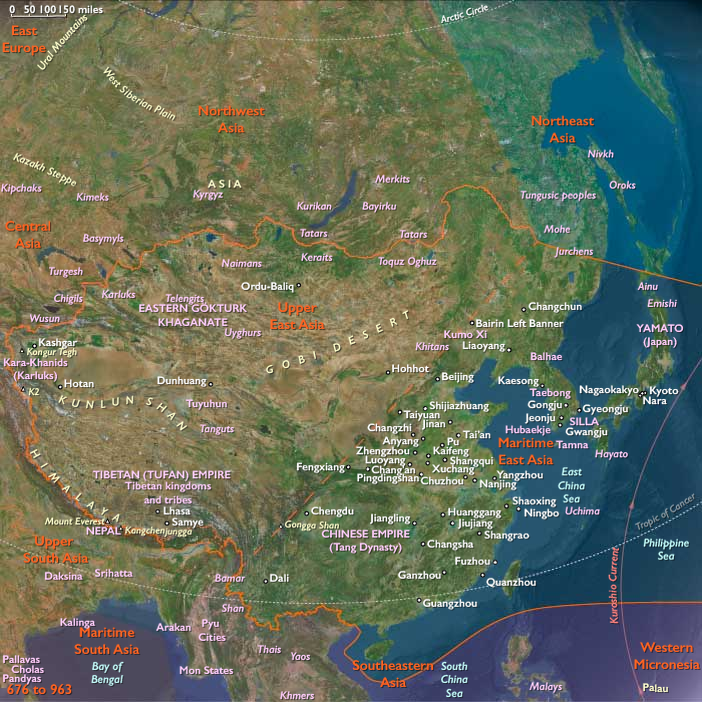
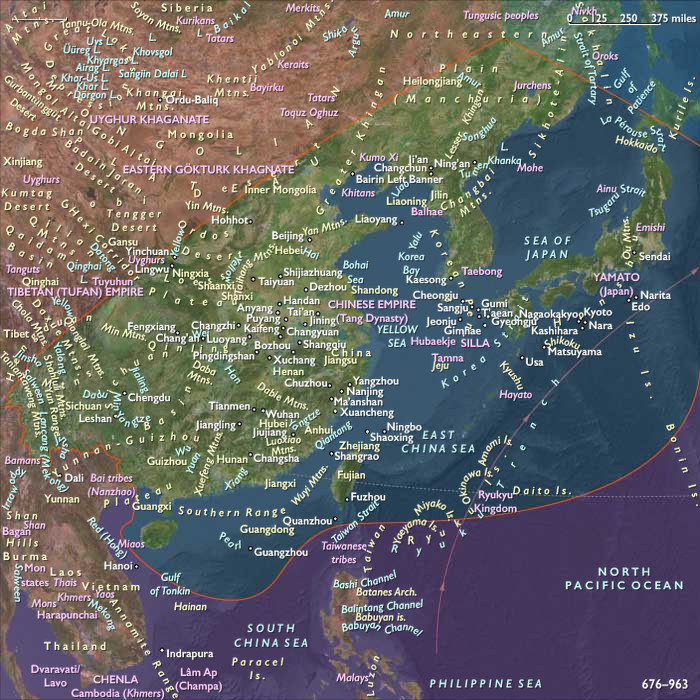
Between 676 CE and 819 CE, Maritime East Asia—comprising lower Primorsky Krai, the Korean Peninsula, the Japanese Archipelago below northern Hokkaido, Taiwan, and southern, central, and northeastern China—experiences significant political stabilization, cultural flowering, and administrative refinement.
Tang Dynasty Stability and Cultural Achievements
China’s Tang Dynasty (618–907), despite facing the severe An Lushan Rebellion and subsequent weakening of central authority in the late eighth century, continues to be marked overall by significant cultural and technological advancements. During this period, Chinese ceramic ware shows the earliest evidence of cobalt use, highlighting advancements in craftsmanship and material technology.
The Tang period remains a cultural pinnacle, demonstrating extraordinary literary, artistic, and scholarly achievements. The Tang capital at Chang'an continues to thrive as a cosmopolitan hub of international trade, cultural exchange, and intellectual pursuit, solidifying China's historical role as a major civilizational center.
Consolidation and Cultural Prosperity in Japan
In Japan, imperial and bureaucratic reforms initiated during earlier periods are further consolidated in 701 with the establishment of the Taiho-ryoritsu (Taiho Code). This code, influenced by Confucian and Chinese models, introduces refined penal provisions, administrative structuring, and civil service examination systems based on Confucian classics. Although designed for merit-based governance, aristocratic lineage remains dominant for high positions.
The reforms establish a permanent imperial capital at Heijokyo (Nara) in 710, modeled on China's Tang capital, Chang'an. Nara quickly becomes Japan's first true urban center, with a population reaching approximately two hundred thousand, including a large bureaucratic class of civil servants. This capital shift marks the beginning of the culturally rich Nara period (710–794), during which Chinese cultural influences permeate deeply into Japanese society, politics, and religion.
The Flourishing of Balhae in Korea and Manchuria
North of the Korean Peninsula, the kingdom of Balhae emerges as a prominent state, strongly influenced by Tang China's political structure and cultural practices. Balhae actively engages in educational exchanges with Tang China, sending students to learn from Tang institutions, which significantly shapes its administrative systems and cultural identity. Recognized by China as a "flourishing land in the East," Balhae develops a sophisticated civilization that blends indigenous practices with Chinese influences.
Silla’s Golden Age
On the Korean Peninsula, Unified Silla experiences its golden age after consolidating control over most of the peninsula. The period sees extensive urban development, administrative standardization, and flourishing Buddhist art and architecture, reflecting the broader East Asian cultural milieu of the era. Silla maintains diplomatic ties with Tang China and Japan, facilitating vibrant cultural and commercial exchanges throughout Lower East Asia.
Legacy of the Age: A Period of Integration and Advancement
The era from 676 to 819 CE is defined by political stabilization, administrative sophistication, and cultural flourishing across Maritime East Asia. Through sustained exchanges and shared influences, China, Korea, and Japan each experience profound developments that shape their respective cultural and historical trajectories, setting foundations for subsequent regional dynamics.
People
Groups
- Buddhism
- Buddhists, Zen or Chán
- Chinese Empire, Tang Dynasty
- Japan, Yamato Hakuho (Late Asuka) Period
- Silla, Unified or Later
- Balhae (Bohai, or Pohai), Kingdom of
Topics
Subjects
Regions
Subregions
Years: 676 - 819
People
Groups
- Buddhism
- Buddhists, Zen or Chán
- Chinese Empire, Tang Dynasty
- Japan, Yamato Hakuho (Late Asuka) Period
- Silla, Unified or Later
- Balhae (Bohai, or Pohai), Kingdom of
Topics
Subjects
Regions
Subregions