
Upper East Asia (49,293 – 28,578 BCE): …
Years: 49293BCE - 28578BCE
Upper East Asia (49,293 – 28,578 BCE): Steppe–Taiga Frontiers and Riverine Corridors
Geographic and Environmental Context
-
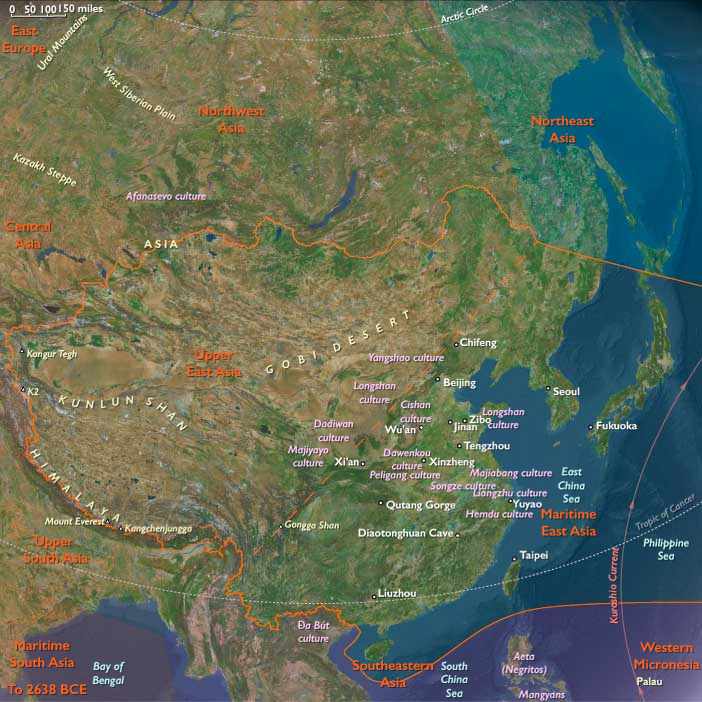
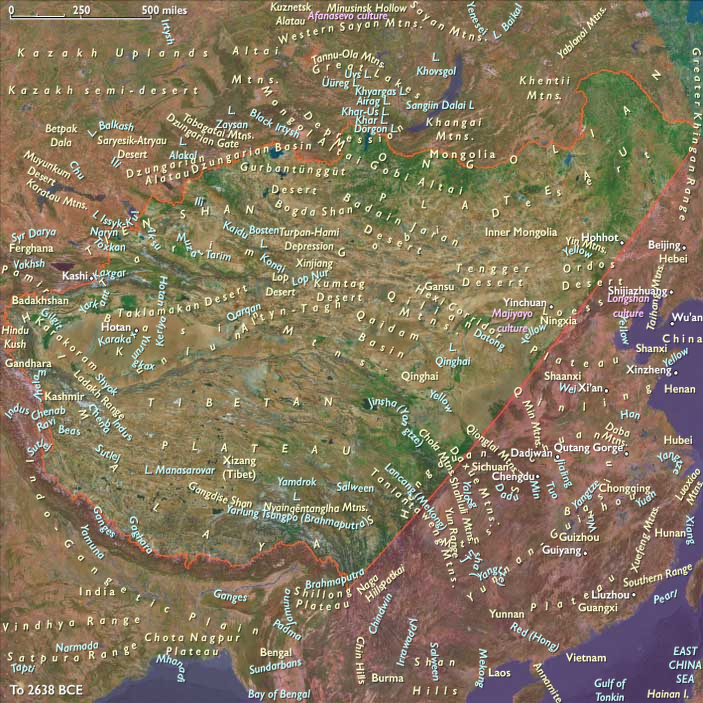
This region spans high, cold plateaus (Mongolia), riverine lowlands (Amur, Sungari, Liao), and coastal zones along the Sea of Japan/East Sea.
-
During this period, sea levels ~60–90 m lower widened coastal plains in Primorye and narrowed straits between Sakhalin, Hokkaidō, and the mainland.
-
The land bridge between the Korean Peninsula and southwestern Japan was narrower but still a significant barrier, crossed only intermittently.
Climate and Environmental Shifts
-
Dansgaard–Oeschger warm phases brought modest summer warming, allowing expansion of meadow-steppe and scattered forest patches in lowlands.
-
Heinrich stadials were cold and dry, expanding open steppe and tundra across Mongolia and northern Manchuria; permafrost zones advanced southward.
-
Winters were long and severe; summers were short but could support rich grassland growth in river valleys.
-
The Amur basin remained a relatively milder corridor compared to the upland plateaus.
Subsistence and Settlement
-
Steppe foragers hunted wild horse, saiga, gazelle, and red deer; used river valleys for fishing and plant gathering in the warmer months.
-
Forest–edge groups took elk, moose, and boar; collected nuts and berries in interstadials.
-
Seasonal movements followed ungulate migrations, often along river systems.
-
Coastal foragers exploited shellfish, anadromous fish (e.g., salmon runs), and marine mammals in ice-free seasons.
Technology and Material Culture
-
Widespread microblade technology in the north and east, suited to composite hunting weapons for mobile steppe and forest hunting.
-
Larger flake tools persisted in some southern zones alongside blades and scrapers.
-
Stone raw materials included fine-grained chert, jasper, and volcanic rock; obsidian sources in the Russian Far East were already in use.
-
Ochre use is attested in some cave and open-air sites; personal ornaments from bone, tooth, and shell.
Movement and Interaction Corridors
-
Amur and Liao river systems acted as north–south migration and exchange routes, linking taiga and steppe populations.
-
Coastal corridor along the Sea of Japan/East Sea connected Primorye to southern Korea and possibly to the southern Japanese islands during favorable crossings.
-
Mountain passes in the Greater and Lesser Khingan ranges provided east–west movement during milder summers.
Cultural and Symbolic Expressions
-
Beads, pendants, and ochre suggest symbolic life was well developed, possibly linked to group identity and seasonal aggregation.
-
Rock shelters with hearths and artifact scatters indicate repeated occupation during favorable seasons.
Environmental Adaptation and Resilience
-
Seasonal mobility between upland hunting grounds and lowland refugia buffered against extreme winter scarcity.
-
Use of both terrestrial and aquatic resources diversified diets.
-
Clothing and shelter technology adapted to cold conditions was crucial, with microblade points likely used in fur processing.
Toward the Last Glacial Maximum
By 28,578 BCE, Upper East Asian foragers were fully adapted to a cold, highly seasonal environment, combining microblade weaponry, long-distance mobility, and social exchange networks to endure increasingly harsh glacial conditions.
Topics
Commodoties
Subjects
Regions
Subregions
Related Events
Showing 10 events out of 69706 total
Years: 49293BCE - 28578BCE
Topics
Commodoties
Subjects
Regions
Subregions