
Maritime East Asia (333–190 BCE): Qin Unification …
Years: 333BCE - 190BCE
Maritime East Asia (333–190 BCE): Qin Unification and Philosophical Consolidation
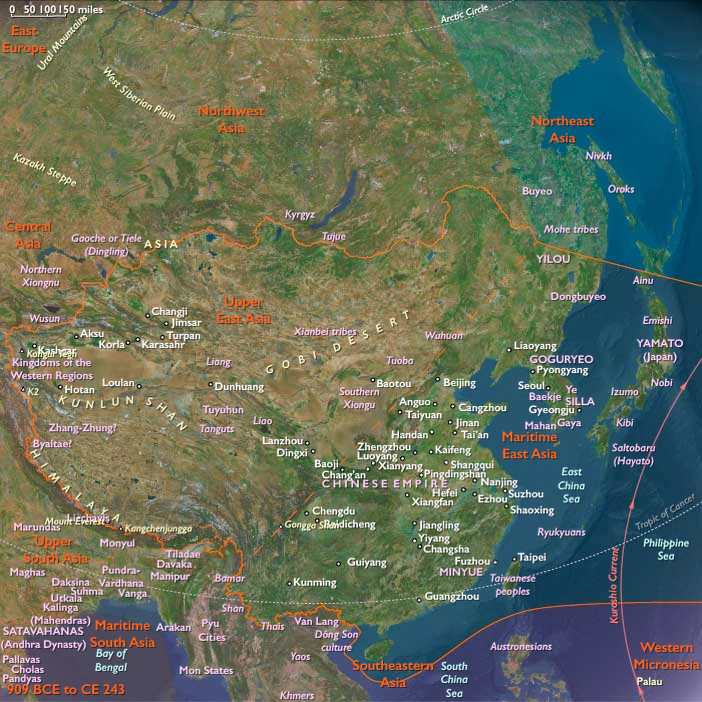
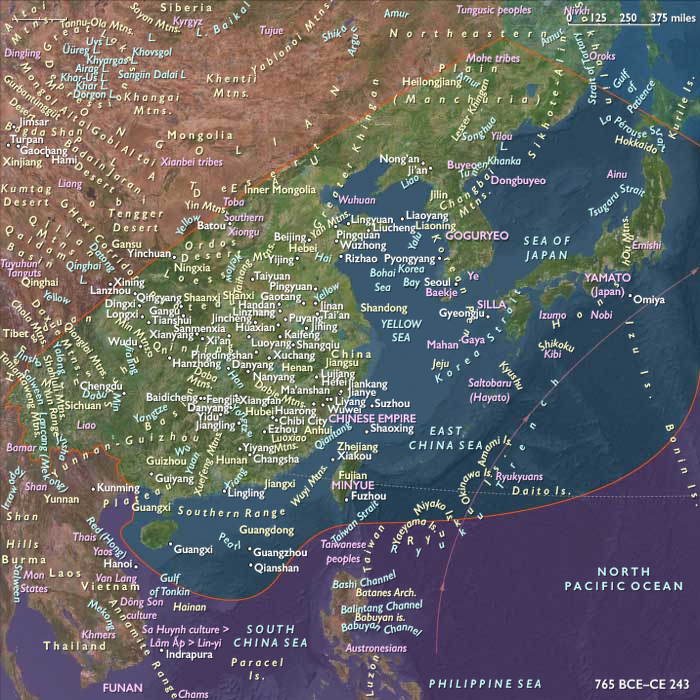
Between 333 BCE and 190 BCE, Maritime East Asia—comprising lower Primorsky Krai, the Korean Peninsula, the Japanese Archipelago below northern Hokkaido, Taiwan, and southern, central, and northeastern China—experiences transformative political unification under the Qin dynasty and significant philosophical and technological developments, setting the stage for imperial China.
Qin Unification and Imperial Foundations
In 221 BCE, the western frontier state of Qin achieves dominance, subjugating the rival Warring States and uniting much of what becomes China Proper. The victorious Qin ruler takes the unprecedented title of Shi Huangdi (First Emperor), centralizing administration through a bureaucratic system that replaces hereditary rule. The Qin empire standardizes legal codes, writing systems, currency, and administrative practices, creating a unified state apparatus.
To consolidate power, the Qin emperors ruthlessly suppress dissent, persecuting Confucian scholars, destroying Confucian texts, and exiling or executing dissidents. Military campaigns expand territorial control northward and southward, while the defensive walls of former states are unified into an extensive fortification, forming the precursor to the Great Wall. Despite these achievements, Qin rule is short-lived; following Shi Huangdi's death in 210 BCE, widespread revolts topple the dynasty by 206 BCE. Nevertheless, the centralized imperial structure established by the Qin endures, influencing Chinese governance for the next two millennia.
Legalism and the State
The Qin dynasty’s consolidation relies heavily on the Legalist philosophy, formulated by Han Feizi and Li Si, who emphasize the inherently selfish nature of humans and advocate strict laws and centralized power as the sole means to maintain social order. Legalism prioritizes state strength, military prowess, and administrative efficiency over individual welfare, becoming the philosophical backbone of the Qin government. Elements of Legalism, combined with Confucian ethics, later underpin the Han dynasty's enduring governmental framework.
Philosophical Traditions and Cultural Developments
Concurrent with Qin's political centralization, philosophical traditions from the Warring States period mature and diversify:
-
Taoism (Daoism), articulated by legendary figures such as Lao Zi and later Zhuang Zi, emphasizes harmony with nature and individual adjustment to the universal Way (dao).
-
The Yin-Yang and Five Elements philosophy emerges prominently, explaining cosmic and natural phenomena through complementary dualities and elemental interactions, significantly impacting both scholarly and popular thought.
-
Mohism, founded by Mo Zi (Mo Di), promotes universal love, pacifism, utilitarianism, and strict social order. Though less dominant, Mohist thought leaves a lasting imprint on Chinese intellectual traditions.
Confucianism continues to evolve, with scholars such as Xunzi presenting a contrasting view to Mencius, arguing for humanity’s inherent selfishness and advocating education and strict authority to achieve social order.
Technological Innovations
Technological developments include early Chinese alchemists experimenting with mercury in attempts at metal transmutation, and notable advancements in mathematics and astronomy. The Zhou Bi Suan Jing, a pivotal mathematical text, emerges during this era, featuring astronomical calculations and providing one of the earliest proofs of the Gougu theorem (Pythagorean theorem). It also calculates an early value of pi, reflecting a sophisticated understanding of geometry and mathematics.
Cultural Influence in Korea
In the Korean Peninsula, archaeological findings from sites like Kŭmtan-ni near modern Pyongyang reveal extensive prehistoric occupation dating back to pottery cultures (Chŭlmun and Mumun periods). Pyongyang itself rises as a significant city during this era under the Gojoseon kingdom, historically identified as the capital Asadal (Wanggomsŏng), highlighting early Korean civilization’s roots.
Legacy of the Age: Foundations for Imperial China
Thus, the age from 333 to 190 BCE is characterized by Qin’s decisive political unification, foundational legalist doctrines, vibrant philosophical traditions, and notable technological advancements. These developments lay critical groundwork for the imperial era of Chinese history, influencing governance, philosophy, and culture profoundly for generations.
People
Groups
Topics
Subjects
Regions
Subregions
Years: 333BCE - 190BCE
People
Groups
Topics
Subjects
Regions
Subregions