
Maritime East Asia (100–243 CE): Decline of …
Years: 100 - 243
Maritime East Asia (100–243 CE): Decline of Han Dynasty and Increasing Turbulence
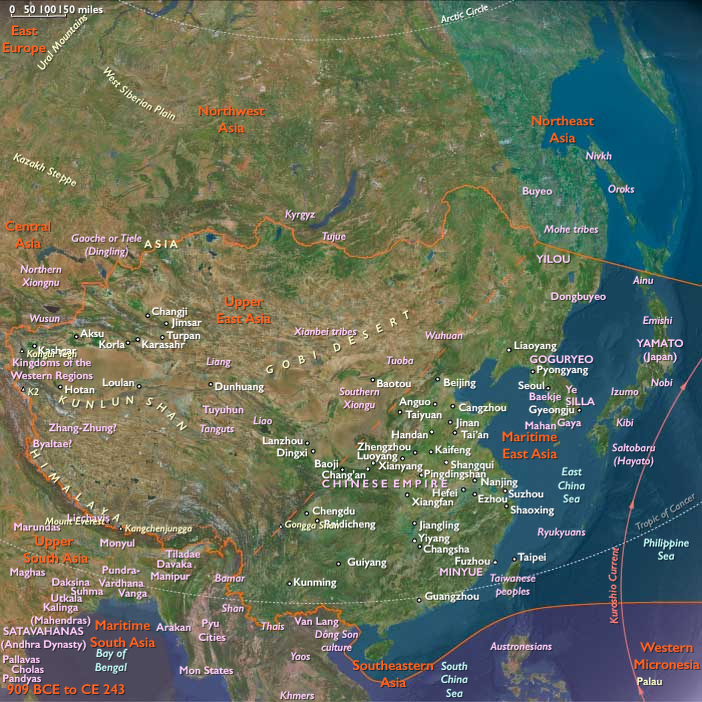
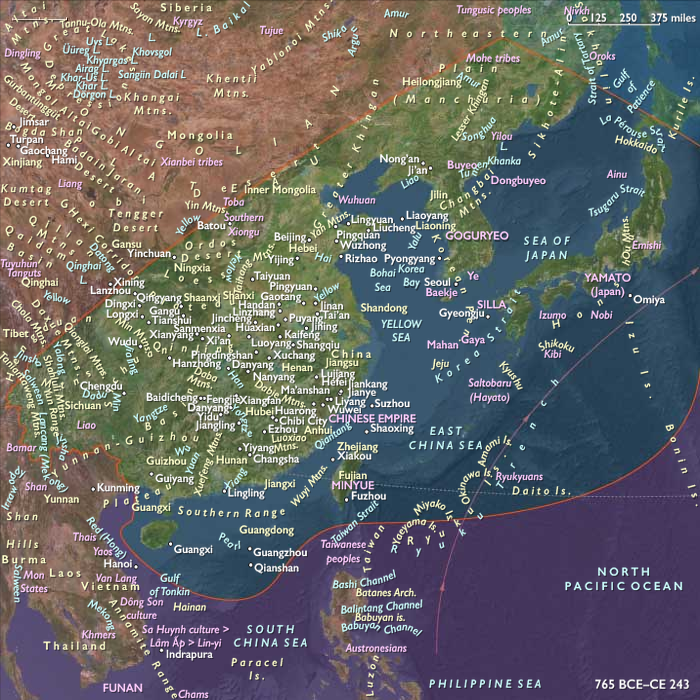
Between 100 CE and 243 CE, Maritime East Asia—comprising lower Primorsky Krai, the Korean Peninsula, the Japanese Archipelago below northern Hokkaido, Taiwan, and southern, central, and northeastern China—faces mounting internal struggles, administrative breakdown, and rebellions that mark the decline and eventual collapse of the Han dynasty.
Continued Han Rule and Increasing Strains
After a brief interruption by Wang Mang's Xin Dynasty (9–24 CE), the Han dynasty had been restored and continues for nearly two centuries more. However, the restored Han rulers struggle to manage a vastly expanded population, increasing economic wealth paired with financial instability, and increasingly complex bureaucratic and political institutions. Administrative corruption spreads widely, a classic symptom of dynastic decline.
Peasant and Taoist Rebellions
Persistent dissatisfaction among peasants leads to widespread agrarian rebellions, exacerbating the empire's instability. Taoist-inspired movements, notably the Yellow Turban Rebellion, challenge Han authority, advocating egalitarian ideals and drawing massive popular support, further weakening imperial governance and draining critical resources from central authority.
Fragmentation and Collapse
The cumulative effect of internal corruption, administrative inefficiency, and recurrent rebellions severely undermines the Han dynasty's stability. By 220 CE, the Han Empire formally collapses, fragmenting into several competing states. This collapse ushers in the Three Kingdoms Period, profoundly altering China's political and social landscape for centuries.
Legacy of the Age: Transition and Fragmentation
Thus, the age from 100 to 243 CE is characterized by mounting administrative strain, widespread popular discontent, and internal rebellions culminating in the definitive collapse of the Han dynasty. These events set the stage for a prolonged period of fragmentation, warfare, and eventual reorganization that reshapes East Asian political dynamics.
People
Groups
- Taoism
- Chinese Empire, Tung (Eastern) Han Dynasty
- Cao Wei, (Chinese) kingdom of
- Shu Han (minor Han), (Chinese) kingdom of
- Wu, Eastern, (Chinese) kingdom of
Topics
Subjects
Regions
Subregions
Years: 100 - 243
People
Groups
- Taoism
- Chinese Empire, Tung (Eastern) Han Dynasty
- Cao Wei, (Chinese) kingdom of
- Shu Han (minor Han), (Chinese) kingdom of
- Wu, Eastern, (Chinese) kingdom of
Topics
Subjects
Regions
Subregions