
Maritime East Asia (2349–2206 BCE): Legendary Flood, …
Years: 2349BCE - 2206BCE
Maritime East Asia (2349–2206 BCE): Legendary Flood, Sage-Kings, and the Foundation of Gojoseon
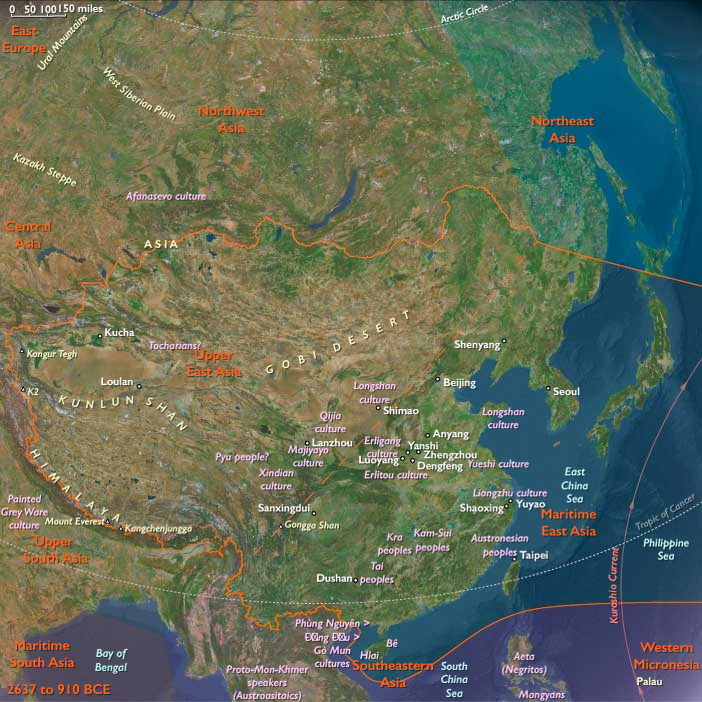
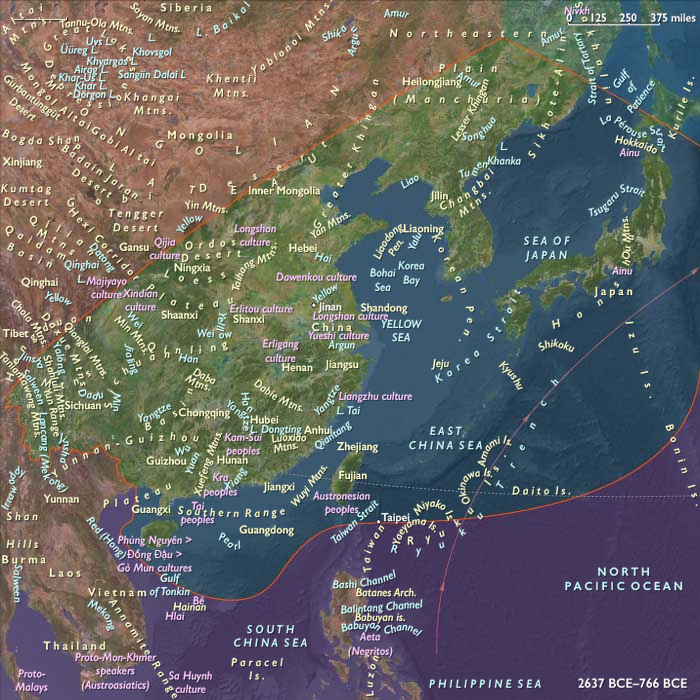
Between 2349 BCE and 2206 BCE, Maritime East Asia—comprising lower Primorsky Krai, the Korean Peninsula, the Japanese Archipelago below northern Hokkaido, Taiwan, and southern, central, and northeastern China—enters an era dominated by legendary events and seminal myths that profoundly influence later historical and cultural identities. This period prominently features China’s foundational legends of the Great Flood, the virtuous reigns of the mythical sage-kings Yao and Shun, the rise of Yu the Great, early jade culture, and the mythical establishment of the Korean kingdom of Gojoseon.
The Legendary Great Flood of China
A pivotal event of this era is the legendary Great Flood of China, traditionally dated to the third millennium BCE during the reign of Emperor Yao. According to Confucian historical texts, notably the Classic of History (Shu Jing)and the writings of the historian Sima Qian, the flood devastates extensive areas, inundating both the Yellow (Huang He) and Yangtze (Chang Jiang) river valleys. Catastrophic flooding, accompanied by severe storms and widespread famine, continues unabated for years, causing massive population displacement and social turmoil.
Initially, a figure named Kun attempts to control the floodwaters by constructing dams and barriers. However, Kun’s efforts fail disastrously, leading Emperor Yao to execute him for incompetence. Kun’s son, Yu—later revered as Yu the Great—adopts innovative, natural methods by creating extensive drainage channels that successfully redirect floodwaters into the sea, ultimately stabilizing the environment and restoring productivity.
Reigns of Legendary Sage-Emperors Yao and Shun
Emperor Yao, traditionally reigning from approximately 2356 BCE to 2255 BCE, is venerated in later Confucian literature as the ideal sage-king, embodying benevolence, moral perfection, and civic virtue. Yao’s reign becomes a model for subsequent Chinese rulers, exemplifying enlightened governance. Among Yao's attributed accomplishments is the legendary invention of the strategic board game Weiqi (Go), reportedly developed to positively influence his unruly son, Danzhu.
In Confucian tradition, Yao, recognizing the unworthiness of his son Danzhu, instead chooses the morally exemplary Shun as his successor. Shun’s ascent to rulership is justified by his exceptional virtue and exemplary filial piety, despite personal adversity and familial mistreatment. Yao cements this selection by marrying his two daughters to Shun. After Yao’s death—at age 119 according to tradition—Shun formally becomes emperor following a customary three-year mourning period.
Alternative accounts, notably those presented in the Bamboo Annals, offer differing narratives, claiming Shun rebels against Yao, imprisoning him and causing his death, exiling Danzhu, and consolidating power by force. Nonetheless, mainstream Confucian historiography maintains Shun as the virtuous and rightful heir.
As emperor, Shun (reigning from 2255 BCE) emphasizes governance based on merit rather than hereditary privilege, becoming another revered model of ethical rulership in Chinese culture. Eventually, Shun designates Yu the Great—the celebrated flood-tamer—as his successor, further solidifying the principle of meritocracy. Yu’s accession will lay foundations for the establishment of China’s earliest dynasty (Xia Dynasty) after 2070 BCE.
Early Chinese often speak of Yao, Shun, and Yu as historical figures, though contemporary historians generally interpret them as symbolic leader-chiefs representing transitional governance from tribal alliances to structured societies with hierarchical, patriarchal systems.
Foundation Myth of Gojoseon (2333 BCE)
Meanwhile, on the Korean Peninsula, traditional legend holds that Dangun Wanggeom establishes the first Korean kingdom, Gojoseon (Choson), in 2333 BCE. This foundational myth, recorded centuries later in Korean historical texts such as the Samguk Yusa (13th century) and Jewang Ungi, associates Dangun’s ascension closely with the reign of China’s Emperor Yao. Historical sources offer varying specific dates: Samguk Yusa places Dangun’s rule beginning in the fiftieth year of Yao’s reign, while Sejong Sillok and Dongguk Tonggam suggest alternative timing. Some historians even argue for a much earlier foundation around 3000 BCE.
Gojoseon’s establishment myth profoundly shapes Korean cultural identity, linking Korean origins symbolically to broader regional historical narratives and enhancing a shared cultural heritage in Lower East Asia.
Early Jade Culture and Regional Artistry
Concurrently, jade carving traditions continue to flourish across China, reflecting significant cultural and artistic continuity from earlier Neolithic periods. Jade remains culturally prominent, with primary ancient nephrite jade sources, such as those in the Ningshao region (Yangtze River Delta, Liangzhu Culture, ca. 3400–2250 BCE) and Liaoning Province (Hongshan Culture, ca. 4700–2900 BCE), influencing regional artisanal styles. During this era, jade artifacts typically exhibit simplicity, with minimal ornamentation reflecting early artistic styles and spiritual symbolism deeply ingrained in regional cultural practices.
Legacy of the Era: Legends Shaping Cultural Identity
Thus, the period 2349–2206 BCE profoundly shapes Maritime East Asia’s early historical narrative, blending legendary sagas, foundational myths, and cultural symbolism. China's Great Flood legend, combined with accounts of virtuous sage-emperors Yao and Shun, embeds enduring moral and social principles that define subsequent Chinese political philosophy. Korea’s Gojoseon legend establishes a foundational cultural identity that resonates deeply in Korean history, while regional jade craftsmanship preserves early cultural continuity across East Asia.
Collectively, these legendary narratives, myths, and artistic practices serve as powerful cultural and historical symbols, profoundly influencing subsequent historical interpretations and cultural identities in Lower East Asia throughout subsequent eras.
People
Groups
- Liangzhu culture
- Longshan culture
- China, archaic (Three Sovereigns and Five Emperors)
- Gojoseon (Choson)
Topics
Commodoties
Subjects
Regions
Subregions
Years: 2349BCE - 2206BCE
People
Groups
- Liangzhu culture
- Longshan culture
- China, archaic (Three Sovereigns and Five Emperors)
- Gojoseon (Choson)
Topics
Commodoties
Subjects
Regions
Subregions