
Maritime East Asia (388–531 CE): Consolidation of …
Years: 388 - 531
Maritime East Asia (388–531 CE): Consolidation of States, Cultural Flourishing, and Technological Advancements
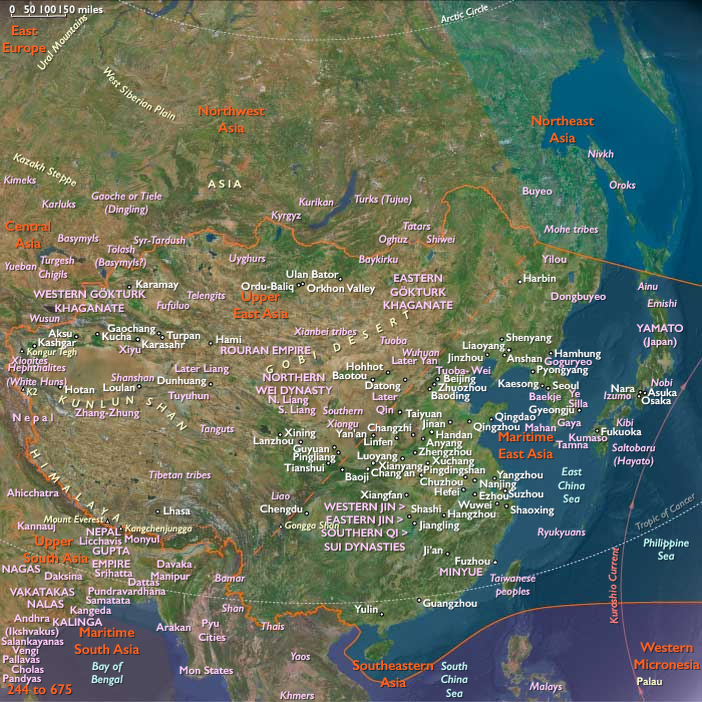
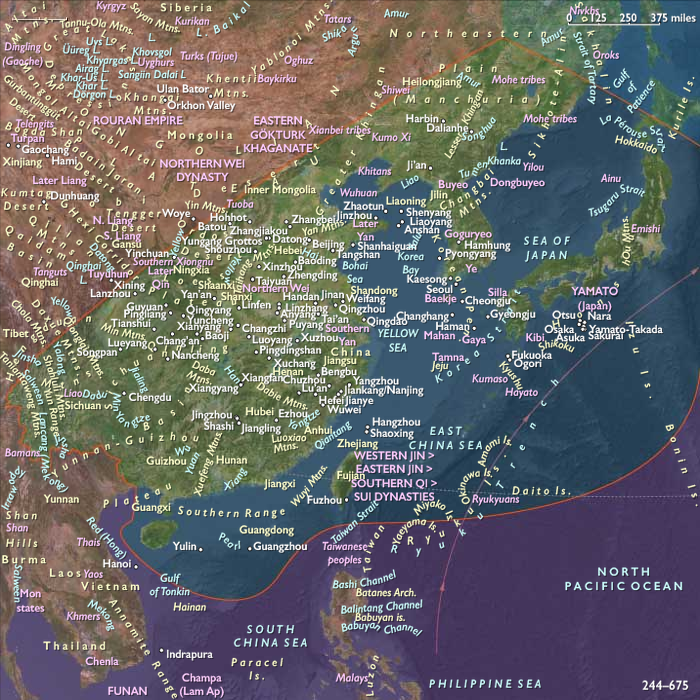
Between 388 CE and 531 CE, Maritime East Asia—comprising lower Primorsky Krai, the Korean Peninsula, the Japanese Archipelago below northern Hokkaido, Taiwan, and southern, central, and northeastern China—witnesses the consolidation of major kingdoms, cultural flourishing, and important technological innovations.
Consolidation and Expansion in Korea: Silla, Baekje, and Goguryeo
Silla, evolving from the walled town of Saro, is consolidated under King Naemul (r. 356–402), establishing a hereditary monarchy east of the Naktong River. By the early sixth century, Silla significantly advances agricultural productivity through oxen plowing and extensive irrigation, enabling greater political stability and cultural development. In 520 CE, an administrative code is adopted, followed by Buddhism becoming the state religion around 535 CE. The bone-rank system emerges, codifying an aristocratic social hierarchy where status and lineage are paramount.
Baekje, after successfully repelling an attack from the Chinese-held region of Lelang in 246 CE, maintains its influential aristocratic state structure, integrating Buddhism officially as the state religion in 384 CE under royal patronage.
Goguryeo, a formidable northern power, continues expansion into Lelang and the broader Korean Peninsula. Its geographic position, marked by harsh climates and mountainous terrain, strengthens its distinct cultural identity, later emphasized in North Korean historiography.
The Gaya Confederacy, consisting of states along the south-central peninsula, maintains close ties with Japan but is eventually absorbed by Silla, despite Japanese military intervention on Gaya’s behalf in 399 CE.
The Yamato Polity and Aristocratic Transformation in Japan
In Japan, the Yamato polity emerges prominently in the mid-Kofun period, defined by influential great clans. Clan patriarchs perform sacred rites to ensure welfare, with a hereditary aristocracy beginning to replace tribal leadership structures. Aristocratic status increasingly determines political influence, shifting power dynamics away from purely clan-based hierarchies.
Political Fragmentation and Cultural Flourishing in China
China experiences continued political fragmentation during the Sixteen Kingdoms (304–439 CE) and the subsequent Southern and Northern Dynasties period (420–589 CE). Despite persistent warfare and instability, this era is culturally vibrant, characterized by advancements in art, science, and religion.
Significant technological innovations include the widespread adoption of the stirrup by 477 CE, enhancing military effectiveness. Additionally, Chinese architecture evolves distinctly, with the development of the pagoda, derived from Buddhist stupa traditions, becoming prominent for housing Buddhist scriptures.
Buddhism and Cultural Exchange
Buddhism spreads widely across China, notably through the influential translations by Kumarajiva, facilitating its integration into Chinese society. By the late fifth century, the distinct Ch’an (Zen) Buddhism emerges prominently, attributed to the teachings of Bodhidharma, emphasizing contemplative meditation as a pathway to enlightenment.
Artistic and Architectural Achievements
Monumental stone sculpture flourishes, exemplified by the Yungang Grottoes near Pingcheng (modern-day Datong). Under imperial patronage of the Northern Wei Dynasty, the caves house immense rock-cut Buddha sculptures, showcasing Central Asian artistic influences. This monumental art form persists through imperial and private support until political upheavals halt further construction by 525 CE.
Legacy of the Age: State Consolidation and Cultural Innovation
Thus, the age from 388 to 531 CE is marked by significant state consolidation, particularly in Korea and Japan, combined with cultural and technological innovations across East Asia. These developments lay foundational structures influencing political, social, and cultural trajectories well into subsequent centuries.
People
Groups
- Buddhism
- Japan, Yayoi Period
- Silla, Kingdom of
- Baekje (or Paekche), Kingdom of
- Di (Wu Hu)
- Goguryeo (Koguryo), Kingdom of
- Gaya confederacy
- Chinese Empire, Tung (Eastern) Jin Dynasty
- Northern Liang, Chinese/Xiongnu state of
- Western Liang, Han Chinese kingdom of
- Huan Xuan, Han Chinese “Empire” of
- Northern Yan, Chinese/Xianbei “Empire” of
- Western Shu, Han Chinese state of
- Buddhists, Zen or Chán
- Southern Qi (Chinese dynasty )
- Liang Dynasty, Southern (Chinese dynasty)
Topics
- Three Kingdoms of Korea
- Six Dynasties Period in China
- Migration Period
- Sixteen Kingdoms Period in China
- Civil Wars in China triggered by the Wu Hu Invasion
- Migration Period Pessimum
Subjects
Regions
Subregions
Related Events
Showing 1 events out of 1 total
Years: 388 - 531
People
Groups
- Buddhism
- Japan, Yayoi Period
- Silla, Kingdom of
- Baekje (or Paekche), Kingdom of
- Di (Wu Hu)
- Goguryeo (Koguryo), Kingdom of
- Gaya confederacy
- Chinese Empire, Tung (Eastern) Jin Dynasty
- Northern Liang, Chinese/Xiongnu state of
- Western Liang, Han Chinese kingdom of
- Huan Xuan, Han Chinese “Empire” of
- Northern Yan, Chinese/Xianbei “Empire” of
- Western Shu, Han Chinese state of
- Buddhists, Zen or Chán
- Southern Qi (Chinese dynasty )
- Liang Dynasty, Southern (Chinese dynasty)
Topics
- Three Kingdoms of Korea
- Six Dynasties Period in China
- Migration Period
- Sixteen Kingdoms Period in China
- Civil Wars in China triggered by the Wu Hu Invasion
- Migration Period Pessimum
Subjects
Regions
Subregions