
Maritime East Asia (244–387 CE): Fragmentation, Cultural …
Years: 244 - 387
Maritime East Asia (244–387 CE): Fragmentation, Cultural Evolution, and Regional Realignments
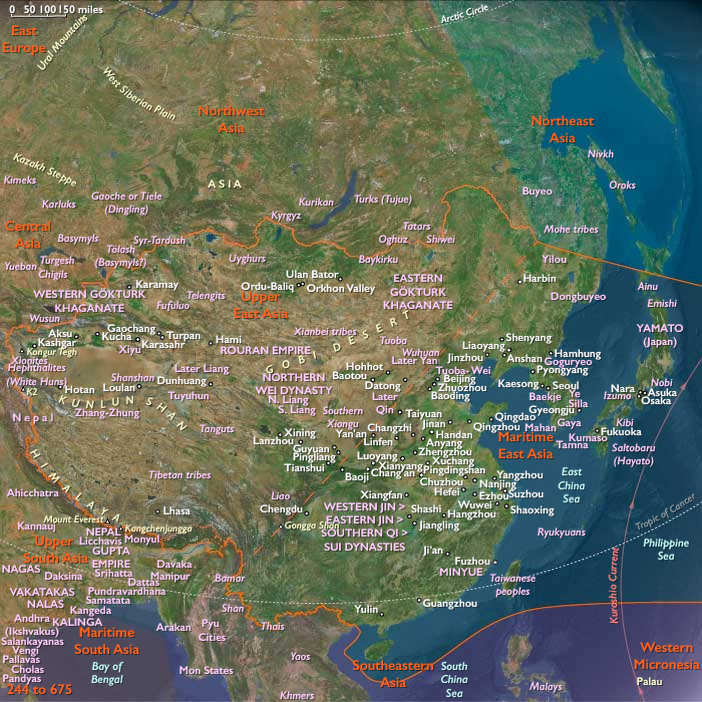
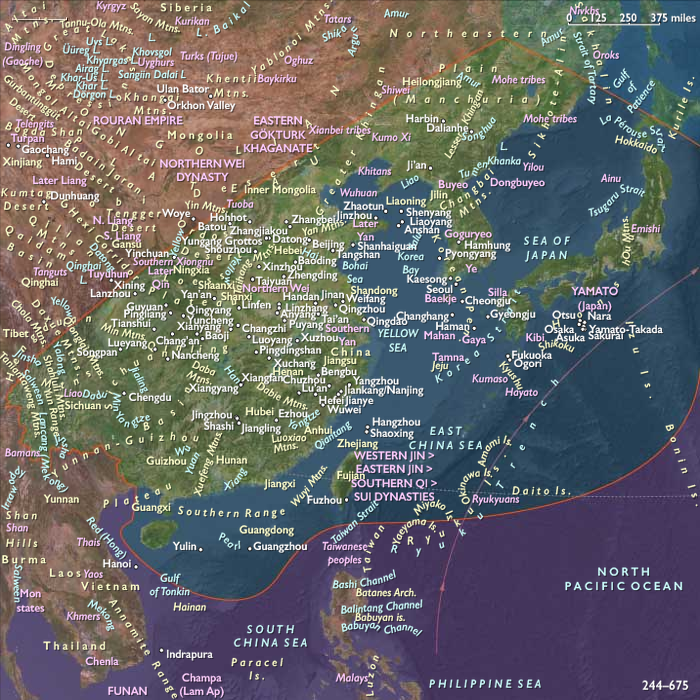
Between 244 CE and 387 CE, Maritime East Asia—comprising lower Primorsky Krai, the Korean Peninsula, the Japanese Archipelago below northern Hokkaido, Taiwan, and southern, central, and northeastern China—experiences profound political fragmentation, regional realignments, cultural evolution, and technological innovation following the collapse of the Han dynasty.
Fragmentation and the Rise of Regional Powers
The collapse of the Han dynasty ushers in nearly four centuries of fragmentation, beginning with the era of the Three Kingdoms (Wei, Shu, and Wu, 220–280 CE). While later romanticized for chivalry, this era is marked by widespread warfare. The brief reunification under the early Jin dynasty (265–420 CE) proves fragile, unable to withstand persistent invasions by northern nomadic groups.
Forced to flee from Luoyang in 317 CE, the Jin court relocates to Nanjing, signaling China's division into successive dynasties and kingdoms lasting until 589 CE. This period sees accelerated sinicization, as non-Chinese groups integrate culturally, notably accompanied by the spread of Buddhism, introduced in the first century CE.
Technological and Cultural Advancements
Despite political fragmentation, significant technological advancements occur. Innovations such as gunpowder(initially for fireworks), the wheelbarrow, and notable developments in medicine, astronomy, and cartography emerge during this turbulent period.
Developments in Korea: Baekje, Goguryeo, and Silla
On the Korean Peninsula, three powerful states emerge: Baekje in the southwest, Goguryeo in the north, and Silla in the southeast.
Baekje, known for its centralized aristocratic structure, emerges strongly by 246 CE, aggressively expanding northward. Its King Kun Ch'ogo (r. ca. 346–375) establishes a lasting royal succession tradition, and in 384 CE, Buddhism is officially adopted as the state religion.
Goguryeo, initially developed near the Yalu River, expands significantly, conquering the Chinese-held region of Lelang in 313 CE. Situated in rugged terrain and harsh climates, Goguryeo becomes a major regional power, heavily influencing Korean history and identity, particularly as claimed by modern North Korea.
Silla, with its capital at Kyongju, becomes known for its cultural richness. The ruling elites from Silla’s region will notably dominate South Korean political leadership in later historical periods, shaping its national historical narrative.
The Kofun Period in Japan
In Japan, the Kofun period represents a critical evolutionary stage toward state formation. Society flourishes particularly along the eastern Inland Sea, with Japanese military influence extending onto the southern Korean Peninsula. Early Japanese rulers actively seek and obtain diplomatic recognition from China. Chinese records from this period describe the Japanese (Wa) society as fragmented, yet increasingly centralized under powerful leaders like the famed queen Himiko of Yamatai, who maintains diplomatic relations with China’s Wei Dynasty (220–265 CE).
Influence of Migration: Wu Hu Tribes
The period witnesses significant migrations into China by various non-Chinese tribes collectively termed the Wu Hu (Five Hu). Initially pastoral nomads from the steppe regions, these tribes leverage the collapse of central authority to settle extensively in the fertile North China Plain, reshaping the region’s demographic and cultural landscape.
Legacy of the Age: Political Realignment and Cultural Foundations
Thus, the age from 244 to 387 CE is characterized by political fragmentation, significant cultural evolution, and regional realignments. Despite instability, this era establishes enduring cultural and political foundations, significantly influencing the historical trajectories of China, Korea, and Japan.
People
Groups
- Buddhism
- Japan, Yayoi Period
- Silla, Kingdom of
- Baekje (or Paekche), Kingdom of
- Di (Wu Hu)
- Chinese Empire, Tung (Eastern) Han Dynasty
- Goguryeo (Koguryo), Kingdom of
- Cao Wei, (Chinese) kingdom of
- Shu Han (minor Han), (Chinese) kingdom of
- Wu, Eastern, (Chinese) kingdom of
- Japan, Yamato Kofun Period
- Jin Dynasty, Western (265–317)
- Chinese Empire, Tung (Eastern) Jin Dynasty
Topics
- Three Kingdoms Period in China
- Six Dynasties Period in China
- Migration Period
- Sixteen Kingdoms Period in China
- Civil Wars in China triggered by the Wu Hu Invasion
Subjects
Regions
Subregions
Related Events
Showing 10 events out of 60511 total
Years: 244 - 387
People
Groups
- Buddhism
- Japan, Yayoi Period
- Silla, Kingdom of
- Baekje (or Paekche), Kingdom of
- Di (Wu Hu)
- Chinese Empire, Tung (Eastern) Han Dynasty
- Goguryeo (Koguryo), Kingdom of
- Cao Wei, (Chinese) kingdom of
- Shu Han (minor Han), (Chinese) kingdom of
- Wu, Eastern, (Chinese) kingdom of
- Japan, Yamato Kofun Period
- Jin Dynasty, Western (265–317)
- Chinese Empire, Tung (Eastern) Jin Dynasty
Topics
- Three Kingdoms Period in China
- Six Dynasties Period in China
- Migration Period
- Sixteen Kingdoms Period in China
- Civil Wars in China triggered by the Wu Hu Invasion
Subjects
Regions
Subregions