
Maritime East Asia (2205–2062 BCE): Agricultural Expansion, …
Years: 2205BCE - 2062BCE
Maritime East Asia (2205–2062 BCE): Agricultural Expansion, Cultural Decline, and the Birth of the Xia Dynasty
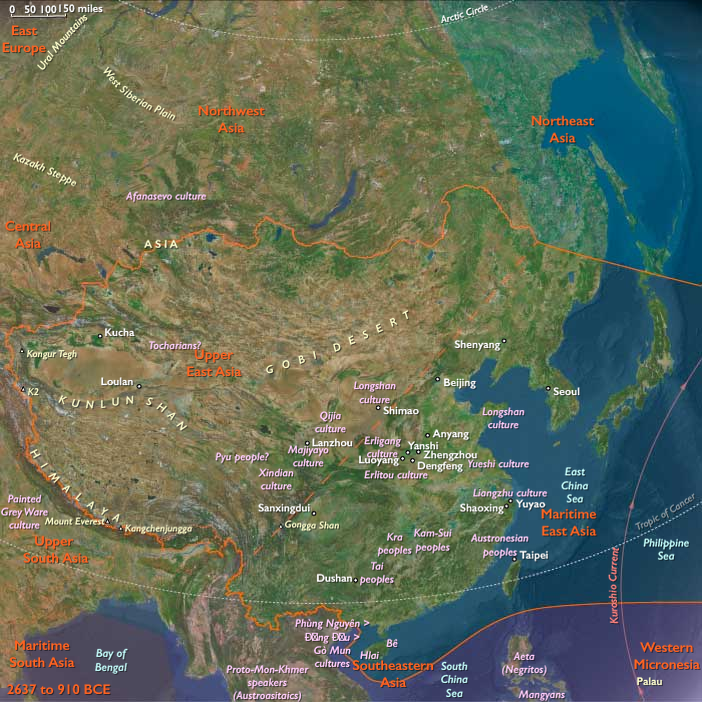
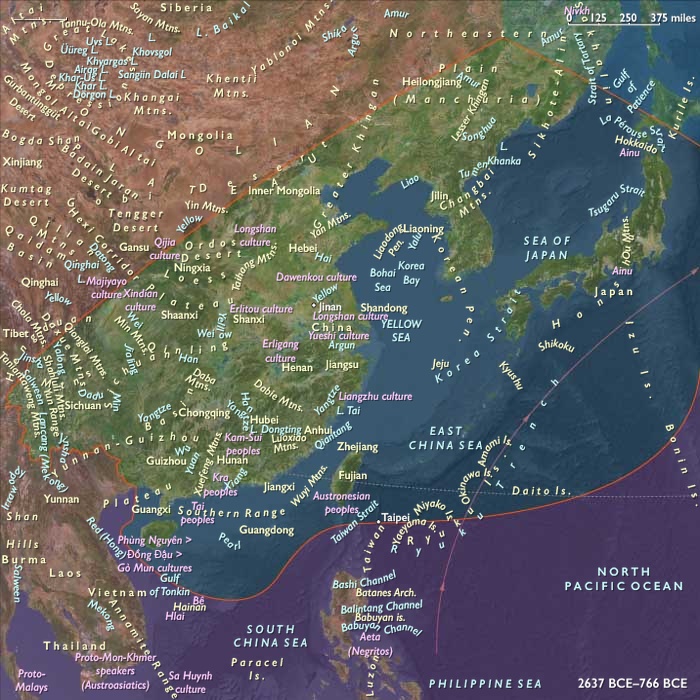
Between 2205 BCE and 2062 BCE, Maritime East Asia—comprising lower Primorsky Krai, the Korean Peninsula, the Japanese Archipelago below northern Hokkaido, Taiwan, and southern, central, and northeastern China—experiences crucial transformations marked by shifts in agricultural practices, climatic upheaval leading to cultural decline, and foundational events associated with legendary Chinese rulers. These developments notably include the agricultural practices of Korea's Middle Jeulmun period, the climatic challenges that cause the decline of China's flourishing Longshan culture, and the rise of legendary figures like Shun and Yu the Great, culminating in the establishment of China’s first hereditary dynasty, the Xia Dynasty.
Middle Jeulmun Agriculture on the Korean Peninsula
During Korea’s Middle Jeulmun period (ca. 3500–2000 BCE), agricultural practices gain importance as a supplement to traditional subsistence methods. Archaeological evidence from at least fourteen sites across the peninsula confirms early cultivation practices through finds such as carbonized plant remains and agricultural stone tools.
Notably, Dongsam-dong Shellmidden in southern Korea yields direct AMS radiocarbon dates for domesticated foxtail millet (Setaria italica ssp. italica), firmly placing its cultivation within this era (Crawford and Lee, 2003). Additional evidence, though somewhat controversial, emerges at Jitam-ri (Chitam-ni) in present-day North Korea. Here, excavations of pit-house structures yield carbonized grains described by local archaeologists as domesticated millet, although limitations in excavation methods and documentation leave room for scholarly debate.
Nevertheless, cultivation remains largely supplementary during this era. Subsistence in Korea continues heavily emphasizing deep-sea fishing, shellfish gathering, and hunting. Simultaneously, the distinctive "Classic Jeulmun" pottery, known locally as Bitsalmunui, develops, characterized by intricate comb-patterning, cord-wrapping, and decorative patterns covering entire vessel surfaces. This pottery is primarily identified in west-central and southern coastal Korea, reflecting regional cultural developments and the increasing complexity of Jeulmun societies.
Collapse of the Late Longshan Culture in China
In China, this period witnesses a dramatic demographic and cultural shift associated with a major climatic event, the 4.2 kiloyear BP aridification event (around 2200 BCE). The previously thriving Longshan culture—known especially for its refined black pottery and urbanizing settlements—faces severe environmental challenges, including drought, cooling climate, and declining agricultural productivity, particularly affecting the Yishu River Basin.
The resulting agricultural failures, notably impacting rice production, lead to substantial population reductions, societal fragmentation, and the disappearance of sophisticated ritual pottery characteristic of the Longshan tradition. Around 2000 BCE (4000 cal. yr BP), archaeological records show that Longshan settlements are gradually replaced by simpler, less sophisticated, and more fragmented cultural groups.
Legendary Chinese Rulers: Shun and Yu the Great
Concurrently, legendary historical narratives transmitted through later Confucian texts provide context for China’s social and political transformations. According to these traditions, the virtuous sage-emperor Shun rules during this time, symbolizing moral integrity and exemplary governance. Shun’s reign is credited with key administrative accomplishments, including standardizing weights and measures, organizing China into twelve administrative provinces, and regulating waterways and infrastructure projects.
Shun’s most significant legacy, however, is his choice of successor, Yu the Great—the celebrated hero famed for controlling the catastrophic flooding of previous decades. Yu is honored in later traditions as a foundational figure, renowned for his mastery of waterways and his pioneering role in early Chinese bronze technology. Cultural memory of Yu survives in rituals such as the Taoist Yu’s Step, a ritual dance commemorating the distinctive limp Yu reportedly developed due to his exhausting labors in flood control.
Establishment of the Xia Dynasty
Around 2070 BCE, according to Chinese literary tradition, Yu the Great officially establishes the Xia Dynasty, China’s first imperial dynasty characterized by hereditary succession. Named after Yu’s own Si clan, the Xia Dynasty symbolizes the crucial transition from tribal or collective leadership structures to formal, dynastic monarchy. Some early historical sources alternatively suggest the Xia Dynasty originated as a confederation of agricultural village leaders organized primarily for defense against northern nomadic intrusions from Mongolia and Manchuria.
Though modern historians debate the Xia Dynasty’s precise historical veracity, its cultural importance is undisputed. Yu’s reign, particularly his legendary founding acts—including organizing China into nine zhou (provinces) during meetings at Mount Miao—establishes an enduring template for subsequent Chinese imperial administration.
Legacy of the Era: Climatic Stress, Cultural Resilience, and Dynastic Foundations
Thus, the era 2205–2062 BCE represents a decisive turning point in Maritime East Asia’s historical and cultural trajectory. On the Korean Peninsula, early agricultural experimentation complements traditional subsistence strategies, signaling nascent complexity within Jeulmun societies. In China, environmental stress triggers the decline of the previously dominant Longshan culture, marking a pivotal cultural shift toward simpler, dispersed societies. Meanwhile, legendary sage-rulers Shun and Yu symbolize enduring models of governance, moral virtue, and technological innovation, culminating in the foundational legacy of China’s earliest recognized dynasty—the Xia.
These developments set critical precedents, profoundly shaping the social, political, and cultural foundations upon which future civilizations throughout Lower East Asia continue to build.
People
Groups
- Jeulmun culture
- Liangzhu culture
- Longshan culture
- China, archaic (Three Sovereigns and Five Emperors)
- Gojoseon (Choson)
- Chinese Kingdom, Xia Dynasty
Topics
- Subboreal Period
- Three Sovereigns and Five Emperors Period in China
- Abrolhos Transgression
- 4.2 kiloyear BP aridification event
Commodoties
Subjects
Regions
Subregions
Years: 2205BCE - 2062BCE
People
Groups
- Jeulmun culture
- Liangzhu culture
- Longshan culture
- China, archaic (Three Sovereigns and Five Emperors)
- Gojoseon (Choson)
- Chinese Kingdom, Xia Dynasty
Topics
- Subboreal Period
- Three Sovereigns and Five Emperors Period in China
- Abrolhos Transgression
- 4.2 kiloyear BP aridification event
Commodoties
Subjects
Regions
Subregions