
Maritime East Asia (1828–1971 CE): Dynastic Collapse, …
Years: 1828 - 1971
Maritime East Asia (1828–1971 CE): Dynastic Collapse, Imperial Encounters, and Industrial Revolutions
Geography & Environmental Context
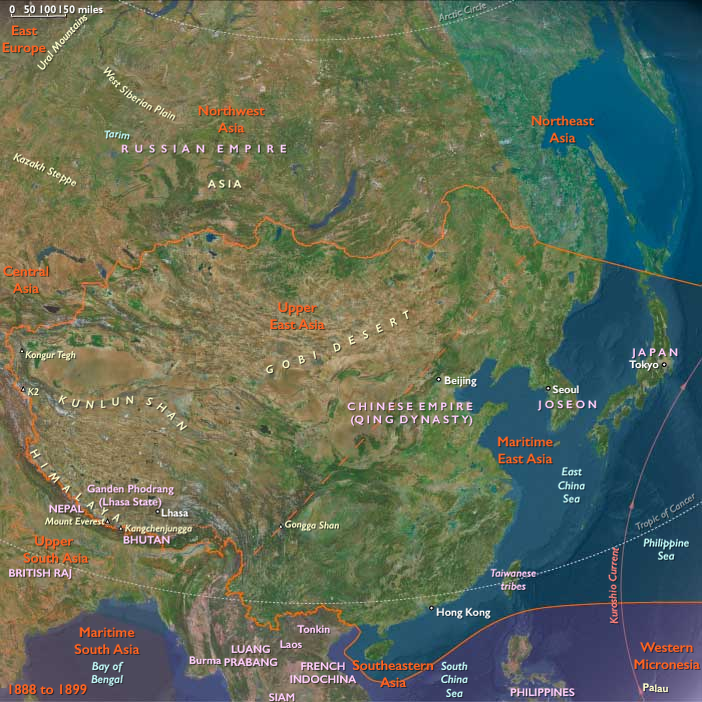
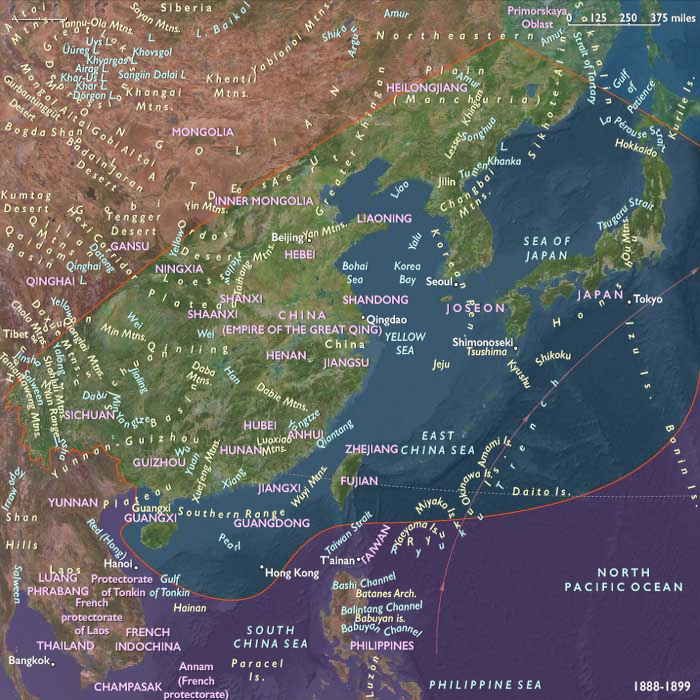
Maritime East Asia encompasses southern and eastern China (Yunnan, Guangxi, Guizhou, Sichuan Basin, Chongqing, Hunan, Hubei, Henan, Shanxi, Hebei, Beijing, Guangdong, Fujian, Zhejiang, Jiangsu, Shandong, Liaoning, Jilin, southern Heilongjiang), Taiwan, the Korean Peninsula, southern Primorsky Krai, and the Japanese islands of Kyushu, Shikoku, Honshu, and southwestern Hokkaidō, plus the Ryukyu and Izu island chains. Anchors include the Yangtze and Yellow River basins, the Sichuan Basin, the Pearl River Delta, the Korean mountains and Han River valley, and the Japanese archipelago stretching into the Pacific.
Climate & Environmental Shifts
The subregion’s monsoonal regime brought alternating floods and droughts. China’s Yellow River repeatedly shifted course (notably floods of 1855, 1931), devastating farmlands. Famines struck northern China and Korea in the 19th century; deforestation in uplands worsened soil erosion. Typhoons regularly battered Taiwan, Fujian, and the Ryukyu chain. Industrial urbanization in Japan, Korea, and later coastal China introduced pollution and new ecological strains by the mid-20th century.
Subsistence & Settlement
-
China: Rice dominated the south (Yangtze, Pearl deltas); wheat, millet, and sorghum fed the north. Tea, silk, and cotton underpinned commerce. Urban hubs like Beijing, Shanghai, Guangzhou, Wuhan, and Chongqing grew rapidly.
-
Korea: Rice paddies in the south, millet and barley in the north; fishing villages dotted the coasts. Seoul (Hanyang) expanded modestly until the late 19th century, then became a colonial capital under Japan.
-
Japan: Rice agriculture was the base, but from the Meiji era (1868), industrialization transformed Osaka, Tokyo, and Yokohama into manufacturing and commercial centers.
-
Taiwan: Rice and sugar cultivation thrived; under Japanese colonial rule (1895–1945), plantations and infrastructure expanded.
-
Primorsky Krai: Fishing, forestry, and Russian settler agriculture integrated this fringe into both East Asian and Siberian networks.
Technology & Material Culture
-
19th century China: Weaving, porcelain, and handicrafts persisted; steamships, telegraphs, and railways entered through treaty ports.
-
Japan: The Meiji era imported Western technology; shipyards, railways, and modern factories reshaped cities. Postwar, Japan pioneered electronics and automobiles.
-
Korea: Under Japanese rule (1910–1945), railways, mines, and ports were developed; after 1945, the peninsula divided—North Korea industrialized under Soviet aid; South Korea struggled with war but began post-1960s export-driven growth.
-
Taiwan: Railways, irrigation, and port works under Japan; post-1949 Nationalist rule built industry with American support.
Movement & Interaction Corridors
-
Maritime hubs: Shanghai, Guangzhou, Nagasaki, and Busan tied the region into global shipping.
-
Railroads: Transcontinental Russian lines reached Primorsky; Japan built dense domestic networks; China’s first railways (1870s onward) expanded in treaty-port regions.
-
Migration: Millions of Chinese emigrated to Southeast Asia and the Americas; Japanese settlers moved into Korea and Taiwan under empire.
-
War corridors: From the Opium Wars (1839–42) to the Sino-Japanese War (1894–95), Russo-Japanese War (1904–05), Pacific War (1941–45), and the Korean War (1950–53), armies moved repeatedly across the subregion.
Cultural & Symbolic Expressions
-
China: The late Qing saw the Taiping and Boxer upheavals; Confucian traditions contended with Christian missions and modern reform. Republican-era intellectuals (May Fourth Movement, 1919) fostered new literature and nationalism.
-
Japan: The Meiji Restoration cultivated Shinto nationalism and Western-style arts; post-1945, pacifist democracy blended tradition with global modernism.
-
Korea: Confucian yangban culture dominated until colonization; Korean nationalism and literature grew under Japanese censorship; division after 1945 entrenched contrasting socialist and capitalist cultures.
-
Taiwan: Indigenous Austronesian traditions persisted alongside Chinese settler practices; Japanese colonial architecture and education left a lasting imprint.
-
Pan-Asian encounters: Buddhism, Confucianism, Shinto, Christianity, and modern ideologies all competed for influence.
Environmental Adaptation & Resilience
-
Flood control: Dikes and canals in China remained vital; 20th-century hydropower projects (Three Gorges precursors, 1950s–60s) began reshaping rivers.
-
Agrarian diversification: Potatoes, maize, and sweet potatoes spread, buffering famine in parts of China and Korea.
-
Urban resilience: Post-1945 reconstruction rebuilt Tokyo, Seoul, and Shanghai after wartime devastation.
-
Industrial adaptation: Japan rebuilt rapidly after 1945 into an export powerhouse, while China’s collectivization and Great Leap Forward (1958–62) caused famine but later stabilized under gradual reforms.
Political & Military Shocks
-
China:
-
Opium Wars (1839–42, 1856–60) opened treaty ports.
-
Taiping (1850–64) and Boxer (1899–1901) Rebellions shook Qing rule.
-
Fall of Qing (1911), Republic of China, and civil war (1920s–1949).
-
PRC founded 1949; Great Leap Forward (1958–62) and Cultural Revolution (1966–76) disrupted society.
-
-
Japan:
-
Meiji Restoration (1868); rapid modernization and empire-building.
-
Wars with China (1894–95), Russia (1904–05), and WWII (1941–45).
-
Defeat in 1945; U.S. occupation (1945–52) imposed democratic reforms.
-
-
Korea:
-
Annexed by Japan (1910–45); liberation after WWII.
-
Division (1945) and Korean War (1950–53) entrenched North/South split.
-
-
Taiwan:
-
Japanese colony (1895–1945).
-
Became base of Republic of China (Kuomintang) after 1949.
-
-
Primorsky Krai: Incorporated into Russian Empire (mid-19th c.); fortified as Soviet Far Eastern frontier in the Cold War.
Transition
Between 1828 and 1971, Maritime East Asia moved from dynastic decline and semi-colonial pressures to industrial revolutions, world wars, and ideological division. Qing China collapsed into republican and then communist rule; Japan transformed into both an empire and then a postwar economic powerhouse; Korea endured colonization, liberation, and Cold War partition; Taiwan became the stronghold of the Kuomintang. By 1971, the subregion was a Cold War flashpoint—with China’s UN seat transferring to the PRC, Japan rising as a global economic power, and the Korean peninsula divided—yet also a region of cultural dynamism and resilience rooted in centuries-old agrarian and urban traditions.
People
Groups
- Chinese Empire, Qing (Manchu) Dynasty
- Taiwan, or Formosa (Qing protectorate)
- United States of America (US, USA) (Washington DC)
- Britain (United Kingdom of Great Britain and Ireland)
- Taiwan, or Formosa (Japanese colony)
- Choson, Japanese protectorate of
- Japan, Taisho Period
- China, Republic of
- Kuomintang (KMT)
- Communist Party of China
- Union of Soviet Socialist Republics (USSR), or Soviet Union
- Japan, Showa Period
- United Nations, The (U.N.)
- Taiwan (Republic of China protectorate)
- Korea, (First) Republic of (South Korea)
- Korea, Democratic People's Republic of (North Korea)
- China, People's Republic of
- China, Republic of (Taiwan)
- Taiwan (Republic of China)
Topics
- Opium War, First
- Taiping Rebellion
- Sino-Japanese War of 1894-95
- Russo-Japanese War
- Chinese Revolution of 1911-12
- World War, First (World War I)
- Warlord Era
- March First Movement
- March 1st Movement
- Warlord era in China
- Sino-Japanese War of 1937-45
- World War, Second (World War II)
- Cold War
- Korean War
- Great Leap Forward
Commodoties
- Grains and produce
- Textiles
- Fuels, lubricants and sealants
- Industrial chemicals
- Manufactured goods
- Narcotics
Subjects
Regions
Subregions
Years: 1828 - 1971
People
Groups
- Chinese Empire, Qing (Manchu) Dynasty
- Taiwan, or Formosa (Qing protectorate)
- United States of America (US, USA) (Washington DC)
- Britain (United Kingdom of Great Britain and Ireland)
- Taiwan, or Formosa (Japanese colony)
- Choson, Japanese protectorate of
- Japan, Taisho Period
- China, Republic of
- Kuomintang (KMT)
- Communist Party of China
- Union of Soviet Socialist Republics (USSR), or Soviet Union
- Japan, Showa Period
- United Nations, The (U.N.)
- Taiwan (Republic of China protectorate)
- Korea, (First) Republic of (South Korea)
- Korea, Democratic People's Republic of (North Korea)
- China, People's Republic of
- China, Republic of (Taiwan)
- Taiwan (Republic of China)
Topics
- Opium War, First
- Taiping Rebellion
- Sino-Japanese War of 1894-95
- Russo-Japanese War
- Chinese Revolution of 1911-12
- World War, First (World War I)
- Warlord Era
- March First Movement
- March 1st Movement
- Warlord era in China
- Sino-Japanese War of 1937-45
- World War, Second (World War II)
- Cold War
- Korean War
- Great Leap Forward
Commodoties
- Grains and produce
- Textiles
- Fuels, lubricants and sealants
- Industrial chemicals
- Manufactured goods
- Narcotics
Subjects
Regions
Subregions