
Maritime East Asia (1773–1630 BCE): Decline of …
Years: 1773BCE - 1630BCE
Maritime East Asia (1773–1630 BCE): Decline of the Xia Dynasty and Early Innovations
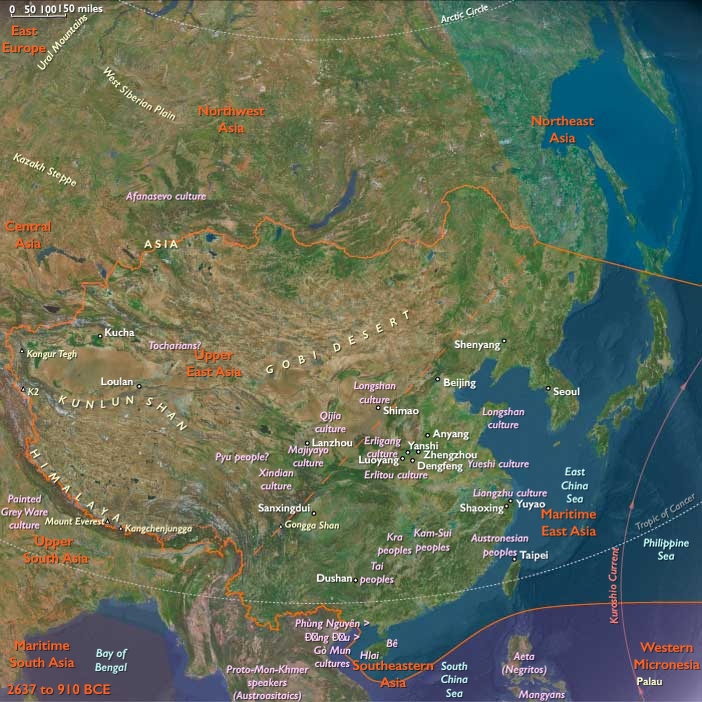
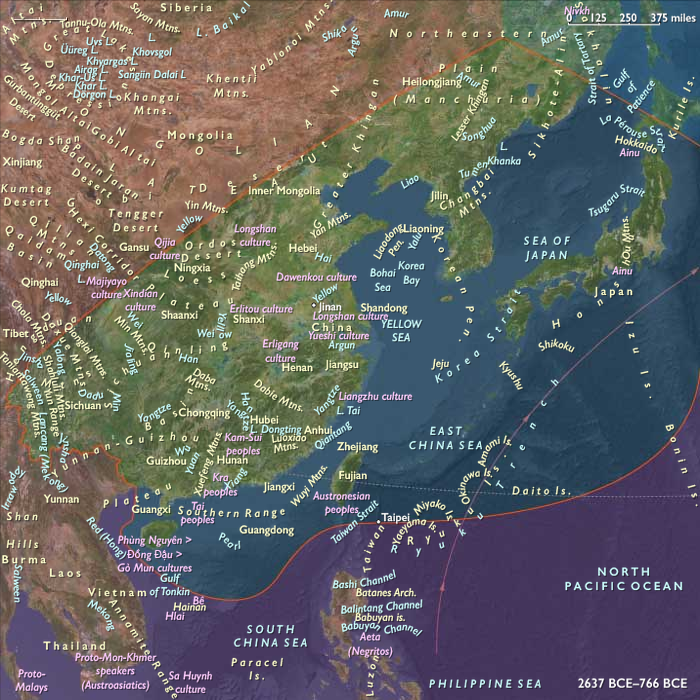
Between 1773 BCE and 1630 BCE, Maritime East Asia—comprising lower Primorsky Krai, the Korean Peninsula, the Japanese Archipelago below northern Hokkaido, Taiwan, and southern, central, and northeastern China—undergoes significant transitions, particularly in ancient China, as the legendary Xia Dynasty faces internal decline, setting the stage for dynastic transformation. Concurrently, early cultural innovations, notably the development of traditional Chinese ink, contribute to regional cultural sophistication.
Kong Jia and the Decline of the Xia Dynasty
According to ancient textual sources such as the Bamboo Annals, the Xia Dynasty—traditionally considered China’s earliest hereditary dynasty—experiences substantial internal decline under its fourteenth ruler, Kong Jia, who reigns approximately from 1789 BCE to 1758 BCE. Governing from the Xia capital located at West River, Kong Jia is remembered unfavorably as a ruler excessively preoccupied with superstition, indulgence in alcohol, and pursuits of pleasure.
His ineffective governance and neglect of administrative responsibilities lead to a gradual weakening of centralized royal authority. During and after Kong Jia’s rule, regional vassal kings gain increasing autonomy and power, undermining Xia dominance. This progressive decentralization of authority continues throughout subsequent generations, ultimately leading to the dynasty’s downfall when the powerful vassal king, Tang of Shang, overthrows the last Xia ruler, Jie, establishing the Shang Dynasty in approximately 1618 BCE.
Early Chinese Ink Traditions
Around the same era, notable cultural advancements occur within Lower East Asia, specifically in the early development of Chinese ink. Historical evidence traces ink-making traditions back to approximately the 18th century BCE, featuring the use of naturally derived inks made from plants (plant dyes), animals, and mineral sources such as graphite. These materials are ground with water to produce inks applied using specially crafted brushes, laying critical foundations for future literary, artistic, and cultural expression throughout China and, eventually, broader East Asia.
The emergence of these early inks underscores the increasing sophistication of cultural practices within the region, marking significant steps toward later artistic and literary traditions.
Legacy of the Era: Dynastic Transition and Cultural Innovation
Thus, the period 1773–1630 BCE marks a critical era in Maritime East Asia’s early historical trajectory. The gradual collapse of the Xia Dynasty—symbolized by Kong Jia’s ineffective reign—paves the way for major political transformations, while concurrent innovations such as early ink-making practices highlight the region’s advancing cultural complexity. These developments significantly shape the historical and cultural evolution of Lower East Asia in subsequent periods.
Groups
- Jeulmun culture
- China, archaic (Three Sovereigns and Five Emperors)
- Gojoseon (Choson)
- Chinese Kingdom, Xia Dynasty
- Erlitou culture
Topics
Commodoties
Subjects
Regions
Subregions
Years: 1773BCE - 1630BCE
Groups
- Jeulmun culture
- China, archaic (Three Sovereigns and Five Emperors)
- Gojoseon (Choson)
- Chinese Kingdom, Xia Dynasty
- Erlitou culture
Topics
Commodoties
Subjects
Regions
Subregions