
Maritime East Asia (45 BCE–99 CE): Dynastic …
Years: 45BCE - 99
Maritime East Asia (45 BCE–99 CE): Dynastic Turmoil, Regional Influence, and Rebellions
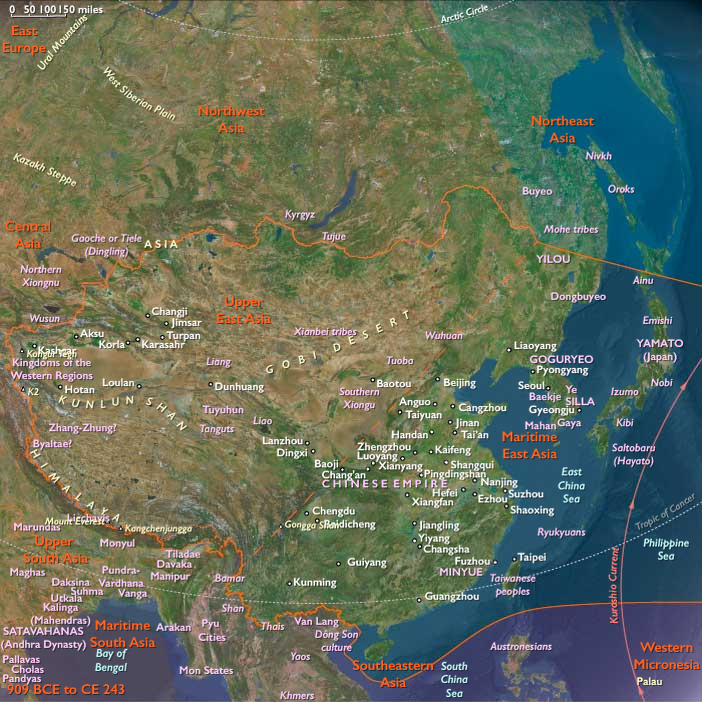
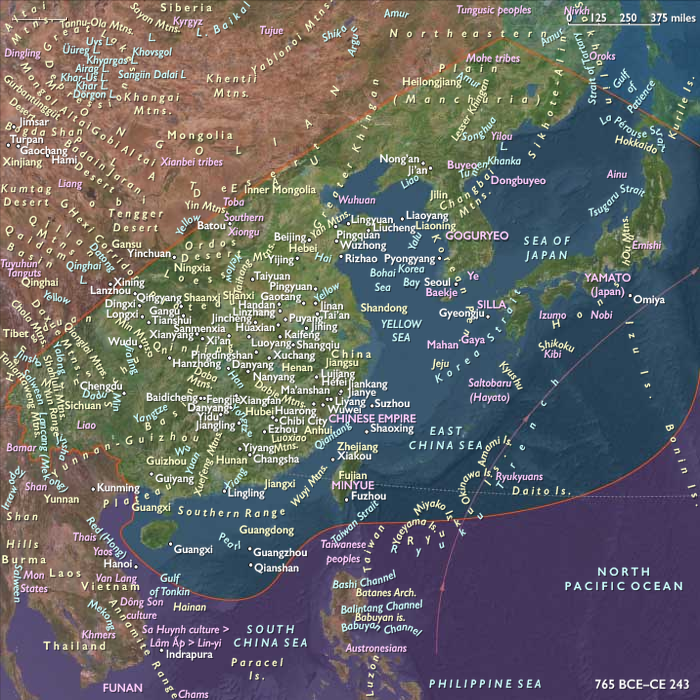
Between 45 BCE and 99 CE, Maritime East Asia—comprising lower Primorsky Krai, the Korean Peninsula, the Japanese Archipelago below northern Hokkaido, Taiwan, and southern, central, and northeastern China—experiences significant political upheavals, regional expansions, and continued cultural and technological advancements during the later Han dynasty.
Political Instability and Dynastic Change
The early first century CE is marked by dynastic turbulence, most notably during Wang Mang's Xin Dynasty. Major agrarian rebellions originating in modern Shandong and northern Jiangsu drain the Xin dynasty’s resources, eventually leading to Wang Mang’s overthrow. The Lülin rebellion elevates Liu Xuan (Emperor Gengshi) to briefly restore the Han dynasty. However, internal divisions soon see Gengshi replaced by the Chimei faction's puppet emperor, Liu Penzi, who himself falls due to administrative incompetence.
By 30 CE, the Eastern Han dynasty under Emperor Guangwu (Liu Xiu) reestablishes control, overcoming these rebellions and restoring a degree of central authority.
Expansion and Influence in Korea
Lelang (Nangnang), near present-day P'yongyang, becomes a significant center of Chinese governance, culture, industry, and commerce, maintaining its prominence for approximately four centuries. Its extensive influence draws Chinese immigrants and imposes tributary relationships on several Korean states south of the Han River, shaping regional civilization and governance.
The Korean Peninsula witnesses substantial agrarian development, notably through advanced rice agriculture and extensive irrigation systems. By the first three centuries CE, walled-town states cluster into three federations: Jinhan, Mahan, and Byeonhan, marking significant strides toward regional organization and agricultural efficiency.
Goguryeo and Han Relations
During the instability of Wang Mang’s rule, the Korean kingdom of Goguryeo exploits the turmoil, frequently raiding Han's Korean prefectures. It is not until 30 CE that Han authority is firmly restored, reasserting control over these border territories.
Xiongnu and Frontier Conflicts
Wang Mang's hostile policy toward the northern nomadic Xiongnu tribes culminates in significant frontier conflicts. By 50 CE, internal division splits the Xiongnu into the Han-allied Southern Xiongnu and the antagonistic Northern Xiongnu. The Northern Xiongnu seize control of the strategically important Tarim Basin in 63 CE, threatening Han’s crucial Hexi Corridor.
However, following their defeat in 91 CE, the Northern Xiongnu retreat into the Ili River valley, allowing the Xianbei nomads to occupy extensive territories from Manchuria to the Ili River, reshaping regional power dynamics.
Technological and Cultural Developments
This period sees continued advancements in mathematics and commerce. Notably, the influential Nine Chapters on the Mathematical Art (Jiu Zhang Suan Shu) documents the first known use of negative numbers, employing distinct color-coded counting rods to represent positive and negative values, and presenting sophisticated methods for solving simultaneous equations.
Peak and Decline under Emperor Zhang
The reign of Emperor Zhang (75–88 CE) is retrospectively regarded as the Eastern Han dynasty's zenith, characterized by administrative stability and cultural flourishing. However, subsequent emperors witness increasing eunuch interference in court politics, sparking violent power struggles between eunuchs and imperial consort clans, foreshadowing dynastic decline.
Legacy of the Age: Turbulence, Expansion, and Innovation
Thus, the age from 45 BCE to 99 CE is defined by significant political turbulence, territorial expansion, technological innovation, and sustained cultural influence. Despite internal strife, this era reinforces critical foundations for subsequent East Asian civilizations, shaping regional dynamics profoundly.
People
Groups
- Confucianists
- Gojoseon (Choson)
- Xiongnu (Hsiung-nu)
- Xianbei
- Han Dynasty (Western)
- Mahan Confederacy
- Jinhan confederacy
- Byeonhan Confederacy
- Xin Dynasty
- Chinese Empire, Tung (Eastern) Han Dynasty
Topics
Commodoties
Subjects
Regions
Subregions
Related Events
Showing 3 events out of 3 total
Years: 45BCE - 99
People
Groups
- Confucianists
- Gojoseon (Choson)
- Xiongnu (Hsiung-nu)
- Xianbei
- Han Dynasty (Western)
- Mahan Confederacy
- Jinhan confederacy
- Byeonhan Confederacy
- Xin Dynasty
- Chinese Empire, Tung (Eastern) Han Dynasty
Topics
Commodoties
Subjects
Regions
Subregions