
Maritime East Asia (1864–1875 CE): Restoration, Modernization, …
Years: 1864 - 1875
Maritime East Asia (1864–1875 CE): Restoration, Modernization, and Rising Nationalism
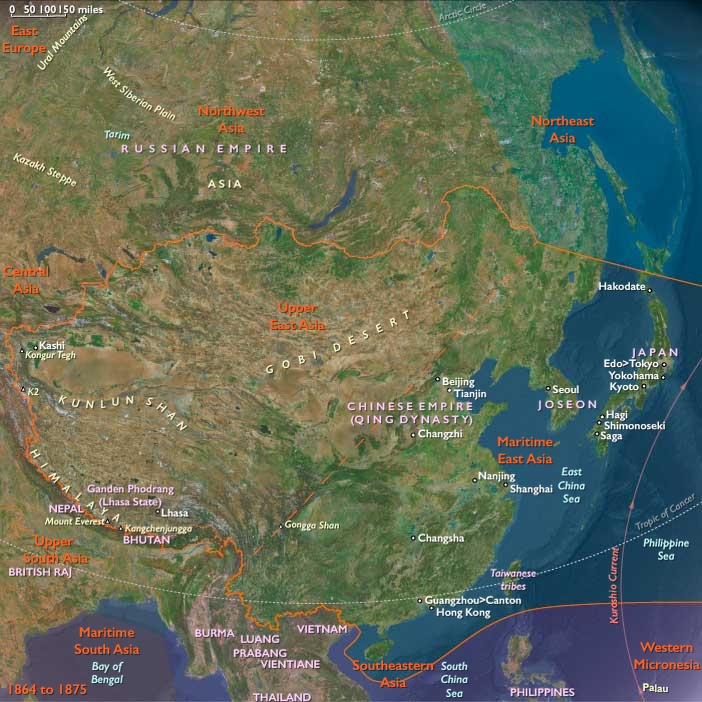
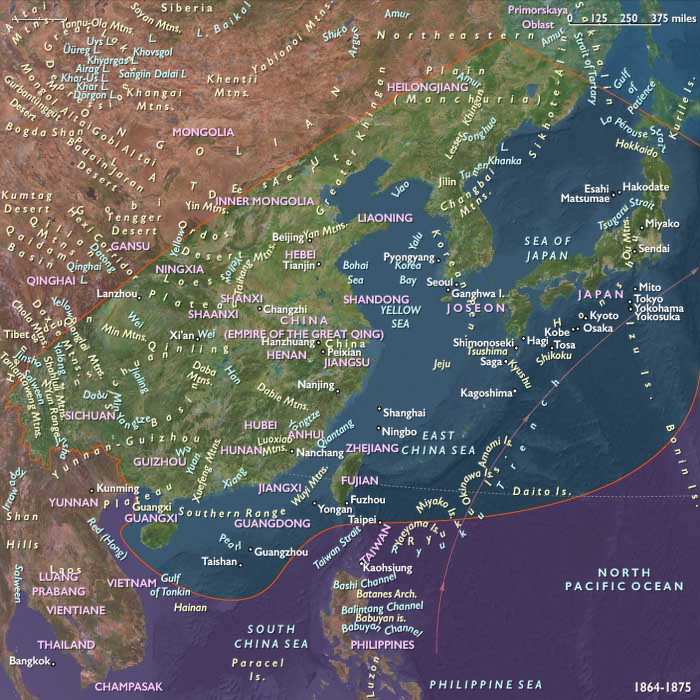
Between 1864 and 1875 CE, Maritime East Asia—encompassing lower Primorsky Krai, the Korean Peninsula, the Japanese Archipelago south of northern Hokkaido, Taiwan, and southern, central, and northeastern China—experiences critical efforts at restoration and modernization, rising nationalist sentiments, and significant political restructuring, laying the foundations for profound regional transformations.
China: The Self-Strengthening Movement and Foreign Encroachments
Following the devastating Taiping Rebellion, Qing China embarks on the Self-Strengthening Movement, driven by scholar-generals such as Li Hongzhang and Zuo Zongtang. These leaders advocate adopting Western science, technology, and military strategies to strengthen China internally while preserving traditional political structures. Between 1861 and 1875, China sees the establishment of modern arsenals, shipyards, factories, schools, and improved diplomatic methods.
However, modernization efforts face significant internal resistance. The conservative bureaucracy, still deeply influenced by Neo-Confucian traditions, slows comprehensive reform. Simultaneously, foreign pressures intensify: Russia seizes significant territories in Manchuria, while Western powers further consolidate economic concessions through extraterritorial rights and treaty ports, severely limiting Qing sovereignty.
The Tongzhi Restoration (1862–1874), under the guidance of Empress Dowager Cixi, seeks to stabilize Qing rule through cautious reform and restoration of traditional authority. Yet, despite modest improvements, Qing China continues to struggle with internal fragmentation and external vulnerabilities.
Japan: The Meiji Restoration and Rapid Transformation
In Japan, internal conflicts culminate dramatically with the fall of the Tokugawa shogunate and the establishment of the Meiji Restoration in 1868. This marks the end of over two centuries of feudal rule, and power formally returns to the imperial court under Emperor Mutsuhito, who reigns as Emperor Meiji. The Restoration fundamentally restructures Japanese governance, aiming to modernize and centralize authority rapidly.
The Charter Oath of 1868 outlines Japan’s new goals: establishing deliberative assemblies, allowing social mobility, embracing international knowledge, and discarding outdated customs. Feudal domains (han) are abolished and replaced by prefectures, dramatically centralizing authority. Comprehensive reforms reshape the social order, economy, military, and education system, heavily influenced by Western models.
Influential leaders such as Okubo Toshimichi, Saigo Takamori, Kido Koin, and Iwakura Tomomi emerge as architects of modernization, promoting industrialization, infrastructure expansion, military enhancement, and international diplomatic engagement. A landmark diplomatic mission, the Iwakura Mission (1871–1873), travels extensively through the United States and Europe to learn and implement Western governance practices, technology, and education.
Korea: Continued Isolation and Internal Strife
Joseon Korea maintains its stringent isolationist policies amid escalating Western pressure on neighboring nations. Harsh persecution of Christians continues, reflecting deep suspicion toward foreign influence. Economic hardship intensifies due to governmental inaction and societal rigidity, fueling internal unrest and widespread poverty.
The rigid isolation contributes to deepening internal instability, setting the stage for growing social unrest and major rebellions in subsequent decades. Despite awareness of international developments in Japan and China, the Joseon court resolutely resists change, increasingly alienating progressive factions within the kingdom.
Legacy of the Era: Foundations of Modernization and Persistent Challenges
The years 1864 to 1875 CE witness crucial steps toward modernization and nation-building in Mariime East Asia. While Japan rapidly transforms into a centralized, modern nation-state, China's conservative approach limits the effectiveness of its reforms, leaving it vulnerable to continued external exploitation and internal tensions. Meanwhile, Korea’s determined isolation preserves immediate stability at the cost of long-term preparedness, foreshadowing severe challenges in the rapidly changing international environment. This era thus profoundly shapes the region’s trajectory, determining each nation’s path into the late nineteenth century.
People
- Emperor Meiji
- Empress Dowager Cixi
- Iwakura Tomomi
- Kido Takayoshi
- Li Hongzhang
- Saigō Takamori
- Zuo Zongtang
- Ōkubo Toshimichi
Groups
- Shinto
- Neo-Confucianism
- Christians, Roman Catholic
- Joseon (Yi) kingdom of
- Protestantism
- Japan, Tokugawa, or Edo, Period
- Chinese Empire, Qing (Manchu) Dynasty
- Britain (United Kingdom of Great Britain and Ireland)
- Hong Kong, British Crown Colony of
- Taiping (Heavenly Kingdom)
- Japan, Empire of (Meiji Period)
Topics
Commodoties
Subjects
Regions
Subregions
Related Events
Showing 10 events out of 14241 total
Years: 1864 - 1875
People
- Emperor Meiji
- Empress Dowager Cixi
- Iwakura Tomomi
- Kido Takayoshi
- Li Hongzhang
- Saigō Takamori
- Zuo Zongtang
- Ōkubo Toshimichi
Groups
- Shinto
- Neo-Confucianism
- Christians, Roman Catholic
- Joseon (Yi) kingdom of
- Protestantism
- Japan, Tokugawa, or Edo, Period
- Chinese Empire, Qing (Manchu) Dynasty
- Britain (United Kingdom of Great Britain and Ireland)
- Hong Kong, British Crown Colony of
- Taiping (Heavenly Kingdom)
- Japan, Empire of (Meiji Period)
Topics
Commodoties
Subjects
Regions
Subregions