
East Asia (1828–1971 CE) Empires Unraveled, …
Years: 1828 - 1971
East Asia (1828–1971 CE)
Empires Unraveled, Revolutions Forged, and Economic Miracles Begun
Geography & Environmental Context
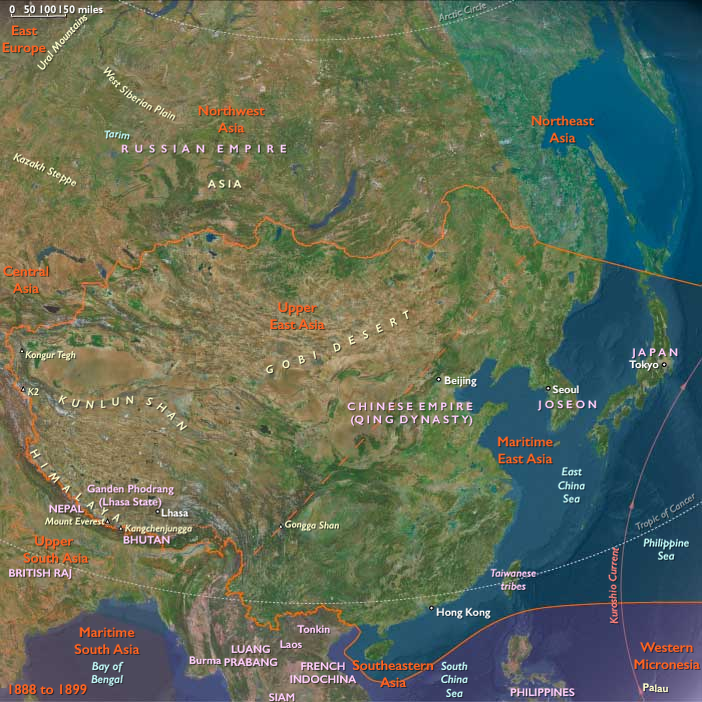
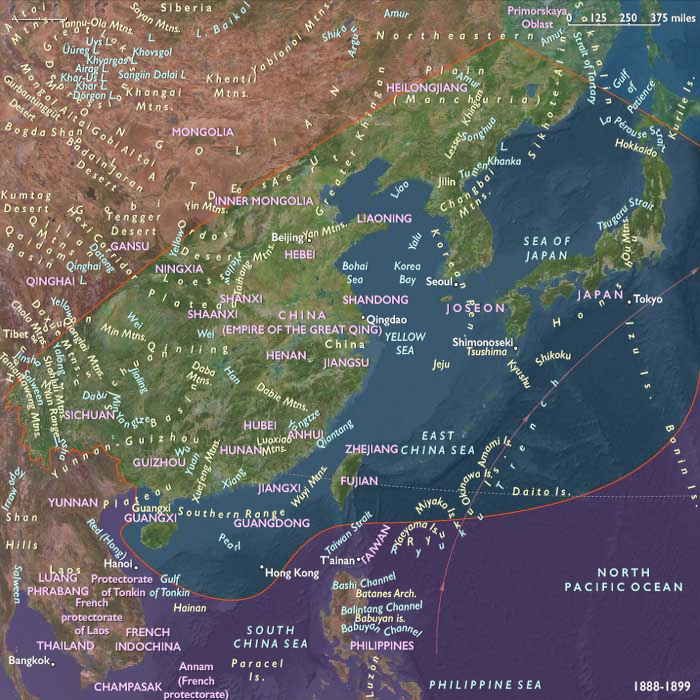
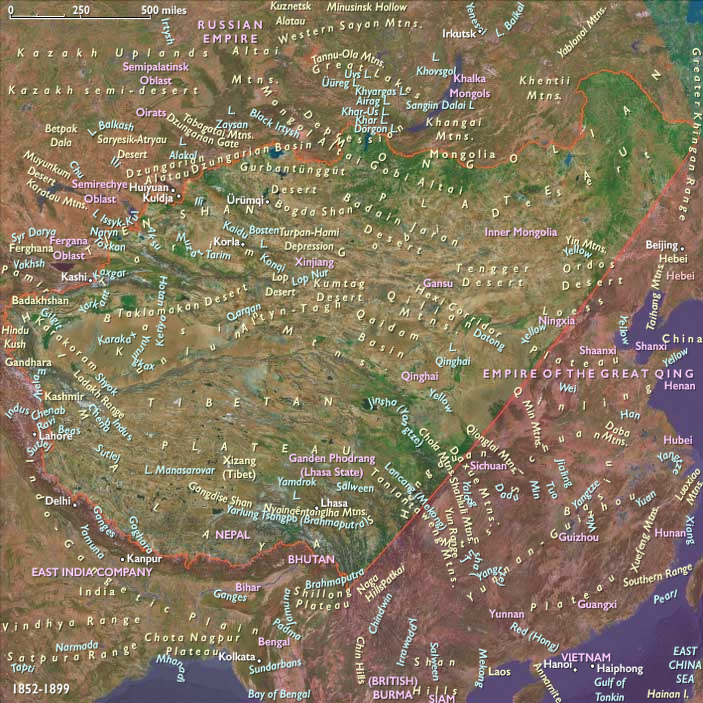
East Asia encompasses the great continental and insular arc from the Tibetan Plateau to the Pacific—two subregions held constant in this framework:
-
Upper East Asia: Mongolia and western China (Tibet, Xinjiang, Qinghai, Gansu, Ningxia, and adjoining uplands).
-
Lower East Asia: eastern and southern China, Taiwan, the Korean Peninsula, Japan, and the Ryukyu and Izu island chains.
The region spans deserts, plateaus, and alpine basins in the interior to humid river plains and monsoon coasts in the east. Its great rivers—the Yellow, Yangtze, and Pearl—linked agricultural cores to seaports that became gateways of both commerce and foreign control.
Climate & Environmental Shifts
Monsoon cycles continued to shape harvests. The 19th century saw floods, droughts, and famine in China (notably the North China Famine, 1876–79). Deforestation and siltation worsened flood damage in the Yellow River basin. The 20th century brought dam projects, terracing, and reforestation but also wartime devastation and later industrial pollution. Typhoons and earthquakes periodically struck Japan, Taiwan, and coastal China.
Subsistence & Settlement
-
Rural continuity: Rice, wheat, and millet remained staples; peasants formed the majority until mid-century land reforms.
-
Urban growth: Treaty ports (Shanghai, Tianjin, Yokohama, Nagasaki) became colonial enclaves; later, modern metropolises—Tokyo, Osaka, Seoul, Shanghai, Beijing—drove industrialization.
-
Migration: Millions moved within and beyond China as laborers and merchants; Mongolian and Tibetan pastoralists faced sedentarization under imperial and later socialist regimes.
Technology & Material Culture
Western industrial technology entered through ports and reforms. Railways, telegraphs, and steam navigation spread from the 1870s. After 1945, mechanization, electrification, and mass production reshaped daily life. Traditional crafts—porcelain, silk, lacquer, calligraphy—remained cultural touchstones even amid industrial growth. In the interior, Buddhist monasteries and nomadic tents coexisted with new socialist collectives and mines.
Movement & Interaction Corridors
-
Continental routes: Trans-Siberian and Chinese trunk railways integrated the interior.
-
Maritime networks: The Pacific and South China Sea tied treaty ports to global trade.
-
Diasporas: Chinese merchants, Korean and Japanese migrants, and Tibetan traders extended East Asian networks across Asia and beyond.
-
Military corridors: Repeated wars—the Opium Wars, Sino-Japanese conflicts, Pacific War, and Korean War—turned transport arteries into front lines.
Cultural & Symbolic Expressions
Confucian and Buddhist traditions persisted but were challenged by Christianity, socialism, and nationalism. The Meiji Restoration (1868) in Japan redefined tradition as modernization; Chinese reformers sought to “self-strengthen” through Western science; Mongolian and Tibetan Buddhism adapted to socialist oversight. Literature and art blended realism and modernism: Lu Xun in China, Tanizaki and Kawabata in Japan, Kim Sowol in Korea. Folk and classical forms—from Chinese opera to Japanese kabuki—remained central to identity.
Environmental Adaptation & Resilience
Irrigation and terracing stabilized yields; community granaries and kinship networks mitigated famine. After mid-century, land reform and collectivization in China, North Korea, and Mongolia transformed agrarian systems. Japan’s and South Korea’s reforestation and flood-control programs paralleled rapid industrial pollution control efforts by the late 1960s.
Political & Military Shocks
-
China: Opium Wars (1839–60) opened treaty ports; the Taiping (1850–64) and Boxer (1899–1901) uprisings shattered Qing control. The 1911 Revolution ended dynastic rule; the People’s Republic (1949) followed decades of warlordism, invasion, and civil war.
-
Japan: The Meiji state (1868) industrialized, defeated China (1894–95) and Russia (1904–05), built an empire, and after WWII reconstruction became an economic power.
-
Korea: From late-19th-century reforms through Japanese annexation (1910–45) to division after liberation and the Korean War (1950–53).
-
Mongolia: Gained independence from Qing (1911), became a Soviet-aligned republic (1924).
-
Tibet & Xinjiang: Integrated into the PRC (1950s) through force and reform; revolts in Tibet (1959) and Xinjiang repression marked ongoing contestation.
-
Cold War: East Asia was divided—communist mainland versus capitalist maritime rim—anchoring the global bipolar order.
Transition
Between 1828 and 1971, East Asia was remade through revolution, industrialization, and ideological division. Dynastic empires gave way to republics, colonies to nation-states. Japan and the “Little Tigers” entered early economic miracles; China and its interior pursued socialist transformation; Korea remained split; Mongolia and Tibet navigated life within Soviet and Chinese spheres. Across the region, modernization carried the weight of memory—Confucian ethics, Buddhist cosmology, and ancestral landscapes enduring beneath steel, slogans, and neon.
People
Groups
- Korean people
- Buddhism
- Confucianists
- Buddhism, Tibetan
- Chinese (Han) people
- Buddhists, Zen or Chán
- Tibetan people
- Christians, Roman Catholic
- Mongols
- Protestantism
- Tibet, Lamacracy of
- Chinese Empire, Qing (Manchu) Dynasty
- Taiwan, or Formosa (Qing protectorate)
- Tibet under Qing rule
- Russian Empire
- United States of America (US, USA) (Washington DC)
- Britain (United Kingdom of Great Britain and Ireland)
- Taiping (Heavenly Kingdom)
- Taiwan, or Formosa (Japanese colony)
- Choson, Japanese protectorate of
- Japan, Taisho Period
- China, Republic of
- Korea, Provisional Government of the Republic of
- Kuomintang (KMT)
- Mongolia
- Communist Party of China
- Union of Soviet Socialist Republics (USSR), or Soviet Union
- Japan, Showa Period
- Taiwan (Republic of China protectorate)
- United Nations, The (U.N.)
- Korea, Democratic People's Republic of (North Korea)
- Korea, (First) Republic of (South Korea)
- China, People's Republic of
- Taiwan (Republic of China)
- China, Republic of (Taiwan)
- Tibet Autonomous Region (China)
- Korea, (Second) Republic of (South Korea)
- Korea, (Third) Republic of (South Korea)
Topics
- China: Famines of 1810, 1811, 1846 and 1849
- Opium War, First
- Sino-Sikh War
- Sino-Turkomen War
- China: Famine of 1850-73
- Taiping Rebellion
- Opium War, Second (Arrow War)
- Sino-Japanese Confrontation
- Sino-French War
- Sino-Japanese War of 1894-95
- China, northern: Famine of 1896-97
- Boxer Rebellion
- China, east-central: Famine of 1907
- Chinese Revolution of 1911-12
- China, east-central: Famine of 1911
- World War, First (World War I)
- Warlord Era
- Chinese Reoccupation: Mongolia
- March First Movement
- March 1st Movement
- Warlord era in China
- Chinese Civil War
- China, northern: Famine of 1928-29
- Sino-Soviet conflict of 1929
- Chinese Civil War of 1930-34
- China: Famine of 1936
- Sino-Japanese War of 1937-45
- World War, Second (World War II)
- Second World War in the Pacific
- China: Famine of 1942-43
- Chinese Civil War of 1945-49
- Cold War
- Sino-Mongolian Border Clashes
- Sino-Taiwanese War
- Korean War
- Chinese Communist Terror
- Sino-Burmese War
- Great Leap Forward
- Sino-Indian Border Dispute
- Sino-Indian War
- Chinese “Cultural Revolution”
- Sino-Soviet border conflict of 1969
Commodoties
- Grains and produce
- Textiles
- Fuels, lubricants and sealants
- Industrial chemicals
- Manufactured goods
- Narcotics
Subjects
- Commerce
- Environment
- Conflict
- Mayhem
- Games and Sports
- Government
- Custom and Law
- Catastrophe
- Human Migration
Regions
Subregions
Years: 1828 - 1971
People
Groups
- Korean people
- Buddhism
- Confucianists
- Buddhism, Tibetan
- Chinese (Han) people
- Buddhists, Zen or Chán
- Tibetan people
- Christians, Roman Catholic
- Mongols
- Protestantism
- Tibet, Lamacracy of
- Chinese Empire, Qing (Manchu) Dynasty
- Taiwan, or Formosa (Qing protectorate)
- Tibet under Qing rule
- Russian Empire
- United States of America (US, USA) (Washington DC)
- Britain (United Kingdom of Great Britain and Ireland)
- Taiping (Heavenly Kingdom)
- Taiwan, or Formosa (Japanese colony)
- Choson, Japanese protectorate of
- Japan, Taisho Period
- China, Republic of
- Korea, Provisional Government of the Republic of
- Kuomintang (KMT)
- Mongolia
- Communist Party of China
- Union of Soviet Socialist Republics (USSR), or Soviet Union
- Japan, Showa Period
- Taiwan (Republic of China protectorate)
- United Nations, The (U.N.)
- Korea, Democratic People's Republic of (North Korea)
- Korea, (First) Republic of (South Korea)
- China, People's Republic of
- Taiwan (Republic of China)
- China, Republic of (Taiwan)
- Tibet Autonomous Region (China)
- Korea, (Second) Republic of (South Korea)
- Korea, (Third) Republic of (South Korea)
Topics
- China: Famines of 1810, 1811, 1846 and 1849
- Opium War, First
- Sino-Sikh War
- Sino-Turkomen War
- China: Famine of 1850-73
- Taiping Rebellion
- Opium War, Second (Arrow War)
- Sino-Japanese Confrontation
- Sino-French War
- Sino-Japanese War of 1894-95
- China, northern: Famine of 1896-97
- Boxer Rebellion
- China, east-central: Famine of 1907
- Chinese Revolution of 1911-12
- China, east-central: Famine of 1911
- World War, First (World War I)
- Warlord Era
- Chinese Reoccupation: Mongolia
- March First Movement
- March 1st Movement
- Warlord era in China
- Chinese Civil War
- China, northern: Famine of 1928-29
- Sino-Soviet conflict of 1929
- Chinese Civil War of 1930-34
- China: Famine of 1936
- Sino-Japanese War of 1937-45
- World War, Second (World War II)
- Second World War in the Pacific
- China: Famine of 1942-43
- Chinese Civil War of 1945-49
- Cold War
- Sino-Mongolian Border Clashes
- Sino-Taiwanese War
- Korean War
- Chinese Communist Terror
- Sino-Burmese War
- Great Leap Forward
- Sino-Indian Border Dispute
- Sino-Indian War
- Chinese “Cultural Revolution”
- Sino-Soviet border conflict of 1969
Commodoties
- Grains and produce
- Textiles
- Fuels, lubricants and sealants
- Industrial chemicals
- Manufactured goods
- Narcotics
Subjects
- Commerce
- Environment
- Conflict
- Mayhem
- Games and Sports
- Government
- Custom and Law
- Catastrophe
- Human Migration
Regions
Subregions