
Maritime East Asia (1629–1486 BCE): Rise and …
Years: 1629BCE - 1486BCE
Maritime East Asia (1629–1486 BCE): Rise and Consolidation of the Shang Dynasty
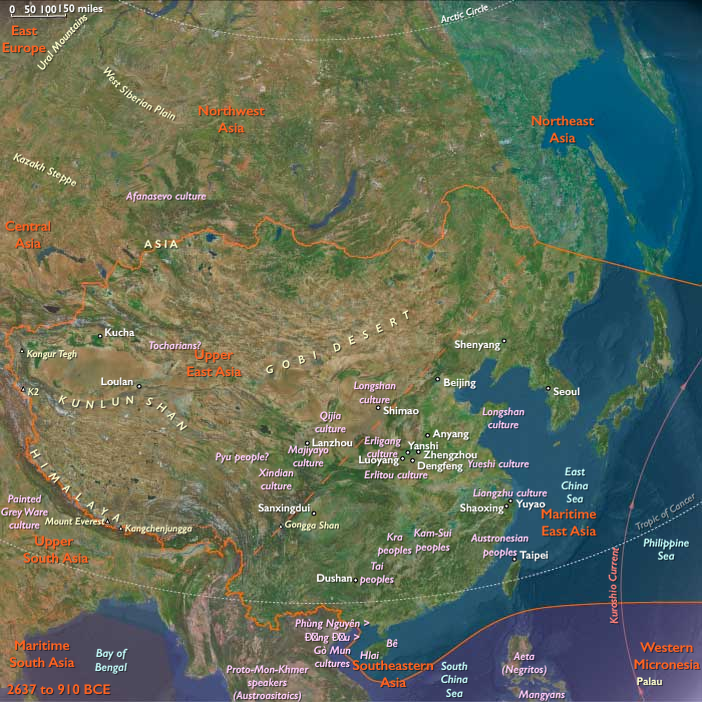
Between 1629 BCE and 1486 BCE, Maritime East Asia—comprising lower Primorsky Krai, the Korean Peninsula, the Japanese Archipelago below northern Hokkaido, Taiwan, and southern, central, and northeastern China—experiences a pivotal transition with the fall of the quasi-legendary Xia Dynasty and the rise of the historically attested Shang Dynasty. This era is marked by significant cultural advancements, including the introduction of sophisticated bronze metallurgy, the establishment of Chinese writing, and the formation of distinct social hierarchies, laying lasting foundations for Chinese civilization.
Fall of the Xia Dynasty
According to traditional Chinese historical accounts—including the Xia Shang Zhou Chronology Project—the Xia Dynasty’s last ruler, Jie, reigns for fifty-two years until approximately 1618 BCE. Jie’s oppressive and corrupt rule, characterized by tyranny and cruelty, precipitates the dynasty’s downfall. Later historical records, particularly the Bamboo Annals, describe catastrophic natural phenomena during Jie's final years, including unusual climatic events such as frost in July, heavy rains, crop failures, and an anomalous "yellow fog" accompanied by dim sunlight and multiple suns appearing simultaneously. Modern scientists speculate that these phenomena could have been related to volcanic events, notably the Thera eruption, linking environmental disturbances to historical upheaval.
Ultimately, Jie is overthrown by Tang of Shang at the pivotal Battle of Mingtiao, marking the end of Xia dominance and the beginning of a new era under the Shang Dynasty.
Rise and Expansion of the Shang Dynasty
Emerging prominently around 1600 BCE, the Shang Dynasty establishes dominance in North China’s Henan region, absorbing smaller kingdoms including the remnants of the Xia state. Archaeological evidence and historical texts—particularly Sima Qian’s Shiji (Records of the Grand Historian) and later Zhou Dynasty documents—indicate the Shang people share an ethnic affinity with the Huaxia peoples of the Yellow River basin.
The Shang society is fundamentally agrarian, supplemented by hunting and animal husbandry, and characterized by advanced urban centers supporting complex social stratification. Notably, the Shang Dynasty represents an early Chinese "slave society," structured hierarchically from the king and ruling elite—including royal family members, nobility, priesthood, and specialized artisans—down to the urban craftspeople, village agriculturists, and, at the bottom, enslaved populations.
Bronze Metallurgy and Cultural Achievements
During this period, sophisticated bronze metallurgy rapidly develops, transforming Shang society. Bronze-casting technology, previously undocumented at this level of sophistication in China, emerges fully formed, enabling the production of intricate ritual vessels, ceremonial weapons, and artistic objects. Shang bronze-working also enhances the crafting of jade artifacts, integrating multiple advanced artistic practices.
Development of Early Chinese Writing
The Shang Dynasty is critically significant for developing an early and fully operational system of Chinese writing. This script, evident in surviving inscriptions on bronze artifacts, oracle bones (turtle shells, cattle scapulae, and other bones), pottery, jade, and other media, indicates a complex writing system already mature by this period. Although the direct antecedents of Shang script remain obscure, it is widely assumed to have evolved from earlier hieroglyphic forms, attesting to a long period of development.
These oracle bone inscriptions represent China's earliest substantial corpus of recorded written characters, providing invaluable insights into Shang society, religion, governance, and daily life.
Religious Practices and Social Organization
Shang religion prominently features worship of the supreme deity Shangdi (Shang-ti), alongside rituals and prayers directed toward ancestral spirits. Ritual practice includes human sacrifice, reflecting beliefs about the afterlife, divine favor, and dynastic legitimacy. The Shang’s distinct religious and social systems solidify political cohesion, enforce hierarchical relationships, and reinforce the centralized authority of the king.
Legacy of the Era: Foundations of Historic Chinese Civilization
Thus, between 1629 and 1486 BCE, Maritime East Asia witnesses profound historical transformation as the Shang Dynasty supplants Xia, bringing advances in bronze metallurgy, sophisticated writing systems, hierarchical social structures, and centralized governance. These developments shape the essential foundations of historic Chinese civilization, significantly influencing subsequent cultural and political evolution in the region.
Groups
- Jeulmun culture
- China, archaic (Three Sovereigns and Five Emperors)
- Gojoseon (Choson)
- Chinese Kingdom, Xia Dynasty
- Erlitou culture
Topics
Commodoties
Subjects
- Commerce
- Watercraft
- Painting and Drawing
- Labor and Service
- Decorative arts
- Government
- Custom and Law
- Technology
Regions
Subregions

Related Events
Showing 10 events out of 54 total
Years: 1629BCE - 1486BCE
Groups
- Jeulmun culture
- China, archaic (Three Sovereigns and Five Emperors)
- Gojoseon (Choson)
- Chinese Kingdom, Xia Dynasty
- Erlitou culture
Topics
Commodoties
Subjects
- Commerce
- Watercraft
- Painting and Drawing
- Labor and Service
- Decorative arts
- Government
- Custom and Law
- Technology
Regions
Subregions