
Maritime East Asia (1485–1342 BCE): Shang Dynasty’s …
Years: 1485BCE - 1342BCE
Maritime East Asia (1485–1342 BCE): Shang Dynasty’s Bronze Age Flourishing and Oracle Bone Divination
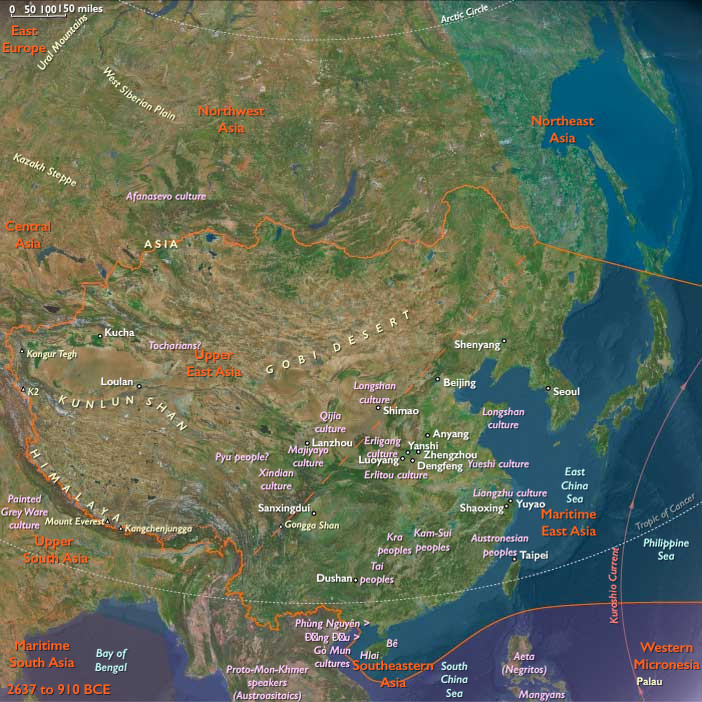
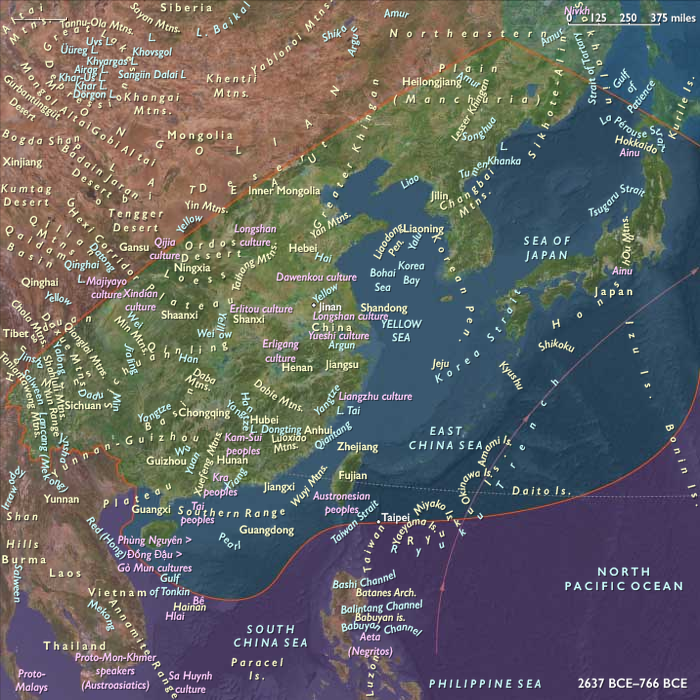
Between 1485 BCE and 1342 BCE, Maritime East Asia—comprising lower Primorsky Krai, the Korean Peninsula, the Japanese Archipelago below northern Hokkaido, Taiwan, and southern, central, and northeastern China—experiences a significant cultural and technological flowering under China’s Shang Dynasty. This era sees the dramatic expansion of sophisticated bronze craftsmanship, the consolidation and expansion of Shang political authority, advancements in construction technology, early medicinal practices, and the widespread use of oracle bone script.
Sophisticated Bronze Craftsmanship
Under the Shang Dynasty, Chinese artisans achieve remarkable advancements in bronze metallurgy, crafting highly sophisticated ceremonial vessels such as urns and vases. Molded in sections and featuring intricate decorative patterns, these bronze artifacts appear quite suddenly around the early Shang period (circa 1600 BCE) without clear prior evidence of a comparable metal technology, aside from earlier jade-carving traditions. This advanced bronze technology attests to the remarkable skill, centralized control, and artistic sophistication of Shang culture.
Political Consolidation and Capital Establishment
The Shang Dynasty, traditionally founded around 1600 BCE by the rebel leader Tang of Shang, refers to its rulers as Sons of Heaven, reinforcing their divine right to rule and legitimizing centralized political authority. Shang civilization primarily depends on agriculture, supplemented by hunting and animal husbandry, forming a stable economic base for political expansion and urban growth.
By approximately 1500 BCE, the Shang establish their early capital at Aodu (Bodu)—modern Zhengzhou (Cheng-chou), located strategically in the Yellow River Valley. Here, Chinese engineers demonstrate advanced construction techniques, including the innovative use of open caissons to stabilize and sink shallow walls in the region’s unstable soils.
The Shang court subsequently moves its capital multiple times—six relocations in total, according to the Records of the Grand Historian—culminating in its final, most significant relocation around 1350 BCE to the city of Yin (modern Anyang). This move initiates the dynasty’s "golden age," marking the peak of its political and cultural dominance.
Extent and Influence of Shang Authority
At its zenith following the move to Yin, the Shang domain expands significantly, extending from the Wei River tributaries west of the central Yellow River Valley, eastward to the Yellow Sea coast, northward toward territories occupied by nomadic peoples on the steppes, and approaching the northern boundaries of the Yangtze River basin to the south. The Shang Dynasty will endure as one of China’s longest dynasties, traditionally featuring thirty-one rulers who succeed each other through a fraternal succession pattern, from Tang to the final king, Zhou of Shang.
Early Medicinal Practices
During this period, early medical records in China document the medicinal use of fermented and moldy substances—derived from animal dung and fermented soybean curd—to treat superficial wounds and swelling. These primitive antibiotic treatments underscore early empirical medical experimentation and reflect the beginnings of China's enduring medicinal traditions.
Oracle Bone Script and Divination Practices
Around 1400 BCE, Shang priests increasingly employ the oracle bone script, a form of Chinese writing inscribed onto animal bones or turtle shells during divination rituals. The vast majority of surviving oracle bones date from the Shang capital at Yin (Anyang), ranging approximately from the fourteenth century to the mid-eleventh century BCE. Although the script’s origins likely predate this era, its widespread use from 1400 BCE onward provides China’s earliest significant corpus of recorded writing, invaluable for understanding Shang religious practices, governance, and daily concerns.
Legacy of the Era: Cultural Sophistication and Technological Innovations
Thus, the era 1485–1342 BCE represents a pivotal phase in Maritime East Asia, characterized by the Shang Dynasty's political stabilization, advanced bronze craftsmanship, early engineering achievements, formative medical practices, and innovations in literacy and divination practices. These developments collectively deepen cultural complexity, expand regional influence, and set a foundation for future historical trajectories across East Asia.
Groups
Topics
Commodoties
Subjects
- Commerce
- Watercraft
- Painting and Drawing
- Labor and Service
- Decorative arts
- Government
- Custom and Law
- Technology
Regions
Subregions
Related Events
Showing 10 events out of 105 total
Years: 1485BCE - 1342BCE
Groups
Topics
Commodoties
Subjects
- Commerce
- Watercraft
- Painting and Drawing
- Labor and Service
- Decorative arts
- Government
- Custom and Law
- Technology
Regions
Subregions