
East Asia (1540–1683 CE) Silver Flows, …
Years: 1540 - 1683
East Asia (1540–1683 CE)
Silver Flows, Shogunal Power, and Steppe Revivals
Geography & Environmental Context
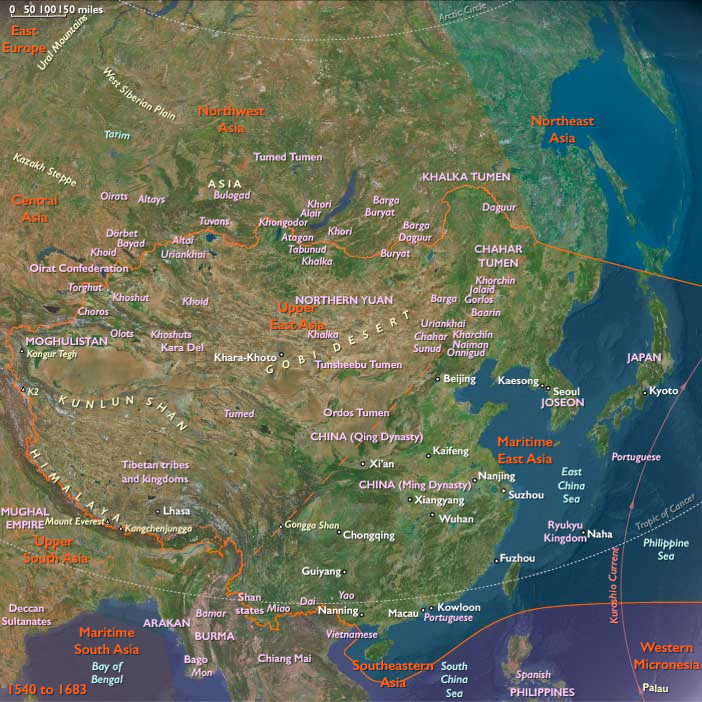
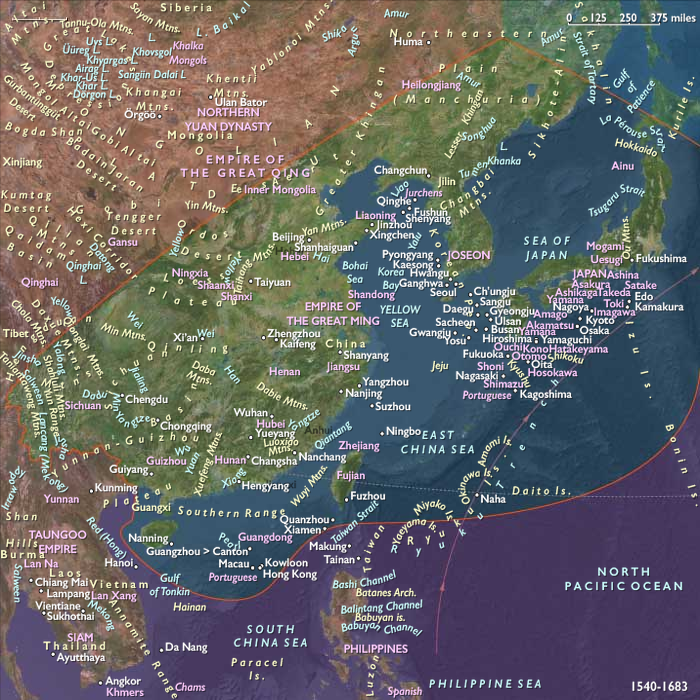
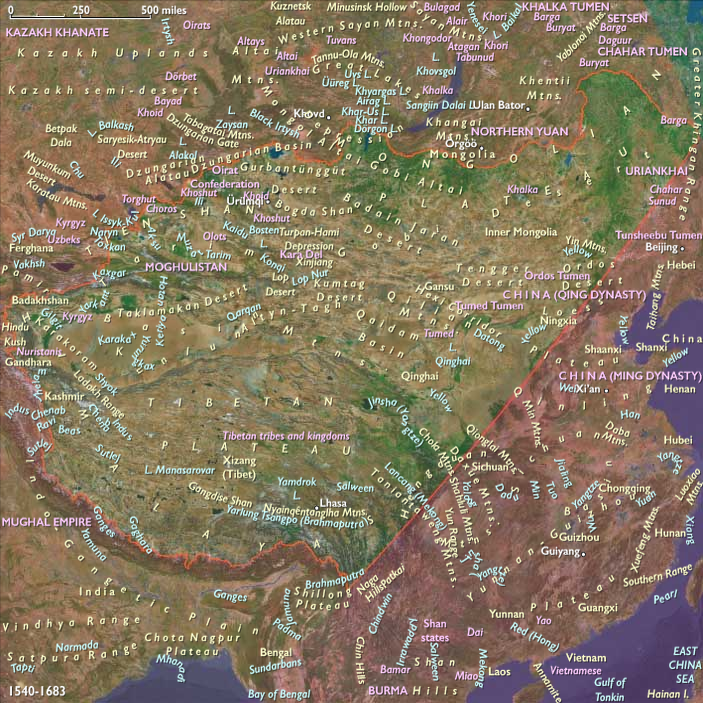
East Asia, encompassing both Lower and Upper East Asia, stretched from the Pacific coasts of China, Korea, and Japan to the Tibetan Plateau and the steppes of Mongolia and Xinjiang. Anchors included the Yangtze and Yellow River basins, Beijing and Edo (Tokyo), the Sichuan Basin, Korea’s Han River valley, and the plateaus and mountain systems of Tibet, the Altai, and the Tianshan. The region united fertile monsoon-fed lowlands and densely settled deltas with highland deserts, alpine grasslands, and frontier oases—together forming one of the world’s largest continuous zones of agricultural, pastoral, and imperial interaction.
Climate & Environmental Shifts
The Little Ice Age deepened its impact, bringing colder winters, shorter growing seasons, and erratic monsoons.
-
In northern China and Korea, frost and drought stressed harvests.
-
Across Japan and the Ryukyus, typhoons and volcanic eruptions (e.g., Mount Asama) caused periodic famine.
-
On the Tibetan Plateau and Inner Asia, intensified winter storms—dzud—decimated herds and fueled migrations.
Despite volatility, agricultural innovation, new crops from the Americas, and redistributive institutions helped mitigate disaster.
Subsistence & Settlement
-
China (Ming → Qing): Rice, wheat, tea, silk, and cotton underpinned one of the world’s largest agrarian economies. Urban centers—Suzhou, Hangzhou, Guangzhou, Nanjing, and Beijing—were hubs of manufacturing and finance.
-
Korea (Joseon): Rice paddies expanded southward; Confucian bureaucracy governed agrarian life, even as the Imjin Wars (1592–1598) brought devastation and subsequent recovery.
-
Japan: Civil wars ended with Tokugawa unification (1600). Stable rice taxation and castle-town growth transformed the country into an urbanizing polity centered on Edo.
-
Taiwan and the Ryukyus: Austronesian farming and fishing persisted alongside growing Chinese settlement and maritime trade; Ryukyu balanced dual vassalage to China and Satsuma (after 1609).
-
Mongolia and the Steppe: Nomadic pastoralism centered on horses, sheep, and camels; Oirat/Zunghar confederations consolidated power across western Mongolia.
-
Tibet and Xinjiang: Monasteries and oasis towns—Lhasa, Yarkand, Turpan—served as agricultural and spiritual nodes linking plateau and desert.
Technology & Material Culture
-
Agriculture: Adoption of maize, sweet potato, and peanuts increased food security. Advanced irrigation, terracing, and hydraulic control spread from China into Korea and Japan.
-
Trade goods:
-
China: Exported porcelain, silk, and tea on a global scale.
-
Japan: Renowned for swordsmithing, lacquerware, and castle construction; ukiyo-e art and kabuki theater emerged late in the period.
-
Korea: Perfected Hangul printing and ceramic artistry (white porcelain and celadon).
-
-
Architecture & religion: Ming palaces, Joseon Confucian academies, Tokugawa castles, and Tibetan monasteries reflected political order and spiritual aspiration.
-
Weaponry: Firearms proliferated; Japanese matchlocks influenced Korean and Chinese arsenals; steppe cavalry adopted muskets and cannon via Central Asia.
Movement & Interaction Corridors
East Asia became a central participant in global and regional trade networks:
-
Maritime routes: Chinese ports—Fujian, Guangdong—channeled trade to Southeast Asia, Japan, and the Philippines.
-
The Silver Circuit: Silver from Spanish America reached China via the Manila Galleons; Japanese silver from Iwami Ginzan flowed through East Asian markets. China became the world’s silver sink, fueling its monetary economy.
-
Continental routes: The Silk Road and Tea-Horse Road linked China with Central Asia and Tibet; caravans carried silk, horses, tea, and jade between Kashgar, Lhasa, and Xi’an.
-
Diplomatic and tributary relations: The Ming and Qing empires maintained tributary ties with Korea, Ryukyu, Vietnam, and—via Peking embassies—Tibet and the Mongols.
-
Frontier integration: Manchu expansion in the 1640s–1680s unified Manchuria, Inner Mongolia, and northern China, culminating in Qing consolidation.
Cultural & Symbolic Expressions
-
China: Late Ming intellectual ferment—individualist Confucianism, vernacular fiction (Journey to the West, Dream of the Red Chamber)—gave way under the Qing to state orthodoxy and artistic refinement in porcelain and painting.
-
Japan: The Tokugawa era fostered Neo-Confucian ethics, kabuki, and the first modern urban culture; Edo became a center of literacy and leisure.
-
Korea: Neo-Confucian scholars such as Yi Hwang and Yi I codified moral philosophy; pansori song cycles blended elite and folk performance.
-
Tibet: The Fifth Dalai Lama unified church and state under the Gelugpa school, constructing the Potala Palace as a monumental symbol.
-
Steppe and oasis cultures: Mongol and Turkic elites patronized Tibetan Buddhism and Sufi Islam respectively, blending pastoral and agrarian worldviews.
-
Ryukyu: Maintained hybrid rituals blending Chinese investiture and local traditions.
Environmental Adaptation & Resilience
-
China & Japan: Diversified cropping with American imports mitigated famine; reforestation and granary systems improved ecological stability.
-
Korea: State granaries and irrigation recovery stabilized after war losses.
-
Tibet: Monasteries managed surplus and redistributed barley during lean years.
-
Steppe regions: Herd diversification and mobile camps buffered nomads against drought and dzud; oasis cities relied on karez irrigation to sustain farming.
-
Maritime peripheries: Island polities (Taiwan, Ryukyu) adapted through fishing, trading, and tribute relations.
Political and Military Transformations
-
China: The Ming dynasty’s collapse (1644) and Qing ascendancy reshaped the empire; Manchu rulers consolidated multiethnic governance.
-
Japan: The Tokugawa shogunate imposed peace (Pax Tokugawa), restricting foreign contact under sakokuwhile encouraging internal commerce.
-
Korea: Survived invasions and reaffirmed Joseon Confucian orthodoxy.
-
Mongolia and Inner Asia: The Oirat/Zunghars rose to regional dominance; Tibet entered a new theocratic era under Mongol protection; Russia advanced into Siberia, meeting Qing forces by century’s end.
Transition
Between 1540 and 1683, East Asia became both a regional order of stability and a key node of the world economy.
-
In Lower East Asia, global silver flows bound China, Japan, and the Philippines into an unprecedented network of trade. The Tokugawa and Qing consolidations fostered domestic peace and population growth.
-
In Upper East Asia, new powers—the Zunghars and the Fifth Dalai Lama’s Tibet—reshaped the inner Asian frontier even as the Qing Empire prepared to extend its reach westward.
By 1683, the region’s great civilizations—Qing China, Tokugawa Japan, Joseon Korea, Tibet, and the Zunghar steppe—stood in relative balance, united by commerce and ideology, yet divided by geography and guarded frontiers. The foundations of early modern East Asia—bureaucratic states, tributary diplomacy, and maritime exchange—were firmly in place, linking the ancient continental empires to an increasingly global age.
People
Groups
- Neo-Confucianism
- Christians, Roman Catholic
- Chinese Empire, Ming Dynasty
- Joseon (Yi) kingdom of
- Jesuits, or Order of the Society of Jesus
- Japan, Azuchi-Momoyama Period
- Japan, Tokugawa, or Edo, Period
- Chinese Empire, Qing (Manchu) Dynasty
Topics
Subjects
- Writing
- Painting and Drawing
- Labor and Service
- Decorative arts
- Conflict
- Government
- Custom and Law
- Technology
Regions
Subregions
Years: 1540 - 1683
People
Groups
- Neo-Confucianism
- Christians, Roman Catholic
- Chinese Empire, Ming Dynasty
- Joseon (Yi) kingdom of
- Jesuits, or Order of the Society of Jesus
- Japan, Azuchi-Momoyama Period
- Japan, Tokugawa, or Edo, Period
- Chinese Empire, Qing (Manchu) Dynasty
Topics
Subjects
- Writing
- Painting and Drawing
- Labor and Service
- Decorative arts
- Conflict
- Government
- Custom and Law
- Technology
Regions
Subregions