
Maritime East Asia (1684–1827 CE): Imperial Order, …
Years: 1684 - 1827
Maritime East Asia (1684–1827 CE): Imperial Order, Maritime Gateways, and Cultural Flowerings
Geography & Environmental Context
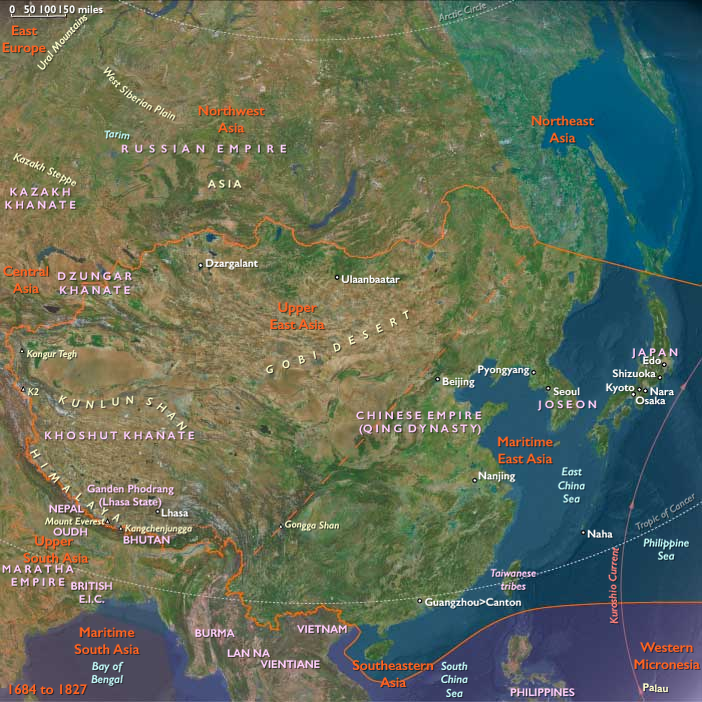
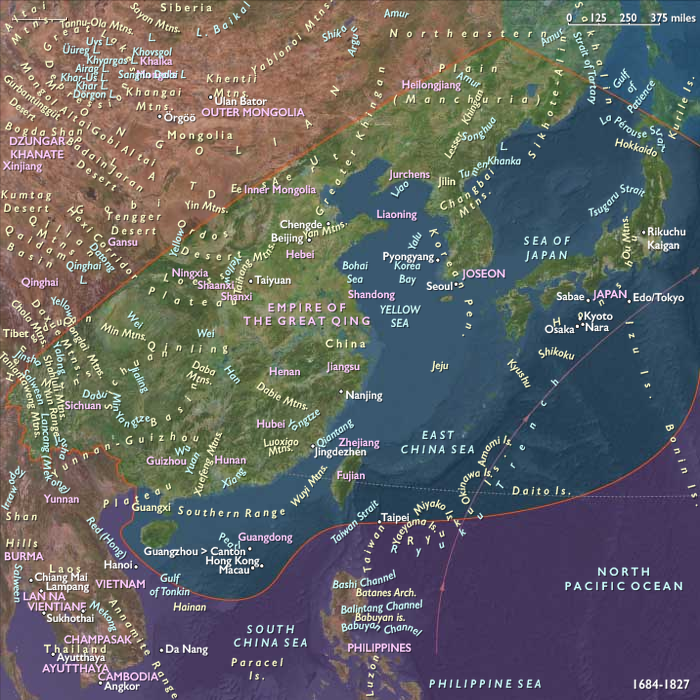
Maritime East Asia encompasses southern and eastern China (Yunnan, Guangxi, Guizhou, the Sichuan Basin, Chongqing, Hunan, Hubei, Henan, Shanxi, Hebei, Beijing, Guangdong, Fujian, Zhejiang, Jiangsu, Shandong, Liaoning, Jilin, and southern Heilongjiang), Taiwan, the Korean Peninsula, southern Primorsky Krai, the Japanese islands of Kyushu, Shikoku, Honshu, and southwestern Hokkaidō, and the Ryukyu and Izu island chains. Anchors include the Yangtze and Yellow River valleys, the Sichuan Basin, the Pearl River Delta, the rugged coasts of Fujian and Zhejiang, the Taiwan Strait, the mountainous spine of Korea, and Japan’s great urban and agricultural heartlands from Kantō to Kansai. The region combines vast agrarian river basins, fertile plains, strategic straits, and densely settled coastal archipelagos.
Climate & Environmental Shifts
The subtropical–temperate monsoon shaped agriculture, with wet summers and drier winters. The waning Little Ice Age brought occasional severe winters (notably in North China and Korea) and episodes of drought that stressed rice harvests in Hunan, Jiangxi, and the Korean Peninsula. Typhoons battered the coasts of Fujian, Taiwan, and the Ryukyus. In Japan, volcanic eruptions (such as Mount Asama in 1783) caused famines and hardship, while floods along the Yellow and Yangtze Rivers periodically displaced entire communities.
Subsistence & Settlement
-
China: Wet-rice agriculture dominated in the Yangtze basin and south, supplemented by millet, wheat, and sorghum in the north. Tea, mulberries (for silk), and cotton became vital cash crops. The Sichuan Basin supported immense populations with rice and maize. Urban centers such as Beijing, Nanjing, Hangzhou, Suzhou, Guangzhou (Canton), and Chongqing flourished as administrative, commercial, and cultural hubs.
-
Taiwan: Han settlers expanded irrigated rice and sugarcane fields, pressing Indigenous Austronesian groups into the interior highlands.
-
Korea: Rice paddies dominated southern valleys, while barley, millet, and dry-field crops supplemented diets further north. Villages clustered around Confucian schools and market towns.
-
Japan: The Tokugawa regime stabilized settlement; rice yields increased through new irrigation and fertilization, while cash crops like cotton, indigo, and tobacco gained importance. Cities like Edo (Tokyo), Osaka, and Kyoto grew into some of the world’s largest.
-
Ryukyu Kingdom: Dependent on rice imports from Japan, it thrived on inter-island trade, serving as a conduit between China and Japan under Satsuma domain oversight.
Technology & Material Culture
-
Agriculture: Advanced irrigation, terracing, and the widespread use of organic fertilizers (night soil, compost) sustained high yields.
-
Manufacturing: China’s silk and porcelain industries dominated exports; Japan’s kilns (Arita ware) and cotton weaving became major domestic and export commodities.
-
Shipbuilding: Chinese junks, Korean panokseon warships, and Japanese coastal vessels were crucial for regional commerce. European ship designs were selectively adopted in Japan.
-
Architecture: Confucian academies, Buddhist temples, and Edo-period castles marked landscapes, alongside urban palaces and gardens in China.
-
Printing and literacy: Woodblock and movable type printing flourished—Confucian texts, Buddhist sutras, vernacular novels, and practical handbooks circulated widely.
Movement & Interaction Corridors
-
China: After 1684, the Qing legalized overseas trade, but restricted it under the Canton System (1757), making Guangzhou the sole port for Western commerce. American silver flowed into China in exchange for tea, silk, and porcelain.
-
Taiwan: Exported sugar and rice to Fujian and Guangdong; served as a frontier zone of Han migration.
-
Korea: Maintained tributary ties with Qing China, cautiously limited external contact, but cultivated a rich scholarly and Confucian culture.
-
Japan: Under the sakoku system, Japan restricted European contact to the Dutch at Dejima (Nagasaki), while maintaining tributary relations with Korea and the Ryukyu Kingdom.
-
Ryukyus: Functioned as diplomatic and commercial intermediaries, carrying goods and rituals between Okinawa, Japan, and China.
-
Global circuits: The Manila Galleon funneled New World silver into Asian markets, while the VOC and EIC pressed for greater access, focusing on China’s southern ports.
Cultural & Symbolic Expressions
-
China: The Qing dynasty reinforced Neo-Confucian orthodoxy through the civil service exams, while popular religion blended Daoism, Buddhism, and local cults (notably Mazu, goddess of the sea). Literati culture produced calligraphy, painting, and novels such as Dream of the Red Chamber.
-
Taiwan: Coastal temples honored Chinese deities, while Indigenous peoples retained ancestral rituals tied to hunting, fishing, and agriculture.
-
Korea: The yangban elite upheld Confucian values through schools and shrines; popular culture thrived in mask dramas and pansori storytelling.
-
Japan: Tokugawa ideology emphasized Neo-Confucian order, while Shinto shrines and Buddhist temples framed spiritual life. The Edo period produced a cultural efflorescence—kabuki theater, ukiyo-e prints, haiku poetry, and vibrant urban popular culture.
-
Ryukyus: Ritual specialists (noro) maintained ancestral rites; Chinese Confucian influences blended with indigenous traditions.
Environmental Adaptation & Resilience
-
Flood control and granaries: Hydraulic works in the Yangtze and Yellow River valleys, and state granaries, mitigated famine risks (though corruption undermined relief in some crises).
-
Agricultural diversification: Widespread adoption of maize, sweet potatoes, and peanuts (American introductions) strengthened resilience against rice failures.
-
Fisheries and forestry: Coastal communities balanced rice dependence with fishing and salt production; Japan regulated forests under Tokugawa edicts to prevent deforestation.
-
Trade buffering: Korean, Ryukyuan, and Japanese polities balanced restricted external contacts with strong internal redistribution systems.
Transition
Between 1684 and 1827, Maritime East Asia embodied both stability and global entanglement. The Qing dynasty consolidated rule over vast agrarian systems while restricting trade to Canton. Korea remained the “Hermit Kingdom,” committed to Confucian orthodoxy. Japan’s Tokugawa shogunate enforced sakoku, but nurtured a thriving domestic economy and Edo’s cultural efflorescence. Taiwan transformed into a frontier of Han settlement, and the Ryukyus remained intermediaries between larger powers. By the early 19th century, Lower East Asia stood as one of the most populous, literate, and economically dynamic regions of the world—yet pressures from European trade and demographic strain hinted at the upheavals soon to come.
People
Groups
- Christians, Roman Catholic
- Chinese Empire, Ming Dynasty
- Joseon (Yi) kingdom of
- Japan, Tokugawa, or Edo, Period
- Chinese Empire, Qing (Manchu) Dynasty
- Britain, Kingdom of Great
- Britain (United Kingdom of Great Britain and Ireland)
Commodoties
Subjects
- Writing
- Painting and Drawing
- Labor and Service
- Decorative arts
- Conflict
- Government
- Custom and Law
- Technology
Regions
Subregions
Years: 1684 - 1827
People
Groups
- Christians, Roman Catholic
- Chinese Empire, Ming Dynasty
- Joseon (Yi) kingdom of
- Japan, Tokugawa, or Edo, Period
- Chinese Empire, Qing (Manchu) Dynasty
- Britain, Kingdom of Great
- Britain (United Kingdom of Great Britain and Ireland)
Commodoties
Subjects
- Writing
- Painting and Drawing
- Labor and Service
- Decorative arts
- Conflict
- Government
- Custom and Law
- Technology
Regions
Subregions