
Maritime East Asia (1197–1054 BCE): Cultural Achievements …
Years: 1197BCE - 1054BCE
Maritime East Asia (1197–1054 BCE): Cultural Achievements and Ritual Life under the Late Shang
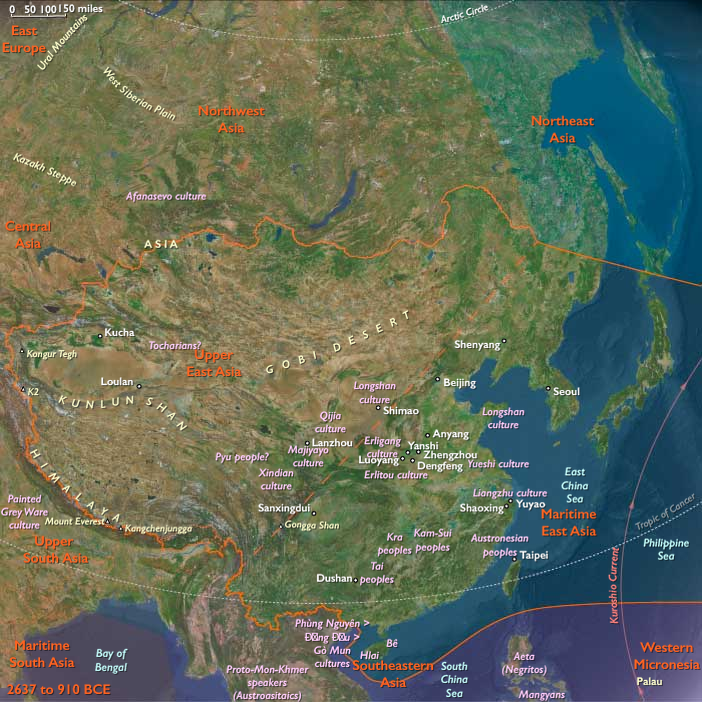
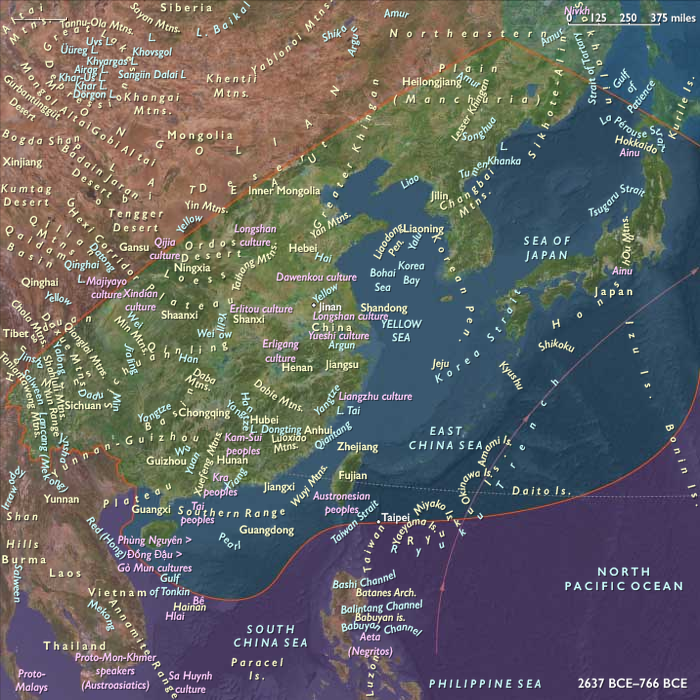
Between 1197 BCE and 1054 BCE, Maritime East Asia—comprising lower Primorsky Krai, the Korean Peninsula, the Japanese Archipelago below northern Hokkaido, Taiwan, and southern, central, and northeastern China—continues to flourish culturally under the Shang Dynasty, even as signs of internal unrest become evident. This era is distinguished by significant developments in Chinese script, music, ritual practices, and the establishment of early zoological collections, demonstrating both sophisticated cultural expression and complex social structures.
Early Zoological Collections
In the 12th century BCE, powerful Shang rulers begin to gather collections of exotic animals to display their wealth and power, impress foreign dignitaries, and showcase the marvels of nature. These collections constitute the first real zoological gardens (zoos) in Chinese history, reflecting both the extensive reach of Shang diplomatic and trade networks, and the dynasty’s opulent cultural tastes.
Development of Chinese Writing
The late Shang period produces the earliest significant corpus of Chinese writing, notably inscriptions on oracle bonesand contemporary bronze artifacts. These inscriptions, dating roughly from 1200 to 1050 BCE, represent the earliest clearly documented ancestors of modern Chinese script. Shang writing is critically important to the study of Chinese etymology, as many current Chinese characters trace their origins directly back to these late Shang forms. Although the creation and evolution of Chinese characters likely began centuries earlier, the Shang oracle bone inscriptions provide the earliest tangible foundation of the Chinese script family.
Flourishing of Chinese Music
By the late Shang Dynasty, Chinese music experiences a remarkable flowering. Although music’s origins certainly predate this era, written evidence from oracle bones and other contemporary sources suggests significant developments from the 14th through 12th centuries BCE. New instruments appear during this time, notably the sheng, a Chinese free-reed wind instrument first recorded in oracle bone inscriptions as he and yu.
The earliest known sheng consists of a gourd body fitted with a mouthpiece and between twelve to seventeen vertically arranged cane pipes. While a few of these pipes remain silent ("non-speaking"), the instrument produces harmonic sounds by inhalation and exhalation, with pitches determined by covering finger holes. The sheng primarily produces chords using a pentatonic (five-tone) scale, rather than melodic lines. Over time, this instrument evolves into a more refined form featuring a lacquered wooden bowl as a base and thin metal reeds, creating an enduring element in Chinese musical culture.
Royal Rituals and Ancestor Worship
During the Shang Dynasty’s late period, elaborate court rituals evolve to appease ancestral and natural spirits, becoming integral to governance and daily life. The Shang king plays a central religious role, serving as both the secular leader and head of ancestor worship rituals. Frequently, the king himself engages in oracle bone divinations, especially in times of crisis or uncertainty toward the dynasty’s end.
Archaeological excavations at royal tombs, particularly around the capital city of Yin (modern Anyang), provide evidence of elaborate funerary rites and beliefs regarding the afterlife. Royalty are interred with valuable objects—ceremonial bronzes, jades, pottery—likely intended for use in the afterlife. Additionally, burials often involve mass human sacrifice, with hundreds of commoners—possibly enslaved—buried alive alongside deceased royalty, underscoring the profound social stratification and religious beliefs of Shang society.
Internal Unrest and Decline
Despite the dynasty's impressive cultural achievements, signs of internal strain begin emerging by the 12th century BCE. The frequent oracle bone divinations conducted personally by Shang kings suggest growing anxieties about the dynasty’s stability. Such unrest foreshadows eventual decline, as internal divisions and external pressures begin weakening the dynasty’s foundations.
Legacy of the Era: Cultural Refinement and Ritual Complexity
Thus, the era from 1197 to 1054 BCE encapsulates a period of significant cultural sophistication, marked by advancements in zoological collections, writing systems, musical instrumentation, and religious rituals. Simultaneously, it sets the stage for internal tensions that will ultimately contribute to the transition from Shang to Zhou rule, profoundly influencing subsequent historical trajectories in Maritime East Asia.
Groups
Topics
Commodoties
Subjects
- Commerce
- Watercraft
- Painting and Drawing
- Labor and Service
- Decorative arts
- Government
- Custom and Law
- Technology
- Invention
- Astronomy
Regions
Subregions
Years: 1197BCE - 1054BCE
Groups
Topics
Commodoties
Subjects
- Commerce
- Watercraft
- Painting and Drawing
- Labor and Service
- Decorative arts
- Government
- Custom and Law
- Technology
- Invention
- Astronomy
Regions
Subregions