
Maritime East Asia (1540–1683 CE): Silver Flows, …
Years: 1540 - 1683
Maritime East Asia (1540–1683 CE): Silver Flows, Shogunal Power, and Tributary Worlds
Geography & Environmental Context
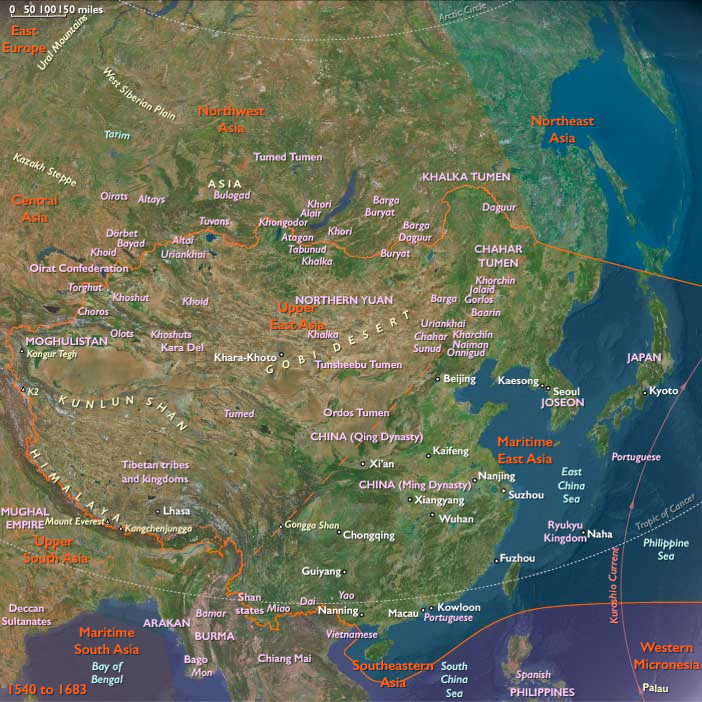
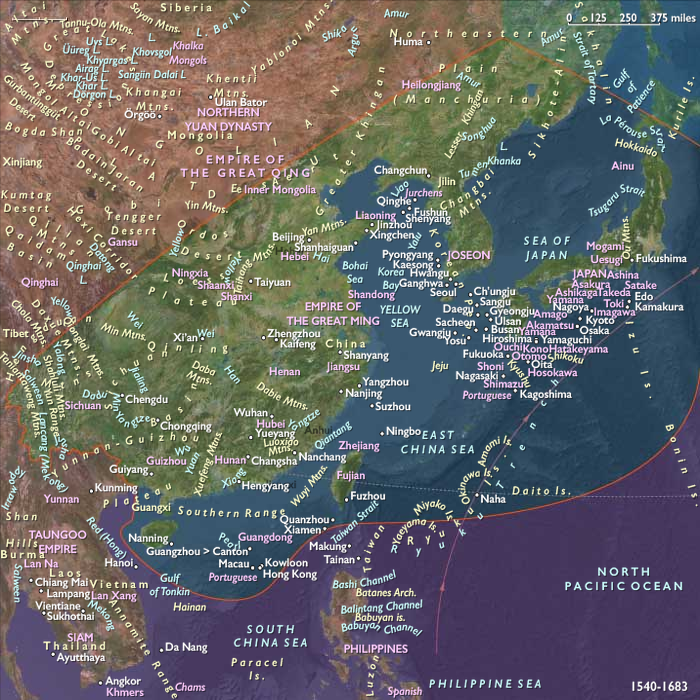
Maritime East Asia includes southern and eastern China (Yunnan to Shandong, Guangdong to Beijing, Liaoning to southern Heilongjiang), Taiwan, the Korean Peninsula, southern Primorsky Krai, the Japanese islands of Kyushu, Shikoku, Honshu, southwestern Hokkaidō, and the Ryukyu and Izu islands. Anchors include the Yangtze and Yellow basins, the Pearl River Delta, the Beijing court, the Sichuan Basin, Korea’s Han River valley, and Japan’s Kantō and Kansai regions.
Climate & Environmental Shifts
The Little Ice Age produced shorter growing seasons in northern China and Korea, occasional droughts in the Yangtze basin, and harsher winters across Honshu. Typhoons struck the Ryukyus and Fujian coast. Volcanic eruptions in Japan disrupted harvests. Yet agricultural intensification and American crop introductions (maize, sweet potatoes) helped buffer crises.
Subsistence & Settlement
-
China (Ming → Qing transition): Rice and wheat harvests sustained vast populations. Commercial crops like tea, silk, and cotton spread in Jiangnan. Southern cities (Suzhou, Hangzhou, Guangzhou) flourished as trade hubs.
-
Korea: Rice paddies expanded in the south; yangban elites maintained dominance. Villages were devastated by Japanese invasions (1592–1598) but recovered slowly.
-
Japan: Civil war ended with Tokugawa unification (1600). Rice remained staple; castle towns expanded. Edo grew into a major metropolis.
-
Taiwan: Settled by Austronesians but increasingly contested by Europeans (Dutch and Spanish), Chinese migrants, and later Zheng Chenggong (Koxinga), who expelled Europeans in 1662.
-
Ryukyu Kingdom: Continued tribute to China, but after 1609, subordinated to Satsuma domain, creating dual vassalage.
Technology & Material Culture
-
Agriculture: New World crops stabilized food supply. Irrigation and terracing expanded.
-
China: Jingdezhen porcelain, silk, and tea became global exports.
-
Japan: Swordsmithing, castle construction, and Noh theater thrived; ukiyo-e woodblock printing emerged late in the period.
-
Korea: Hangul script, metal type printing, and Confucian texts flourished.
-
Ryukyu: Hybrid material culture blended Chinese, Japanese, and Austronesian elements.
Movement & Interaction Corridors
-
China: Became the sink for global silver, receiving flows from Spanish America via Manila and from Japan via trade. Smuggling and piracy grew as maritime bans faltered.
-
Japan: Silver exports financed imports of silk from China. After 1639, the Tokugawa shogunate instituted sakoku, limiting Europeans to Dutch traders at Nagasaki.
-
Korea: Recovered from devastation of Imjin Wars, maintained tribute to Ming and later Qing.
-
Taiwan: Dutch and Spanish enclaves contested by Chinese settlers; later integrated into Ming loyalist regime of Zheng Chenggong.
-
Ryukyu: Functioned as a diplomatic intermediary, sending tribute to both China and Satsuma.
Cultural & Symbolic Expressions
-
China: Late Ming literati culture produced classics of painting, poetry, and drama; transition to Qing saw reaffirmation of Confucian orthodoxy.
-
Japan: Tokugawa period nurtured Neo-Confucianism, kabuki theater, and castle-town culture.
-
Korea: Neo-Confucian scholarship flourished, with scholars like Yi Hwang. Popular pansori performance emerged.
-
Taiwan: Indigenous Austronesians maintained oral and ritual traditions; Chinese settlers introduced Mazu temples.
-
Ryukyu: Maintained court rituals blending Chinese investiture practices with native traditions.
Environmental Adaptation & Resilience
-
China: Diversification with maize and sweet potatoes reduced famine risk.
-
Japan: Granaries, forestry management, and rice taxation stabilized resources.
-
Korea: Terracing and irrigation spread; state granaries aided recovery post-invasions.
-
Taiwan: Austronesian strategies of mobility and inter-island exchange persisted alongside Chinese agricultural intensification.
-
Ryukyu: Tribute networks ensured food security during typhoon years.
Transition
From 1540 to 1683, Maritime East Asia became a fulcrum of global exchange: Chinese silk and porcelain flowed west in return for silver, Japan stabilized under Tokugawa rule, and Korea recovered from invasion. Taiwan and Ryukyu emerged as contested zones of maritime empire. By the end of the era, Qing consolidation, Tokugawa closure, and Joseon orthodoxy set the stage for a new phase of stability—yet also deeper entanglement with the global economy.
People
Groups
- Neo-Confucianism
- Christians, Roman Catholic
- Chinese Empire, Ming Dynasty
- Joseon (Yi) kingdom of
- Jesuits, or Order of the Society of Jesus
- Japan, Azuchi-Momoyama Period
- Japan, Tokugawa, or Edo, Period
- Chinese Empire, Qing (Manchu) Dynasty
Topics
Subjects
- Writing
- Painting and Drawing
- Labor and Service
- Decorative arts
- Conflict
- Government
- Custom and Law
- Technology
Regions
Subregions
Years: 1540 - 1683
People
Groups
- Neo-Confucianism
- Christians, Roman Catholic
- Chinese Empire, Ming Dynasty
- Joseon (Yi) kingdom of
- Jesuits, or Order of the Society of Jesus
- Japan, Azuchi-Momoyama Period
- Japan, Tokugawa, or Edo, Period
- Chinese Empire, Qing (Manchu) Dynasty
Topics
Subjects
- Writing
- Painting and Drawing
- Labor and Service
- Decorative arts
- Conflict
- Government
- Custom and Law
- Technology
Regions
Subregions