
Maritime East Asia (1053–910 BCE): Transition from …
Years: 1053BCE - 910BCE
Maritime East Asia (1053–910 BCE): Transition from Shang to Zhou and Cultural Flourishing
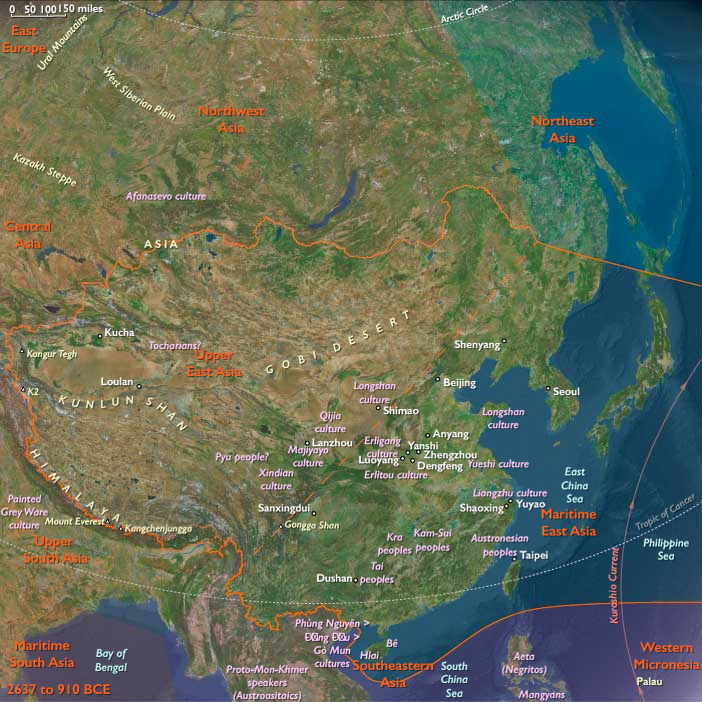
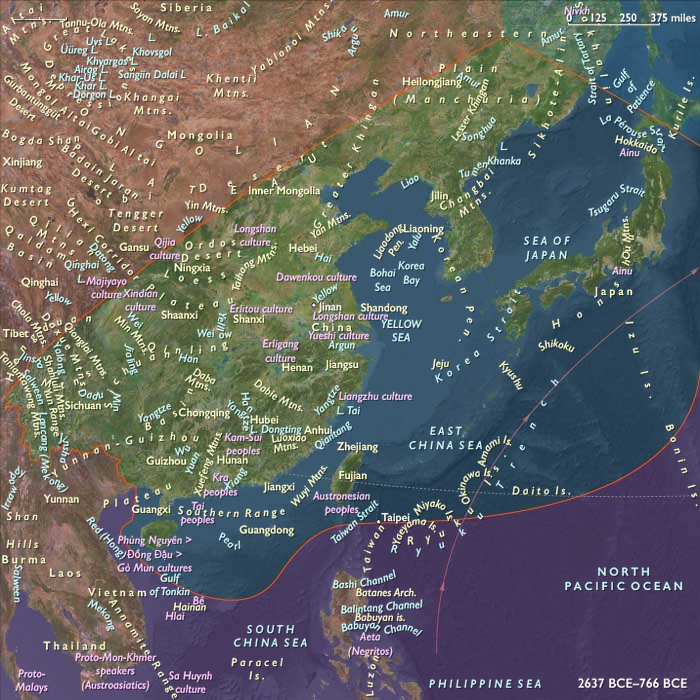
Between 1053 BCE and 910 BCE, Maritime East Asia—comprising lower Primorsky Krai, the Korean Peninsula, the Japanese Archipelago below northern Hokkaido, Taiwan, and southern, central, and northeastern China—experiences significant political transitions and remarkable cultural developments. This era sees the decline of the Shang Dynasty, the rise of the Zhou Dynasty, the origins of several important Chinese states, and archaeological discoveries challenging traditional narratives of Chinese civilization.
Mysterious Civilization at Sanxingdui
Archaeological findings at Sanxingdui, located in southern China’s kingdom of Shu, reveal a technologically advanced civilization distinct from the contemporary Shang capital at Anyang. Sanxingdui culture produces sophisticated bronze casting, including remarkable artifacts such as the world's oldest life-size standing human statue (260 centimeters high, weighing 180 kilograms) and an intricate bronze tree (396 centimeters high) featuring birds, flowers, and ornaments, possibly representing the mythological fusang tree.
Dozens of large bronze masks and heads, some originally adorned with gold foil, portray angular human features with exaggerated almond-shaped eyes, protruding pupils, and large ears. These discoveries, along with similar finds such as the Xingan tombs in Jiangxi, challenge the traditional narrative that Chinese civilization solely radiated from the central plains of the Yellow River. The Sanxingdui culture ultimately declines, potentially due to massive flooding or external invasion.
Artistic and Cultural Achievements of the Late Shang
The Shang Dynasty is renowned for producing artistic masterpieces in bronze, notably elaborate ritual vessels used in ceremonies dedicated to ancestor worship. These distinctive bronze objects continue into the Zhou period. Beginning in the 11th century BCE, artisans also manufacture large, barrel-shaped brass bells richly decorated on their surfaces.
Despite its artistic and ritual achievements, the Shang Dynasty faces internal unrest and declining political stability during the 12th century BCE, setting the stage for its eventual collapse.
Rise and Consolidation of the Zhou Dynasty
The Zhou, initially semi-nomadic people located west of the Shang realm, gradually emerge as a formidable power in the Yellow River valley. Under the leadership of King Wu, assisted by his brother, the Duke of Zhou, the Zhou decisively defeat the Shang at the Battle of Muye. King Wu legitimizes his rule by invoking the influential concept of the Mandate of Heaven, asserting divine justification for rulership contingent upon just governance.
Following their victory, the Zhou move their capital westward near modern Xi'an, on the Wei River, initiating the first of many historic population migrations from northern to southern China. This period, known as the Early or Western Zhou, features rapid consolidation under a centralized bureaucracy supported by vassal states managing peripheral areas. During this era, several notable states emerge that will play significant roles in later Chinese history, including Chen, Chu, Jin, Lu, Qi, and Yan, each originating as Zhou fiefdoms governed by hereditary nobles.
Cultural and Religious Transformations
The Zhou reorient Shang ancestor worship toward universal worship of Tian (Heaven), representing both the physical sky and a supreme divine entity, replacing Shang’s worship of the deity Di. Rituals of divination, bronze casting, and writing continue, blending Shang traditions with evolving Zhou customs.
Adhering to the code of conduct known as li, the Zhou promote detailed rules of etiquette, social hierarchy, and chivalric conduct, emphasizing civilization through adherence to ritual norms. Non-adherents, particularly groups beyond Zhou territories, are considered barbarians. To defend against these external threats, the Zhou begin constructing frontier walls along the northern boundary.
Sacred Geography and Settlement at Luoyang
The region of Luoyang, at the intersection of the Luo and Yi rivers, holds longstanding sacred significance as China's geographical center. Historically, multiple settlements have occupied this site:
-
In 2070 BCE, Xia Dynasty king Tai Kang establishes the capital Zhenxun.
-
Around 1600 BCE, King Tang of Shang builds a new capital called Western Bo.
-
In 1046 BCE, following the Shang defeat, the Duke of Zhou establishes Chengzhou, resettling captured Shang nobility and transferring the ceremonial Nine Tripod Cauldrons from the Zhou capital at Haojing to Chengzhou.
Legacy of the Age: Political and Cultural Transition
Thus, the age from 1053 to 910 BCE marks a critical transition from Shang to Zhou dominance, characterized by dynamic cultural evolution, political transformation, and significant archaeological discoveries. This period reshapes the historical narrative of Maritime East Asia, laying foundations for future social, cultural, and political developments.
Groups
Topics
Commodoties
Subjects
- Commerce
- Watercraft
- Painting and Drawing
- Labor and Service
- Decorative arts
- Government
- Custom and Law
- Technology
- Invention
- Astronomy
Regions
Subregions
Years: 1053BCE - 910BCE
Groups
Topics
Commodoties
Subjects
- Commerce
- Watercraft
- Painting and Drawing
- Labor and Service
- Decorative arts
- Government
- Custom and Law
- Technology
- Invention
- Astronomy
Regions
Subregions