
Low German-speaking colonists from the Holy Roman …
Years: 1257 - 1257
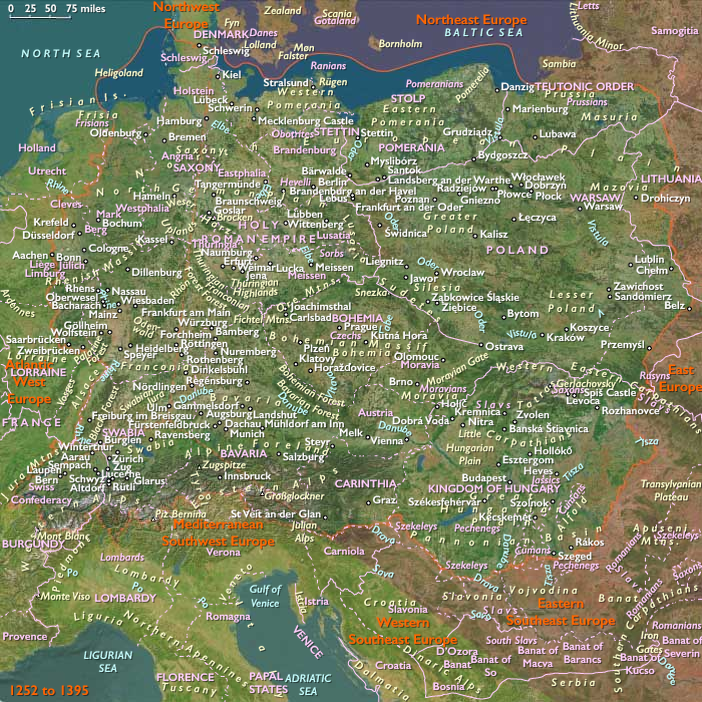
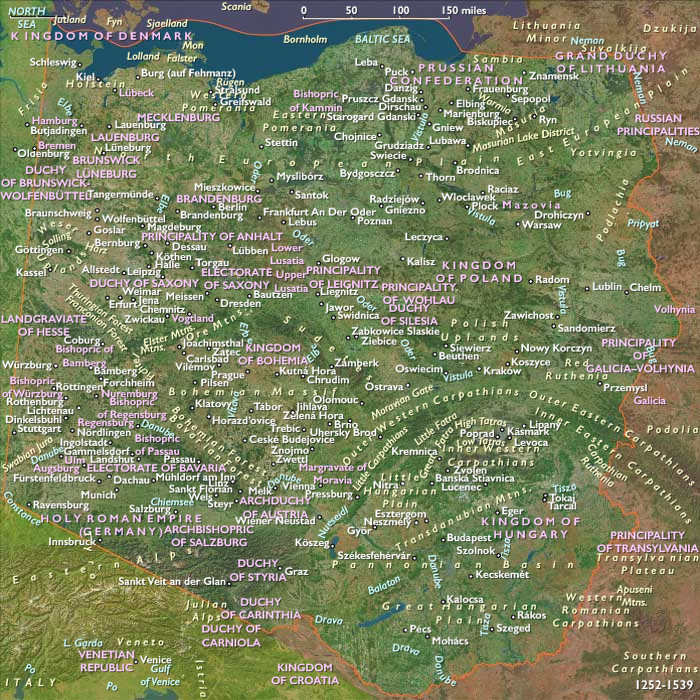
Low German-speaking colonists from the Holy Roman Empire had begun in the 1230s to settle north and south of the Warta and Noteć Rivers upon the initiative of Pomeranian and Polish lords.
The lords have invited members of the Knights Templar and Knights Hospitaller to establish monasteries, in whose surroundings settlements have begun to develop.
To fortify the borderland Pomeranian and Polish dukes built castles in the north, around which settlements have also grown.
Most of the colonists who settle in Brandenburg's new eastern territory come from Magdeburg or the Altmark ("Old March").
Unlike in the rest of Brandenburg, where the Ascanians have settled knights in open villages, the margraves have begun constructing castles in their land east of the Oder to guard against Poland.
The Slavic inhabitants of the region are becoming gradually Germanized.
Through land purchases, marriage pacts, and services to Poland's Piast dynasty, the Ascanians have extended their territory eastward to the Drawa River and northward to the Parsęta River.
To safeguard the region, Margrave John I founds the town of Landsberg an der Warthe in 1257.
Locations
Groups
- Polytheism (“paganism”)
- Polabian Slavs (West Slavs)
- Magdeburg, Archbishopric of
- Christians, Roman Catholic
- Hospitallers of St. John of Jerusalem
- Templar, Knights (Poor Knights of Christ and of the Temple of Solomon)
- Pomerania, Polish Duchy of
- Poland during the period of fragmentation, Kingdom of
- Brandenburg (Ascanian) Margravate of
- Holy Roman Empire
Topics
- Crusades, The
- Ostsiedlung (German: Settlement in the East), a.k.a. German eastward expansion
- Poland, Fragmentation of
- Northern Crusades, or Baltic Crusades
- Teutonic Knights' Conquest of Prussia
Commodoties
Subjects
Regions
Subregions
Years: 1257 - 1257
Locations
Groups
- Polytheism (“paganism”)
- Polabian Slavs (West Slavs)
- Magdeburg, Archbishopric of
- Christians, Roman Catholic
- Hospitallers of St. John of Jerusalem
- Templar, Knights (Poor Knights of Christ and of the Temple of Solomon)
- Pomerania, Polish Duchy of
- Poland during the period of fragmentation, Kingdom of
- Brandenburg (Ascanian) Margravate of
- Holy Roman Empire
Topics
- Crusades, The
- Ostsiedlung (German: Settlement in the East), a.k.a. German eastward expansion
- Poland, Fragmentation of
- Northern Crusades, or Baltic Crusades
- Teutonic Knights' Conquest of Prussia
Commodoties
Subjects
Regions
Subregions