
Louis the German, king of the East …
Years: 873 - 873
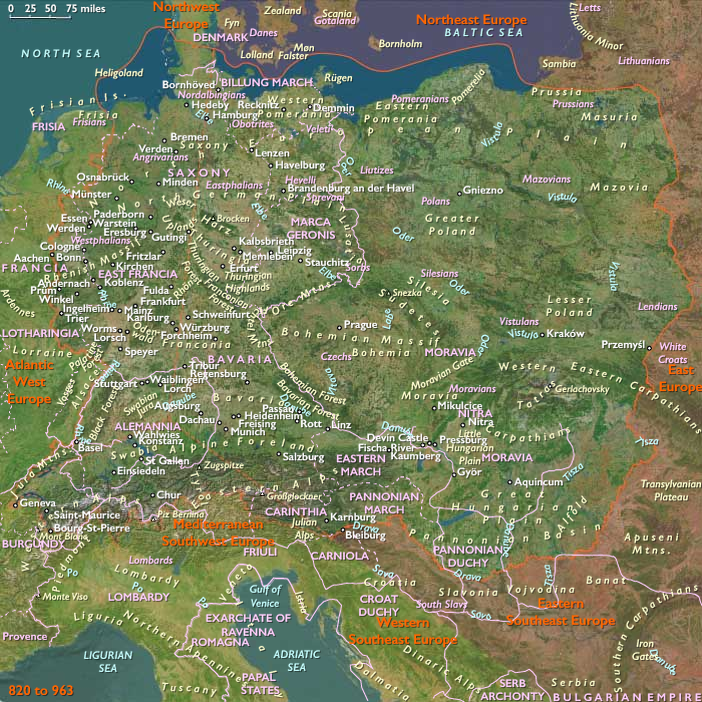
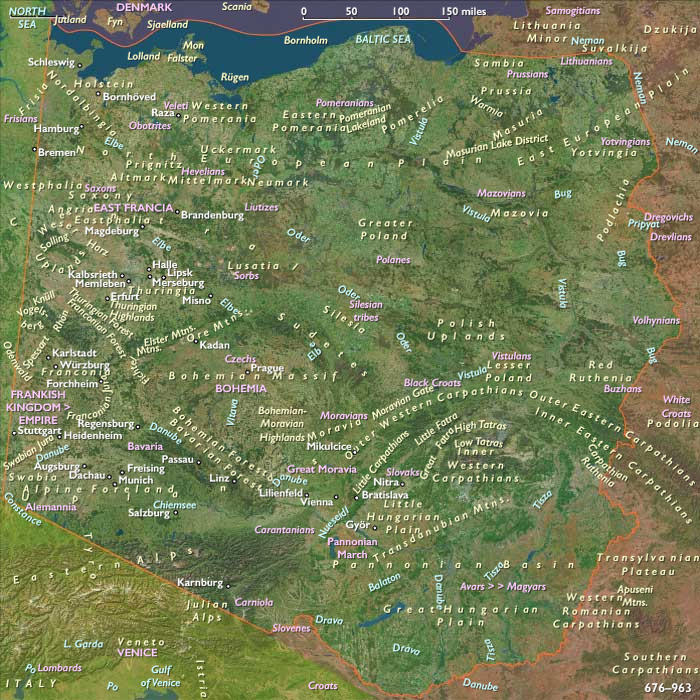
Louis the German, king of the East Franks, supports Frankish Catholic missions in Moravia, but has been unable to maintain control in this area and loses a war that leads to full Moravian independence under Rostislav's successor, Svatopluk (reigned 870–894).
Cyril, in Rome with his brother Methodius to defend their invention of what will become the Cyrillic alphabet, had died there in 869.
Methodius, consecrated an archbishop, had returned to Moravia later in the year as a papal legate.
The German authorities imprison him for three years until Pope John VIII secures his release.
People
Groups
- Franks
- Christianity, Chalcedonian
- Frankish, or Carolingian (Roman) Empire
- Moravia, Great, Kingdom of
- Francia Orientalis (East Francia), Kingdom of
Subjects
Regions
Subregions
Related Events
Filter results
Showing 10 events out of 53907 total
A widespread failure of the agricultural harvest in Tang Dynasty China leads to a widespread famine in 873; in the previous century the central government had been able to curb famine with large grain stores, but this time the central government is already in decline and too weak to properly face the disaster.
Iran’s native Tahirid dynasty has enjoyed a high degree of autonomy in their governance of the Abbasid province Khorasan from 821.
Abdullah ibn Tahir, one of the greatest of the Tahirid rulers, had died in 845 and had been succeeded by his son Tahir II.
Not much is known of Tahir's rule, but the administrative dependency of Sistan was lost to rebels during his governorship.
Tahirid rule had begun to seriously deteriorate after Tahir's son Muhammad ibn Tahir became governor, due to his carelessness with the affairs of the state and lack of experience with politics.
In Khorasan itself, Muhammad's rule has continued to grow increasingly weak, and in 873 he is finally overthrown by the Saffarid dynasty, who annex Khorasan to their own empire in eastern Persia, ruling practically independently of the Samarra-based Abbasid caliphate.
Vímara Peres and the Foundations of Portugal (868 CE)
Vímara Peres, a vassal of King Alfonso III of Asturias, León, and Galicia, is sent to reconquer and secure the western coastal fringe of Gallaecia from the Moors—the Arabs and Berbers who had invaded Visigothic Hispania. His mission covers the territory between the Minho and Douro Rivers, including the strategically important city of Portus Cale (later Porto and Gaia), from which the name Portugal will eventually emerge.
The Birth of the County of Portugal (868 CE)
After successfully expelling the Moors, Vímara Peres is named Count of Portugal in 868 CE, marking the first formal establishment of the county north of the Douro River.
While Portugal will not achieve full independence until the 12th century, later Portuguese historians recognize Vímara Peres' reconquest as the earliest milestone in the formation of the Portuguese state.
The Founding of Guimarães and Vímara’s Legacy
To solidify control over the newly reconquered lands, Vímara Peres establishes a fortified settlement under his own name, Vimaranis, which later evolves into Guimaranis and, ultimately, Guimarães. This city will come to be known as "The Cradle City" (A Cidade Berço) of Portugal.
Vímara Peres dies in 873 CE in Guimarães, leaving the governance of the County of Portugal to his son, Lucídio Vimaranes (Lucídio, son of Vímara), who succeeds him as count.
Hastein’s Seizure of Angers and the Carolingian Response (870–873)
The city of Angers, originally a Gallic settlement and later the Roman city of Juliomagus, is an important Carolingian stronghold located on the Maine River, about 160 miles (257 km) southwest of Paris. Its strategic location makes it a key target during the Viking incursions into West Francia in the 9th century.
Hastein Captures Angers (870)
- Hastein, a prominent Viking chieftain, seizes Angers in 870, likely using the Maine River as an entry route into the Frankish heartland.
- This occupation is part of wider Norse incursions into the Loire Valley, where Vikings had established winter bases at Noirmoutier and along the Loire River.
- However, after a Frankish counteroffensive, Hastein is quickly surrounded and besieged, forcing him to abandon the city.
Hastein Retakes Angers (873)
- Despite his earlier expulsion, Hastein launches another attack in 873, reoccupying Angers.
- His second conquest suggests that Carolingian defenses remain weak, with the kingdom still vulnerable to Viking raids.
- Angers, like many Frankish river towns, is difficult to defend, as Viking longships easily navigate inland waterways, striking before the Franks can respond.
Carolingian Retaliation and the Expulsion of Hastein
- In 873, the Carolingian Emperor (likely Charles the Bald) launches a military campaign to reclaim Angers.
- Hastein is ousted once again, though it is unclear whether he is killed in battle, forced into retreat, or negotiates terms for his withdrawal.
- The successful recapture of Angers marks a temporary Frankish victory, but Viking threats to the Loire Valley continue, forcing the Carolingians to constantly defend the region.
The Significance of the Viking Sieges of Angers (870–873)
- Strategic Importance → The repeated Viking assaults on Angers and the Loire Valley highlight the region’s vulnerability as an access point to deeper Frankish territory.
- Frankish Struggles → The Carolingian response is slow and reactive, showing the difficulty of defending riverine settlements against mobile Viking forces.
- Hastein’s Role → Hastein emerges as one of the most formidable Viking leaders of the 9th century, engaging in raids from Francia to the Mediterranean.
- Foreshadowing Future Invasions → The repeated attacks on Angers are part of a larger pattern of Viking expansion, setting the stage for further raids into Brittany, Neustria, and deeper into Frankish lands.
Though Angers is eventually reclaimed, the Viking incursions of 870–873 further demonstrate the inability of the Carolingians to permanently drive out Norse raiders, who continue to exploit weak river defenses in West Francia.
The Treaty Between Charles the Bald and Rorik of Dorestad (870–873)
Following the Treaty of Meerssen (870), which divided Lotharingia between Louis the German and Charles the Bald, the two Carolingian rulers sought to consolidate their control over Viking-occupied territories, particularly in Frisia and the Low Countries. This led Charles to negotiate with Rorik of Dorestad, a Danish Viking ruler who had previously held Frisian lands under Lothair I and Lothair II.
Charles the Bald’s Treaty with Rorik (870)
- According to the Annales Bertiniani, Charles traveled to Nijmegen to meet with Hrørek (Rorik) and bind him to his rule through a treaty.
- This agreement mirrored earlier arrangements made by Lothair I and Lothair II, under which Rorik had ruled as a semi-independent vassal while acknowledging Carolingian sovereignty.
- Rorik retained control of his territories, holding land on both sides of the new border between Charles’ and Louis’ kingdoms.
Further Negotiations (872) and Rorik’s Final Allegiance to Louis (873)
- In 872, there were further diplomatic exchanges between Charles and Rorik, suggesting that the Viking leader was playing both Frankish rulers against each other to maintain his autonomy.
- However, in 873, Rorik swears allegiance to Louis the German, indicating that he had shifted his loyalty from Charles to East Francia.
- After this event, Rorik disappears from historical records, with no further mentions of his fate.
The Rorik-Rurik Debate: Was Rorik the Founder of Kievan Rus’?
- Since the 19th century, some historians have attempted to identify Rorik of Dorestad with Rurik, the legendary Norse founder of Kievan Rus’ as described in the Primary Chronicle.
- The argument is based on:
- The similarity of the names Rorik (Hrørek) and Rurik (Hrørikr).
- The disappearance of Rorik from Frankish sources after 873, which coincides with the traditional timeframe of Rurik’s rule in Novgorod (c. 862–879).
- However, most scholars remain skeptical, as no contemporary sources explicitly link the Frankish Rorik with the Eastern Slavic Rurik.
Significance of the Treaty and Rorik’s Role
- Rorik’s shifting allegiances demonstrate how Carolingian rulers struggled to control Viking warlords, often resorting to diplomatic agreements instead of military confrontation.
- His control over Frisia and the Low Countries meant that Viking influence remained strong in the region, despite Carolingian attempts to integrate Norse leaders into their feudal system.
- His final allegiance to Louis the German in 873 suggests that East Francia had gained the upper hand in the struggle for control over Frisia and the North Sea trade routes.
Although the Rorik-Rurik connection remains uncertain, what is clear is that Rorik of Dorestad played a significant role in Viking-Frankish diplomacy, navigating between rival Carolingian rulers while maintaining his own territorial autonomy.
The Tang Dynasty, established in 618, had already passed its golden age and entered its long decline beginning with the An Lushan Rebellion by Sogdian general An Lushan.
The power of provincial military governors (Jiedushi) had increased greatly after imperial troops crushed the Anshi rebels.
The morals of these generals had also decayed as their power increased, the resentment of common people against the inability of the government had grown, and their grievances had exploded into several rebellions during the mid-ninth century.
Many impoverished farmers, tax-burdened landowners and merchants, as well as many large salt smuggling operations, had formed the base of the anti-government rebellions of this period.
Wang Xianzhi and Huang Chao are two of the important rebel leaders during this era.
The rebellion of Huang Chao begins in 874, weakening the strength of the already declining Tang Dynasty.
Late in the Xiantong era (860-873) of Emperor Yizong, there had been severe alternating droughts and floods that have caused terrible famines.
Despite this, the Tang imperial government had not tended to the victims of these natural disasters, and the taxes not only were not decreased, but had been increased to fund Emperor Yizong's luxurious lifestyle and campaigns.
As a result, the survivors have grouped themselves into bands and rise to resist Tang rule.
Wang Xianzhi (who, like Huang Chao, is a salt privateer) and Shang Junzhang rise at Changyuan (in modern Xinxiang, Henan) in 874.
Methodius now returns to Moravia and places himself under the protection of Svatopluk.
Relations between the ruler and the archbishop, however, are not harmonious.
After Svatopluk's conciliation with the Franks at Forchheim in 874, clerics of the Latin rite appear again in Moravia, interfering with the archbishop's work.
The Vistulans (also known as the Vislanes), have from the first century and possibly earlier been part of the Carpian Tribe, which got its name from the area that they lived in, which was beside the Carpathian Mountain Range.
Vistulans in the ninth century have created a tribal state, with major centers in Kraków, Wiślica, Sandomierz, and Stradów.
They are subjugated by Svatopluk, probably around 874, and the Vistulan duke is forced to accept baptism.
The historical existence of the twelfth imam has been long debated since the death of eleventh Imam.
Even though Shi’ite scholars admit that the Twelfth Imam is an actual person, the Eleventh Imam, Hasan al-Askari, had been kept more or less a prisoner by the Abbasids in the camp at Samarra, about one hundred kilometers north of Baghdad, and dies here in 874 at the age of twenty-eight.
It appears that none of the Shi'i notables knew of the existence of the son of eleventh Imam.
The only possible occasion the son of eleventh Imam is said to made a public appearance was at the time of his death, then as a child and the boy was seen no more.
The Shiite Twelvers (“Ithna Ashariyya”) believe he will return as the “mahdi” (messiah).
The Cretan raids reach a new intensity in the early 870s: the Emirate’s fleets, often commanded by imperial renegades, range the Aegean and further afield, reaching the Dalmatian coasts.
On one occasion a Cretan fleet even penetrates into the Marmara Sea and unsuccessfully attacks Proconnesos; the first time since the Second Arab Siege of Constantinople in 717–718 that a Muslim fleet had come so close to the imperial capital.
They also suffer two successive heavy defeats, however, in 873 and again in 874, at the hands of the new imperial admiral, Niketas Ooryphas.
After the latter battle in particular, Ooryphas takes many prisoners, whom he tortures extensively in revenge for their raids.
At about the same time, …
Years: 873 - 873
People
Groups
- Franks
- Christianity, Chalcedonian
- Frankish, or Carolingian (Roman) Empire
- Moravia, Great, Kingdom of
- Francia Orientalis (East Francia), Kingdom of
