Louis IV of the House of Wittelsbach …
Years: 1314 - 1314
November
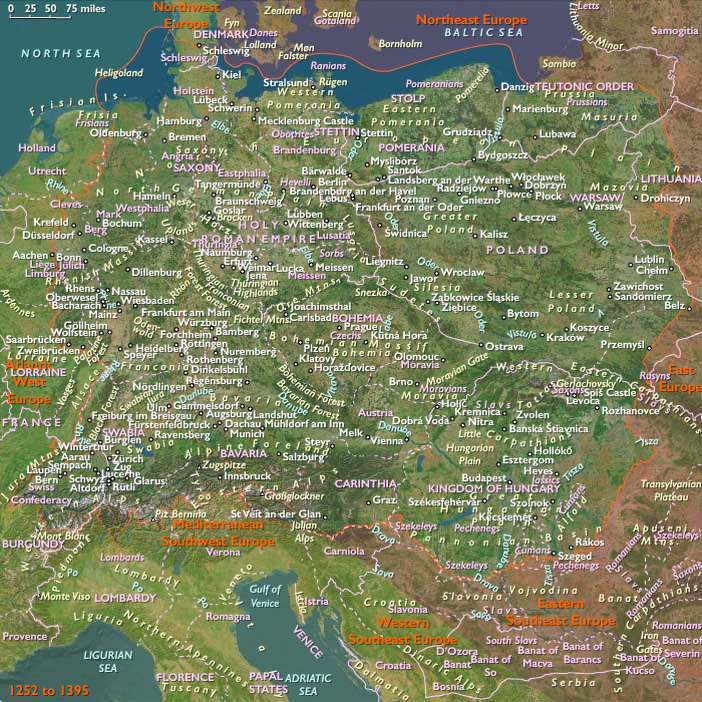
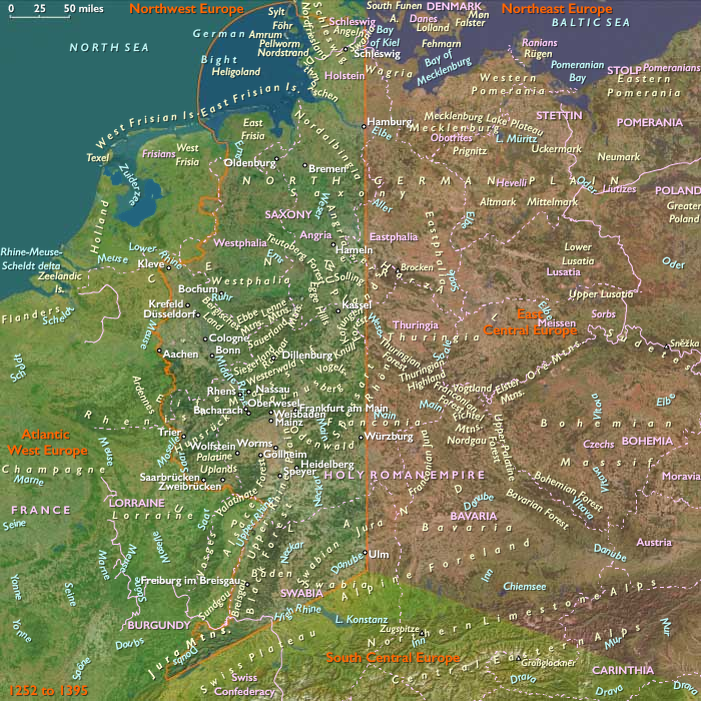
Louis IV of the House of Wittelsbach had been elected King of the Romans at Sachsenhausen by five of the electors on October 20 , being crowned on November 25 at Aachen.
Locations
People
Groups
Topics
Commodoties
Subjects
Regions
Subregions
Related Events
Filter results
Showing 10 events out of 44787 total
The testament of Boleslaw III Krzywousty had initiated the period of fragmentation of Poland (1138–1320), in which the western part of Greater Poland (including Poznań) had been granted to Mieszko III the Old.
The eastern part, with Gniezno and Kalisz, was part of the Duchy of Kraków, granted to Wladyslaw II the Exile.
However for most of the period the two parts were under a single ruler, and were known as the Duchy of Greater Poland (although at times there were separately ruled duchies of Poznań, Gniezno, Kalisz and Ujście).
The region comes under the control of Wladyslaw I the Elbow-High in 1314, who, continuing his campaign to unite the separate Polish principalities, unites it to Little Poland.
Dragutin in the meantime has expanded, holding lands from Braničevo in the east to the Bosna river in the west.
His capital is Belgrade.
War had broken out between the brothers and, though clergy had calmed by the clergy in 1313, lasts, with sporadic cease-fires, until Dragutin's death.
During this war Milutin had appointed Stefan Dečanski as regent in Zeta, modern Montenegro.
This means that Stefan Dečanski is to inherit the throne in Serbia and not Dragutin's son Stefan Vladislav II.
Dragutin separates from his Hungarian friends and strengthened his connections in Serbia near the end of his life, later becoming a monk and changing his name to Teoktist.
He dies in 1316 and is buried in the Đurđevi Stupovi monastery near Novi Pazar.
His son Stefan Vladislav II becomes the new ruler of the Kingdom of Srem, but Milutin, his uncle, defeats him and imprisons him.
The Integration of Champagne into the French Crown (1314)
The Counts of Champagne ruled the region from 950, with the territory evolving from the County of Troyes in the late 11th century. Hugh I was the first to officially use the title "Count of Champagne," solidifying its status as a distinct feudal entity.
The Personal Union of Champagne and Navarre (1234)
- In 1234, Count Theobald IV of Champagne inherited the Kingdom of Navarre upon the death of his childless uncle, Sancho VII of Navarre.
- This created a personal union between Champagne and Navarre, greatly increasing the count’s political influence in both France and Spain.
The Union of Champagne, Navarre, and France
- Theobald IV’s great-granddaughter, Joan I of Navarre, married King Philip IV of France, bringing both Champagne and Navarre into the Capetian sphere.
- Their marriage marked the first unification of the Crowns of France and Navarre.
Champagne’s Absorption into the French Crown (1314)
- When their son, Louis X, ascended the French throne in 1314 after Philip IV’s death, Champagne was fully integrated into the French royal domain.
- Unlike Navarre, which would later separate from France, Champagne remained a permanent part of the Crown's territories.
Impact of Champagne’s Integration
- Champagne had long been an economic powerhouse, known for its prosperous fairs and trade networks that connected northern Europe with the Mediterranean.
- With Champagne now under direct royal control, its role as a commercial and financial center became even more central to the Capetian monarchy.
- The loss of its autonomy contributed to the decline of Champagne’s great medieval fairs, as royal policies increasingly centralized trade in Paris.
The integration of Champagne into the French Crown in 1314 marked the end of its independent rule but solidified Capetian control over one of medieval Europe’s most economically vibrant regions.
The Execution of Jacques de Molay and the Final Suppression of the Templars (1314)
By 1314, after years of persecution, the last leaders of the Knights Templar, including Grand Master Jacques de Molay, faced their final trial under King Philip IV of France. Despite enduring years of imprisonment and forced confessions under torture, de Molay and other Templar leaders retracted their confessions, declaring both their own innocence and that of the order.
Philip IV’s Response: The Burning of the Templar Leaders
- On March 18, 1314, in Paris, Jacques de Molay and Geoffroi de Charney (Preceptor of Normandy) were publicly burned at the stake on an island in the Seine River, near the Île de la Cité.
- Their execution was meant as a final display of royal power, preventing any further challenges to the verdict against the Templars.
- According to legend, as he was being burned, de Molay cursed Philip IV and Pope Clement V, summoning them to divine judgment within a year—both men indeed died within months of his execution.
The Fate of the Templars’ Holdings
- The Templars' vast estates and wealth, though heavily sought after, did not directly enrich Philip IV.
- Many of their landholdings and assets were transferred to the Knights Hospitaller, another military order that remained in papal favor.
- Some Templar properties were absorbed by secular rulers, particularly in Spain and Portugal, where remnants of the order continued to operate under new names.
- The French Crown, despite orchestrating the suppression of the Templars, gained little financially from their downfall.
Legacy of the Templars’ Suppression
- The destruction of the Knights Templar removed one of the most powerful institutions of medieval Christendom, marking a shift in power from military orders to centralized monarchies.
- The brutality of Philip IV’s campaign against the Templars is remembered as one of the most cynical acts of royal opportunism in medieval history.
- The mystique surrounding the Templars’ fate has fueled centuries of legends, conspiracy theories, and speculation about hidden treasures and secret survival of the order.
The burning of Jacques de Molay on March 18, 1314, was the final act in Philip IV’s ruthless suppression of the Templars, ensuring their destruction as an institution but securing their place in legend.
The Pope, who openly favors Frenchmen, as well as his relatives, promulgates the “Clementinae,” a collection of decretals (later incorporated in canon law), shortly before his death, at about fifty, on April 20, 1314.
The Scots have by 1314 recovered all the castles controlled by English garrisons except Berwick and Stirling.
Edward II leads a large and lavishly equipped English army, heavy with cavalry, north in an effort to relieve Robert the Bruce’s months-long siege of Stirling Castle.
Bruce creates a two thousand-foot front by positioning eight thousand men on a hill at Bannockburn, near Stirling, placing his left flank in dense woods and his right on a bend the brook.
The English must not only advance up a hill but must also cross a bog in order to reach it.
Edward gives the order to advance on June 24; as the heavily armored knights advance through a hail of Scottish spears and arrows, they begin to sink in the marsh while Scottish spearmen drive back Edward’s archers.
The English, although superior in number by a factor of three to one, suffer heavy losses against the Scottish pikemen and soon retreat with the Scottish infantry in pursuit.
Edward panics and flees, followed by his surviving troops.
The Scots consider the victory a confirmation of their independence, but the obstinate Edward refuses to agree.

Frederick the Fair of the House of Habsburg had been elected King of the Romans at Sachsenhausen (Frankfurt am Main) on October 19 by four of the electors, being crowned on November 25 at Bonn Minster.
The Death of Philip IV and the Succession of Louis X (1314)
On November 29, 1314, King Philip IV of France (Philip the Fair) died at the age of forty-six, amid growing unrestover his harsh fiscal policies. His reign had been marked by territorial expansion, conflicts with the papacy, and the destruction of the Knights Templar, but by the end of his life, his stringent taxation and financial measures had provoked widespread discontent among his subjects.
Philip IV’s Legacy and the Causes of Unrest
- Philip's financial demands—which included heavy taxes on the nobility, the Church, and townspeople—led to resentment and opposition from all classes.
- His coinage debasement policies, meant to counterbalance financial shortfalls, contributed to economic instability and angered merchants and peasants alike.
- His confiscation of Jewish property (1306) and destruction of the Templars (1307–1314) had enriched the crown but at the cost of political controversy and loss of financial expertise in France.
- His wars with Flanders and England, although initially successful, had drained resources and led to further taxation, deepening popular dissatisfaction.
Succession: Louis X, "the Stubborn"
- Philip IV was succeeded by his eldest son, Louis X, also known as Louis the Stubborn (Louis le Hutin).
- Louis inherited a troubled kingdom, where resentment toward royal fiscal policies was high, and the nobility sought to reclaim lost privileges.
- His reign would be short-lived (1314–1316), but he would introduce key reforms, including abolishing serfdom in parts of France.
Philip IV’s Death: A Turning Point in Capetian Rule
- The unexpected death of Philip IV marked the beginning of the end of the direct Capetian line, as his three sons would all die without male heirs, leading to the eventual rise of the House of Valois and the Hundred Years’ War.
- Though ruthless and pragmatic, Philip IV left behind a centralized French monarchy, paving the way for the continued expansion of royal authority in later centuries.
Philip IV’s death in 1314, amid revolt and financial turmoil, ushered in a new phase of instability under Louis X, whose reign would struggle with noble resistance and economic unrest.
The loyalties of the German electors, seeking a king from another dynasty at the death of thirty-nine-year-old Emperor Henry VII on August 24, 1313, had been divided between Wittelsbach dynastic family member Louis, duke of Bavaria, and the Habsburg Frederick the Fair, duke of Austria, the choice of the majority.
Both have been elected king by their respective constituencies in 1314, and war ensues to settle the claim and decide who will be Holy Roman Emperor, a title both claimants assume.
Moreover, the papacy had become vacant upon the death of Clement V, thus obviating the pope’s rightful adjudication of contested elections.
Charles gradually encircles the Csák dominion, appointing loyal castellans to head of the nearby forts.