...Louis II obtains the western part of …
Years: 1255 - 1255
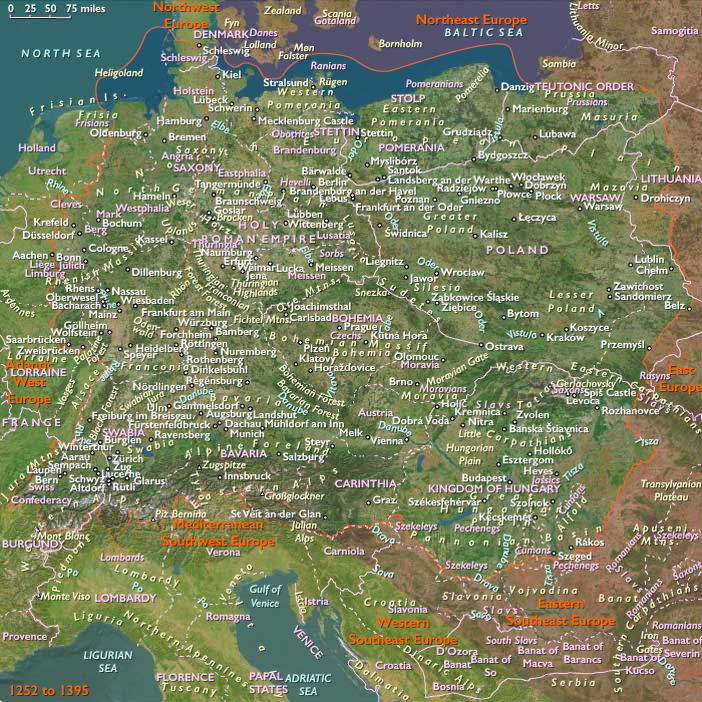
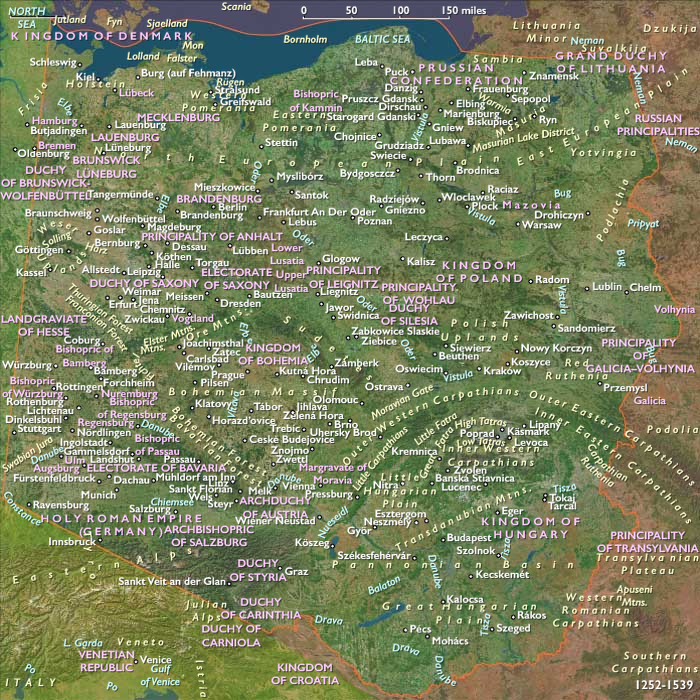
...Louis II obtains the western part of the duchy, afterwards called Upper Bavaria; he also receives the Electoral Palatinate.
Locations
People
Groups
- Germans
- Palatinate of the Rhine, County
- Bavaria, Wittelsbach Duchy of
- Holy Roman Empire
- Bavaria, Upper, Duchy of
- Bavaria, Lower, Duchy of
Topics
Subjects
Regions
Subregions
Related Events
Filter results
Showing 10 events out of 46159 total
Great Khan Möngke dispatches his brother Hulagu to the southwest, an act that is to expand the Mongol Empire to the gates of Egypt.
European conquest is neglected due to the primacy of the other two theaters, but Möngke's friendliness with Batu ensures the unity of empire.
Batu Khan's relations with his cousins had been so poor after he returned from Mongolia that not until the election of Möngke Khan as Khagan did he again consider turning westward to Europe.
Planning new campaigns after Guyuk's death, and intent on carrying out Subutai's original plans to invade Europe, Batu dies in 1255 and the khanate passes to Sartaq, his son by Khanum Boraqcin of Hwarizim Sahi.
Sartaq is reputed to be a Christian convert; his father being a Shamanist.
There are several stories of Sartaq's conversion.
The Armenian writers, for example, alleged that Sartaq was brought up and baptized among the Russians.
However, a message dated August 29, 1254 by Sartaq addressed to Pope Innocent IV, stated that Sartaq, at this time a duke, had been baptized as a Christian.
The Pope had heard the news from a priest whom the khan had sent as envoy to the papal court.
Sartaq decides against the invasion of Europe.
The Kipchak Khanate, or Golden Horde, is to rule Russia through local princes for the next two hundred and thirty years.
In 1255, the Teutonic Knights establish the city of Königsberg, naming it in honor of Ottokar II of Bohemia, situated on the Pregolya River near where it empties into the Vislinsky (Wislany) Lagoon of the Baltic Sea, on the foundations of a destroyed Sambian settlement known as Tvanksta. (Eventually a capital of the monastic state of the Teutonic Knights, the Duchy of Prussia, and the German province of East Prussia, the seaport is today the administrative center of Kaliningrad Oblast, the Russian exclave between Poland and Lithuania on the Baltic Sea.)
The Order of the Teutonic Knights, having moved to Transylvania in 1211 to help defend Hungary against the Cumans after Christian forces were defeated in the Middle East, had been expelled in 1225 after allegedly attempting to place themselves under papal instead of Hungarian sovereignty.
Following the Golden Bull of Rimini, which bestowed on the Order a special imperial privilege for the conquest and possession of Prussia, the Order’s Grand Master Hermann von Salza and Duke Konrad I of Mazovia had made a joint invasion of "Old Prussia" in 1226 to Christianize the Baltic Old Prussians in the Prussian Crusade.
Christopher of Denmark, elected King upon the death of his older brother Abel in the summer of 1252, had been crowned at Lund Cathedral on Christmas Day 1252.
Christopher had begun organizing the effort to have his brother Erik IV Plovpenning canonized, laying his murder directly at the feet of his other brother Abel.
If recognized by the pope, the murder will exclude Abel's sons from the succession and guarantee Christopher's own sons Denmark's crown.
This means that Christopher as a younger son tries to keep the sons of his older brothers from ruling Denmark, which goes against prevailing customs.
The king will spend most of his reign fighting his many opponents.
By allowing Abel's son, Valdemar Abelsøn, to be Duke of Schleswig, he prevents an all-out civil war, but becomes the target of intrigue and treachery.
Southern Jutland, including Schleswig and Holstein, are independent from the king's rule for a time.
Christopher also gains a ferocious enemy in the newly named Archbishop of Lund, Jacob Erlandsen, who is closely connected with Abel's family.
Erlandsen asserts his rights often at odds with the king.
King Christopher insists that the church pay taxes like any other land owner.
Bishop Jacob refuses and goes so far as to forbid peasants who live or work on church properties to give military service to King Christopher.
Erlandsen is perhaps the wealthiest man in the kingdom and insists that the secular government has no control or hold over the church, its property, or ecclesiastical personnel.
He simply excommunicates the king to show that he isn't about to surrender to the king's will.

The efforts of Bavaria’s Wittelsbach dukes to increase their power and to give unity to the duchy had met with a fair measure of success.
Now, however, Louis II and Henry XIII, the sons of Duke Otto II, who for two years after their father's death have ruled Bavaria jointly, split their inheritance: …
Henry secures eastern or Lower Bavaria.
Bavaria’s partitioning and repartitioning among different members of the family will for the next two hundred and fifty years bring intermittent warfare and attendant weakness.
Ottokar II also leads two crusade expeditions against the pagan Old Prussians.
Königsberg (now Kaliningrad, Russia), founded in 1255 by the Teutonic Order, is named in his honor; it will later become the capital of Ducal Prussia.
Theodore II Doukas Laskaris, the only son of Emperor John III Doukas Vatatzes and Eirene Laskarina, the daughter of Emperor Theodore I Laskaris and Anna Angelina—Anna was a daughter of Emperor Alexios III Angelos and Euphrosyne Doukaina Kamaterina—had received a scholarly education.
(He will remain devoted to science and art throughout his life.)
In contrast with earlier practice, Theodore was not crowned co-emperor with his father, though he has assisted in the government since about 1241.
At his father’s death on November 4, 1254, the army and the court had acclaimed Theodore emperor but he is crowned only after the appointment of a new patriarch, Arsenios Autoreianos, at the beginning of 1255.
Theodore’s succession is exploited by the Bulgarians, who, under the young and inexperienced Tsar Michael II Asen, invade Thrace and Macedonia.
In spite of his own scholarly predisposition, Thedore immediately marches against the Bulgarians, waging two victorious campaigns against them.
William of Rubruck and his companions reach Tripoli on August 15, 1255.
His is the fourth European mission to the Mongols.
Before William had gone Giovanni da Pian del Carpine and Ascelin of Lombardia in 1245 and André de Longjumeau in 1249.
William’s account is one of the masterpieces of medieval geographical literature, comparable to that of Marco Polo.
A good observer and an excellent writer, William had asked many questions along the way and, unlike Marco Polo, did not take folk tale and fable as truth.
In this report, he describes the peculiarities of Mongolia as well as many geographical observations, making it the first scientific description of central Asia.
There are also anthropological observations, such as his surprise at the presence of Islam in Inner Asia.
William also answers a long-standing question, demonstrating by his passage north of the Caspian, that it is an inland sea and does not flow into the Arctic Ocean; although earlier Scandinavian explorers had doubtless already known this, he is the first to report it.
The French King is encouraged to send another mission by reports of the presence of Nestorian Christians at the Mongolian court.
Years: 1255 - 1255
Locations
People
Groups
- Germans
- Palatinate of the Rhine, County
- Bavaria, Wittelsbach Duchy of
- Holy Roman Empire
- Bavaria, Upper, Duchy of
- Bavaria, Lower, Duchy of