
Filters:
The Succession Crisis of 1316–1317 and the …
Years: 1317 - 1317
The Succession Crisis of 1316–1317 and the Origins of the Salic Law Interpretation
Upon the death of Louis X of France in 1316, his only son, John I, posthumously born on November 15, 1316, became king. However, John lived only a few days, dying on November 19, 1316. His eldest uncle, Philip of Poitiers, had been acting as regent but now saw an opportunity to claim the throne for himself.
Philip V’s Claim and the Exclusion of Joan
- John I’s death created uncertainty, as Louis X had also left behind a daughter, Joan (born in 1312), who by traditional inheritance laws should have succeeded him.
- However, Philip of Poitiers, Louis X’s twenty-three-year-old younger brother, disregarded Joan’s claim, arguing that a woman could not inherit the throne.
- To legitimize his claim, Philip convened an assembly of prominent citizens in 1317, which declared that a woman could not succeed as ruler of France.
- He was crowned Philip V in January 1317, solidifying his rule.
The Establishment of the Male-Only Succession Rule
- Although no formal "Salic Law" (excluding female succession) was yet established, Philip V’s succession set a powerful precedent that later French kings and legal scholars would invoke.
- This principle would be fully codified in the 15th century, but its origins trace back to this 1316–1317 succession crisis.
- The exclusion of Joan of Navarre from the French throne had long-term consequences, particularly in the Hundred Years' War (1337–1453), when England’s Edward III used his maternal descent from Philip IV to justify his claim to the French crown.
Navarre’s Separation from France
- While Philip V successfully secured the French throne, Joan’s exclusion from France's succession did not go unchallenged elsewhere.
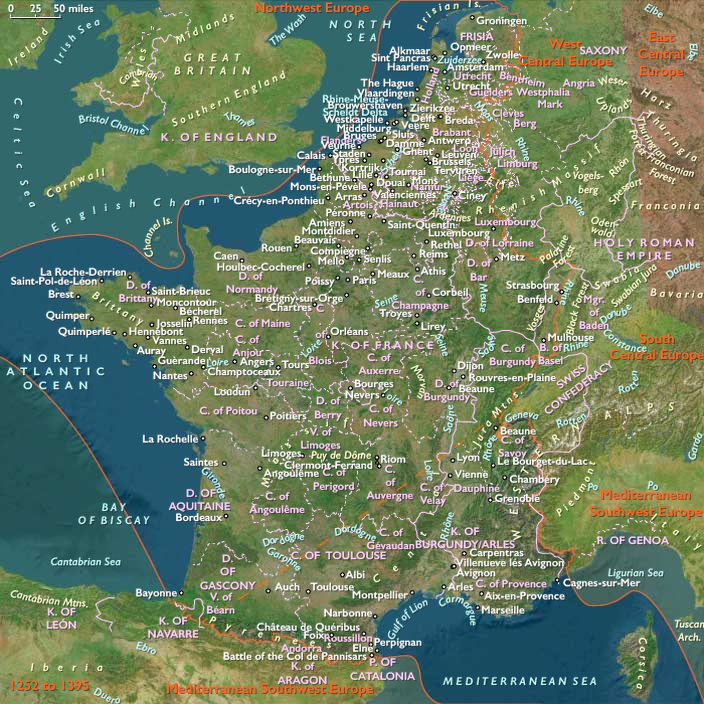
- In Navarre, where inheritance laws did allow female succession, Joan’s claim was later recognized, and she became Queen Joan II of Navarre in 1328, effectively separating Navarre from France after nearly thirty years of union.
Legacy
- The events of 1316–1317 shaped the future of French succession law, ensuring that only male heirs could inherit the throne, a rule that remained in force until the end of the monarchy.
- Philip V’s strategic maneuvering prevented the Capetian line from passing through a female heir, securing his family's continuity in power.
- The exclusion of female heirs later became a key point of contention in European dynastic disputes, influencing both internal French politics and international conflicts.
Philip V’s assumption of the throne in 1317 not only determined the immediate succession crisis but also set the foundation for centuries of male-only inheritance in France, ultimately influencing the course of European history.
Locations
People
Groups
Commodoties
Subjects
- Commerce
- Labor and Service
- Conflict
- Faith
- Government
- Custom and Law
- Technology
- Medicine
- Philosophy and logic
Regions
Subregions

Related Events
Showing 1 events out of 1 total
Years: 1317 - 1317
Locations
People
Groups
Commodoties
Subjects
- Commerce
- Labor and Service
- Conflict
- Faith
- Government
- Custom and Law
- Technology
- Medicine
- Philosophy and logic
Regions
Subregions