
The Creation of the Kingdom of Aquitaine …
Years: 781 - 781
The Creation of the Kingdom of Aquitaine and the Crowning of Louis (781)
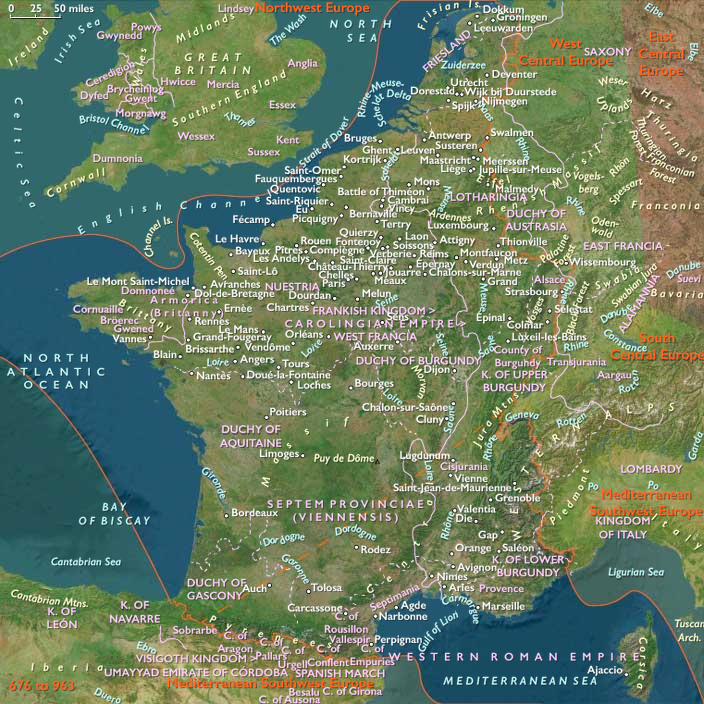
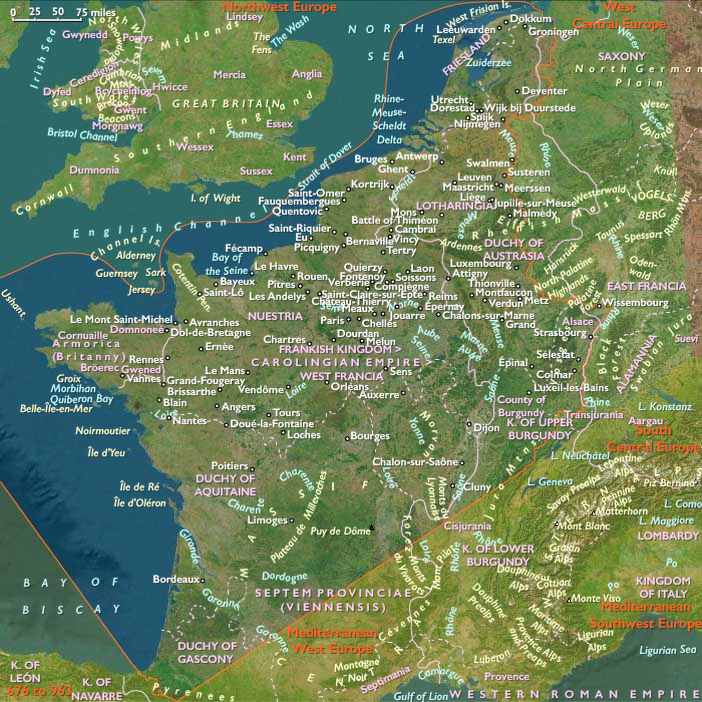
In 781, Louis, the three-year-old son of Charlemagne, is crowned King of Aquitaine and sent to rule from the region, accompanied by regents and a court. This move is part of Charlemagne’s broader territorial strategy, aimed at securing the southwestern border of the Frankish kingdom after decades of conflict with the Aquitanians and Basques.
Strategic Importance of the Kingdom of Aquitaine
The decision to establish a subkingdom in Aquitaine follows the destructive war against Duke Waifer (768) and the subsequent rebellion of Hunald II, culminating in the disastrous Battle of Roncevaux Pass (778), where Charlemagne’s rear guard was ambushed and annihilated by Basque forces. By placing his son in Aquitaine, Charlemagne ensures that Louis grows up in the land he is to govern, fostering stronger regional ties and loyalty while maintaining Frankish control over the volatile region.
Territorial Composition and Governance
The new Kingdom of Aquitaine, while formally subordinate to Francia, is larger than Aquitaine proper and includes:
- Aquitaine itself,
- Gothia (Septimania),
- Frankish possessions in Spain, forming the early Spanish March, a key frontier against Muslim Al-Andalus.
While Louis resides in the northern palaces of the kingdom, the actual administration is centered in Toulouse, governed by Count Guilhèm de Gellona (William of Gellone), one of Charlemagne’s most trusted vassals and military commanders.
Palaces of the Young King
To ensure proper governance and regional integration, Louis’s court moves among various Carolingian palaces in the northern part of the kingdom, including:
- Limoges / Le Palais-sur-Vienne,
- Poitiers / Chasseneuil,
- Ebreuil,
- Bourges,
- Angeac-sur-Charente / Angoulême,
- Doué-La-Fontaine.
Long-Term Impact
By establishing Louis as King of Aquitaine, Charlemagne creates a more stable administration in the region while ensuring a direct Carolingian presence in a previously rebellious area. This move also lays the foundation for future Frankish expansion into Muslim-held Spain, as the Spanish March develops into a key military frontier. Ultimately, Louis will grow into his role, later ascending as Louis the Pious, the sole heir to the Carolingian Empire after Charlemagne’s death.
Locations
People
Groups
Topics
Subjects
Regions
Subregions
Years: 781 - 781
Locations
People
Groups
Topics
Subjects
Regions
Subregions