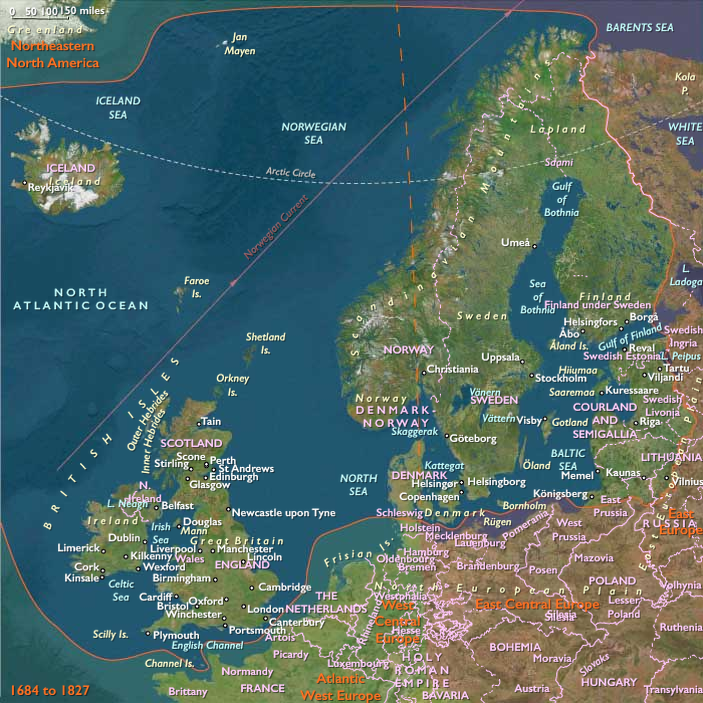
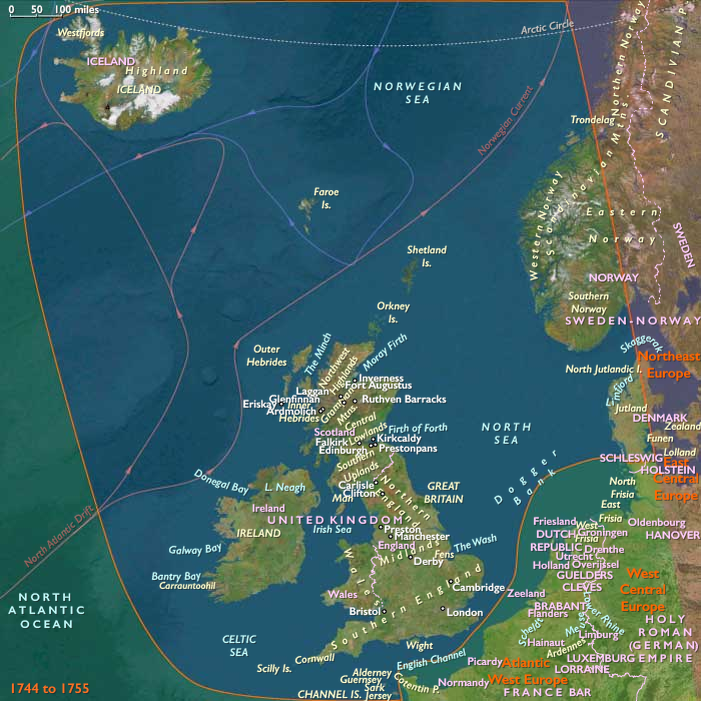
Lord Derby abandons the defense of Manchester …
Years: 1745 - 1745
November
Lord Derby abandons the defense of Manchester on November 23.
A three hundred-strong Manchester Regiment is raised in the town.
Locations
People
- Charles Edward Stuart
- George II of Great Britain
- Henry Pelham
- James Francis Edward Stuart
- John Cope
- John Murray
- Louis XV of France
- Prince William, Duke of Cumberland
Groups
Topics
Commodoties
Subjects
Regions
Subregions
Related Events
Filter results
Showing 10 events out of 27125 total
The Austrians enjoy further military success following the death of the French puppet, Emperor Charles VII, in January 1745.
When his successor, Maximilian III Joseph, hesitates over peace proposals, the Austrians launch a rapid campaign, culminating in April with the Franco-Bavarian defeat at the decisive Battle of Pfaffenhofen.
Max Joseph sues for peace and gives his support for the candidacy of Maria Theresa's husband, Francis Stephen, in the coming Imperial election for the vacant throne.
The Austrians, with Bavaria out of the war, can now try to win back Silesia from Frederick II.
Bavarian repudiation of its French ties likewise means France is freed of its German involvement, and can now concentrate on its own military efforts in Italy and the Low Countries.
Jean-Étienne Liotard had gone to Vienna in 1742 to paint the portraits of the imperial family, and in 1745 sells La belle chocolatière (The Chocolate Girl) to Francesco Algarotti.
Classified by Liotard’s contemporaries as his masterpiece, the pastel shows a girl carrying a tray with a porcelain chocolate mug and a glass of water.
Liotard, whose father was a jeweler who had fled France for Switzerland after 1685, was born at Geneva and began his studies under Professors Gardelle and Petitot, whose enamels and miniatures he copied with considerable skill.
He had gone to Paris in 1725, studying under Jean-Baptiste Massé and François Lemoyne, on whose recommendation he had been taken to Naples by the Marquis Puysieux.
He was in Rome in 1735, painting the portraits of Pope Clement XII and several cardinals.
Three years later, he accompanied Lord Duncannon to Constantinople, where his eccentric adoption of oriental costume had secured him the nickname of the Turkish painter.
Nader Shah returns in August 1745 to meet and rout a huge Turkish army at the Battle of Kars.
The Turks flee west, raiding their own country as they go and prompting fighting among the various Turks.
The war disintegrates.
Brilliantly successful as a soldier and general, Nader Shah has little talent for statesmanship or administration, and Iran has become utterly exhausted during the later years of his reign.
Tens of thousands of people have perished in his ceaseless military campaigns, and the exactions of his tax gatherers have ruined the country's economy.
Nader Shah has always been harsh and ruthless, but these traits have become more pronounced as he grows older.
His suspicious nature and capricious cruelty have continued to grow, and wherever he goes he has people tortured and executed.
The consequence is that revolt after revolt against him has occurred.
Now growing insane, Nader Shah punishes his subjects by extorting money and blinding or executing ineffective officials; the result, from early 1745 through June 1746, is further Persian revolt.
Saxe had prepared plans for a spring offensive in the Low Countries as early as December 1744.
He has made up his mind not only what he will do, but what he will compel his enemy to do, correctly calculating the operational and political difficulties that such a diverse opponent will face.
This opponent comprises Britain, the Dutch Republic, Austria, and Saxony, who conclude the defensive Treaty of Warsaw in January 1745—the Quadruple Alliance—by which all signatories commit themselves to uphold the Pragmatic Sanction and the House of Austria's claim to the Imperial crown.
To the Low Countries, the British send the son of King George II, the twenty-four-year old Duke of Cumberland, as the new Captain General of Britain's army, while Maria Theresa sends the experienced Count Königsegg to command Austrian forces.
The trio of generals is completed by Prince Waldeck, commander of the Dutch contingent in theater.
They hope to gain the initiative by the establishment of forward magazines and an early opening of the campaign season.
Major supply and ammunition depot magazines are set up for the British by General Ligonier at Ghent, Oudenarde and Tournai, while the Dutch General Vander—Duyn places theirs at Mons, Charleroi and Tournai.
The victory is followed by a rapid French advance.
Tournai surrenders to Saxe on 21 May and on June 20 the citadel of Tournai capitulates.
Ghent follows in mid-July after Moltke's repulse at Melle with an immense amount of supplies and material along with its garrison consisting of twenty-two hundred Dutch troops; and some seven hundred British troops.
The Allied field army, now reduced to thirty-five thousand men, is less than half the number of the French and they fall back to Diegem in the vicinity of Brussels.
Bruges and Oudenarde soon capitulate, and by the end of July the French stand on the threshold of Zeeland, the south-western corner of the Dutch Republic.
Additionally, the triumph of Saxe over the British inspires the second Jacobite rising, the Forty-Five, under the Young Pretender, Bonnie Prince Charlie.
Charles with a small contingent of troops returns to Scotland and invades England.
He has some reason to believe in his ultimate success as all but eight thousand British troops are away on the continent and recently defeated at Fontenoy.
Charles' return to Scotland combined with a stunning victory at the Battle of Prestonpans obliges Cumberland to pull his army back to England to deal with the Jacobite invasion.
The British government is greatly concerned with developments in Flanders but the military tide has turned in French favor.
Dendermonde and the vital port of Ostend, where a battalion of British Foot Guards and a garrison of four thousand falls to French forces in August, and Nieuport in early September.
The only good news for the British comes in North America when William Pepperrell captures the key French fortress of Louisbourg at Cape Breton in late June.
Saxe has in the space of three months achieved his grand design: he has established himself on the shores of the English Channel and the river Scheldt.
Britain is perilously near to exclusion from the mainland of Europe, and will find it hard to make contact with its continental allies.
With the capitulation of Ath in early October, France controls much of the Austrian Netherlands.
Saxe, now raised to heroic status in his adopted country, is soon threatening Brussels and Antwerp.

The Jacobite (Stuart) rebellion of 1745, which attempts to put “Bonnie Prince Charles” on the British throne, is crushed in Scotland.
La Verendrye, a financial failure despite the establishment of numerous trading posts on the buffalo plains, had resigned in 1744, leaving his sons and nephews to carry on the western commerce.
During his years of activity, La Veredrye has won new Amerind nations to French allegiance and lured their trade away from the Hudson’s Bay Company and toward Montreal.
The new French minister of the marine, Antoine Louis Rouille, has him decorated with the cross of the order of Saint Louis in 1745; La Verendrye dies in December of the same year.
British colonial forces capture Fortress Louisbourg in 1745 after a siege of six weeks.
In retaliation, ...
...the Wabanaki Confederacy of Acadia launches the Northeast Coast Campaign against the British settlements on the border of Acadia in Maine.
His initial aim is to take control of the upper Scheldt basin and thereby gain access to the heart of the Austrian Netherlands.
To these ends, he first besieges the fortress of Tournai, protecting the siege with his main force about five miles (nine kilometers) southeast of the town.
In order to relieve Tournai, the allies first decide to attack Saxe's position—a naturally strong feature, hinged on the village of Fontenoy and further strengthened by defensive works.
After failing to make progress on the flanks—the Dutch on the left, Brigadier Ingolsby's brigade on the right—Cumberland decided to smash his way through the center without securing the flanks of his main attack.
Despite devastating flanking fire the allied column, made up of British and Hanoverian infantry, bursts through the French lines to the point of victory.
Only when Saxe concentrates all available infantry, cavalry, and artillery is the column forced to yield.
The allies retreat in good order, conducting a fighting withdrawal.
The battle has shown, however, the strength of a defensive force relying on firepower and a strong reserve.
Years: 1745 - 1745
November
Locations
People
- Charles Edward Stuart
- George II of Great Britain
- Henry Pelham
- James Francis Edward Stuart
- John Cope
- John Murray
- Louis XV of France
- Prince William, Duke of Cumberland