
People first begin to settle along the …
Years: 4365BCE - 2637BCE
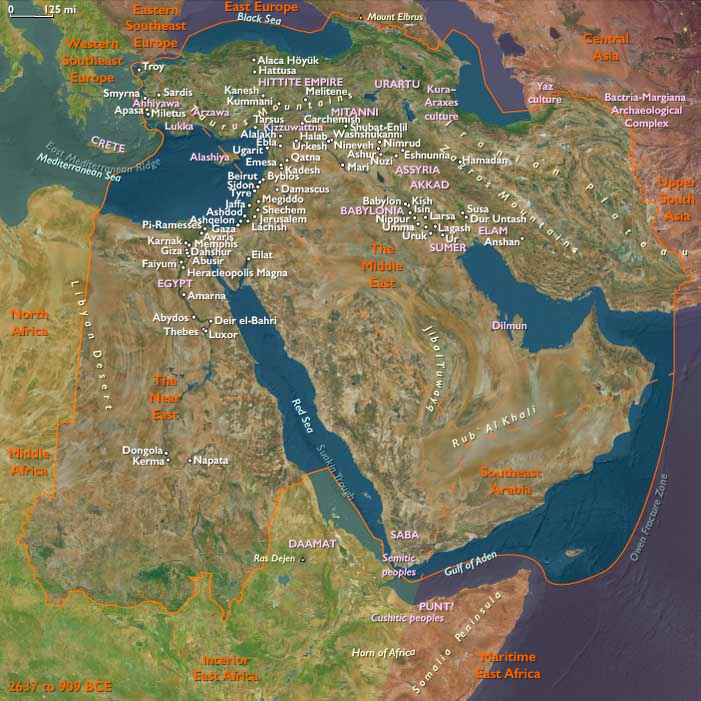
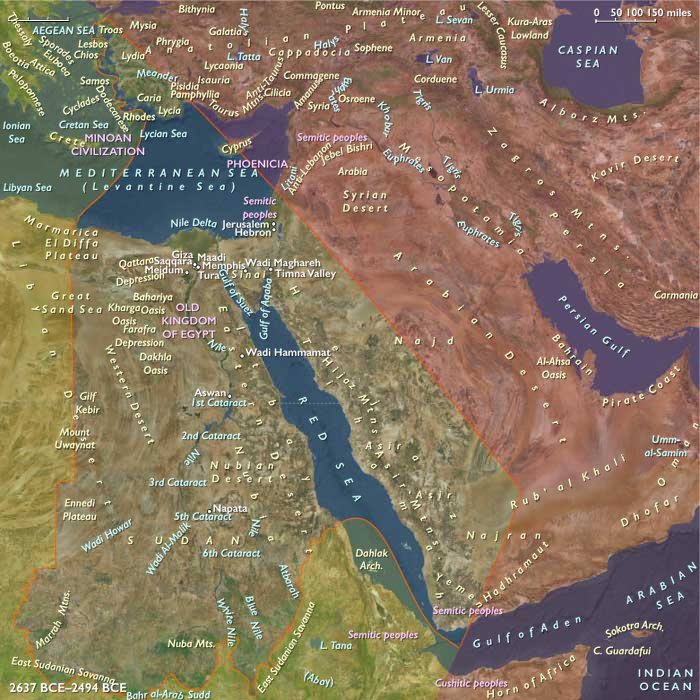
People first begin to settle along the banks of the Nile (Nahr an Nil) and to evolve from hunters and gatherers to settled, subsistence agriculturalists, developing the written language, religion, and institutions that make Egypt the world's first organized society.
Through pharaonic Egypt, Africa claims to be the cradle of one of the earliest and most spectacular civilizations of antiquity.
One of the unique features of ancient Egyptian civilization is the bond between the Nile and the Egyptian people and their institutions.
The Nile causes the great productivity of the soil, for it annually brings a copious deposit of rich silt from the monsoon-swept tableland of Ethiopia.
Each July, the level of the Nile begins to rise, and by the end of August, the flood reaches its full height.
At the end of October, the flood begins to recede, leaving behind a fairly uniform deposit of silt as well as lagoons and streams that become natural reservoirs for fish.
By April, the Nile is at its lowest level.
Vegetation starts to diminish, seasonal pools dry out, and game begins to move south.
In July, the Nile rises again, and the cycle is repeated.
Because of the fall and rise of the river, one can understand why the Egyptians were the first people to believe in life after death.
The rise and fall of the flood waters mean that the "death" of the land will be followed each year by the "rebirth" of the crops.
Thus, rebirth is seen as a natural sequence to death.
Like the sun, which "dies" when it sinks on the western horizon and is "reborn" in the eastern sky on the following morning, humans will also rise and live again.
Groups
Topics
Subjects
Regions
Subregions
Years: 4365BCE - 2637BCE
Groups
Topics
Subjects
Regions
Subregions