
Londinium, situated on a terrace near the …
Years: 47 - 47
Londinium, situated on a terrace near the north bank of the tidal River Thames, forty miles (sixty-four kilometers) from its estuary on the North Sea, is established as a town by the Romans after the invasion of CE 43 led by the Roman Emperor Claudius.
Archaeologists now believe that Londinium was founded by CE 50 as a civilian settlement or civitas.
A wooden drain by the side of the main Roman road excavated at No. 1 Poultry has been dated by dendrochronology to CE 47, which is likely to be the foundation date.
Before the arrival of the Roman legions, the area was almost certainly lightly rolling open countryside traversed by streams such as Walbrook.
Londinium is established at the point where the Thames is narrow enough to build a bridge, but deep enough to handle seagoing marine vessels.
Remains of a massive Roman pier base for a bridge will be found in 1981, close to the modern London Bridge.
It was traditionally thought that Londinium started as a civilian settlement, although there is also slight evidence that there was a Roman fortress.
However, archaeological excavation undertaken since the 1970s by the Department of Urban Archaeology of the Museum of London, now called MOLAS, has failed to unearth any convincing traces of military occupation on the site, so many archeologists now believe that Londinium was the product of private enterprise.
Its site on a busy river-crossing makes it a perfect place for traders from across the Roman Empire to set up business.
The name Londinium is thought to be pre-Roman (and possibly pre-Celtic) in origin, although there has been no consensus on what it means.
It is common practice for Romans to adopt native names for new settlements.
A common theory is that the name derives from a hypothetical Celtic placename, Londinion which may have been derived from the personal name Londinos, from the word lond, meaning 'wild'.
A theory proposed by Richard Coates, which does not have widespread acceptance, suggests that the name derives from a Celticized Old European river-name forming part of the oldest stratum of European toponymy, in the sense established by Hans Krahe; Coates suggested a derivation from a pre-Celtic Plowonida — from two roots, plew and nejd, possibly meaning "the flowing river" or "the wide flowing river".
Therefore, Londinium would mean "the settlement on the wide river".
He suggests that the river was called the Thames upriver where it was narrower, and Plowonida downriver, where it is too wide to ford.
Inscriptions and graffiti found by archaeologists confirm that Latin was the local language.
It has been implied by modern scholars that many of the local people spoke the Celtic language now termed Brythonic, called lingua Gallica (Gaulish) by the Romans; this language is ancestral to Welsh, Cornish and Breton.
The status of Londinium is uncertain.
It was not the capital of a civitas, though Ptolemy lists it as one of the cities of the Cantiaci.
Starting as a small fort guarding the northern end of the new bridge across the River Thames, it will grow to become an important port for trade between Britain and the Roman provinces on the continent.
The lack of private Roman villas (plentiful elsewhere) suggests military or even imperial ownership.
Locations
People
Groups
Topics
- Classical antiquity
- Roman colonization
- Pre-Roman Iron Age of Northern Europe
- Roman Age Optimum
- Pax Romana
- Roman Conquest of Britain
Commodoties
Subjects
- Commerce
- Language
- Watercraft
- Engineering
- Environment
- Labor and Service
- Conflict
- Faith
- Government
- Technology
- Archaeology
Regions
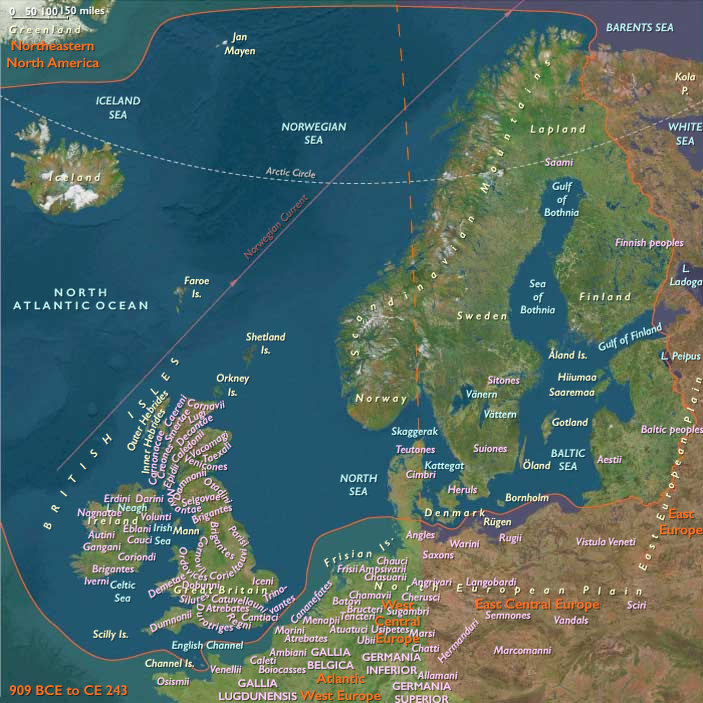
Subregions
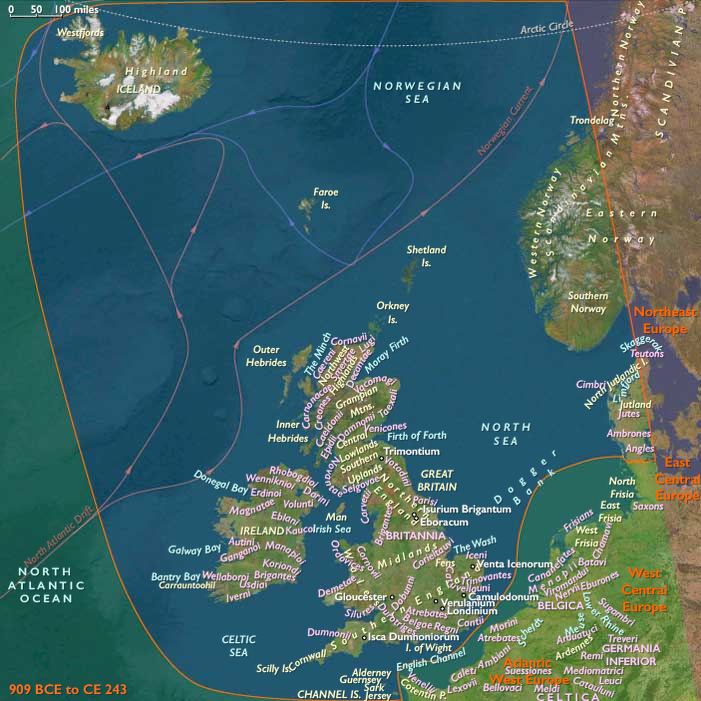
Related Events
Showing 1 events out of 1 total
Years: 47 - 47
Locations
People
Groups
Topics
- Classical antiquity
- Roman colonization
- Pre-Roman Iron Age of Northern Europe
- Roman Age Optimum
- Pax Romana
- Roman Conquest of Britain
Commodoties
Subjects
- Commerce
- Language
- Watercraft
- Engineering
- Environment
- Labor and Service
- Conflict
- Faith
- Government
- Technology
- Archaeology
Regions
Subregions