
Liu Zhang, soon after surrendering his territory, …
Years: 219 - 219
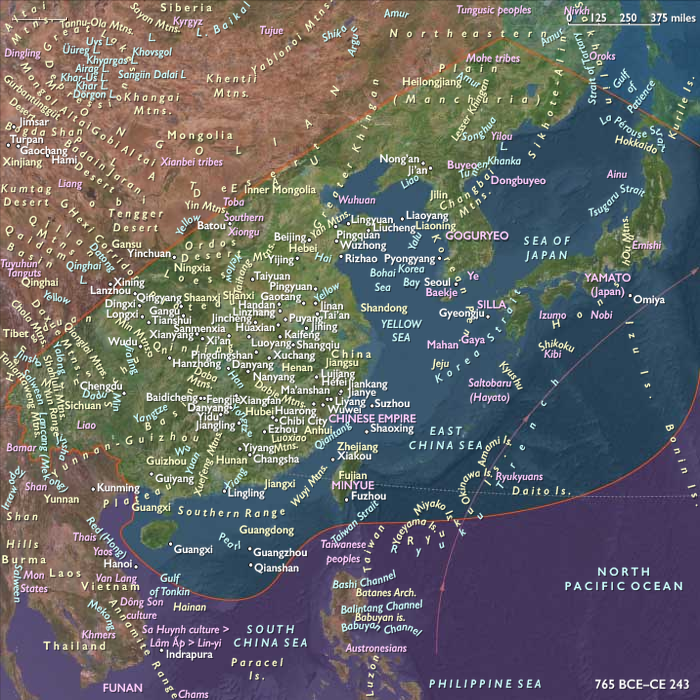
Liu Zhang, soon after surrendering his territory, is sent with his second son Liu Xun by Liu Bei to the western part of Jing Province, on the border with Sun Quan's territory.
In the year 219, however, forces led by Lü Meng, a subordinate of Sun Quan, captures Liu Bei's general Guan Yu and executes him, seizing Jing Province.
Liu Zhang and Liu Xun are taken in by the forces of Sun Quan, who, seeking to establish a claim to the rest of Liu Bei's territory, gives Liu Zhang the title of Governor of Yi Province, which had been his previous title before suffering defeat at the hands of Liu Bei.
However, Eastern Wu makes no further attempts to invade Liu Bei's territory, and Liu Zhang dies shortly after being made a vassal of Sun Quan.
His eldest son, Liu Xun, continues to serve Sun Quan while Liu Chan serves Liu Bei.
Locations
People
Groups
Topics
Commodoties
Subjects
Regions

Subregions
Related Events
Filter results
Showing 10 events out of 60677 total
Liu Bei and Xiahou Yuan have by the spring of 219 faced each other for over a year.
Liu Bei leads the main army to the south of the Mian River and orders Huang Zhong to set up camps on Mount Dingjun, where Xiahou Yuan's encampment in the valley below could be easily monitored.
One night, Liu Bei sends ten thousand troops to attack Zhang He in Guangshi and sets fire to Xiahou Yuan's barricades.
Xiahou Yuan then leads a small detachment to put out the fire and sends the main army to reinforce Zhang He.
Fa Zheng sees an opportunity for attack and signals to Liu Bei to launch an assault.
Liu sends Huang Zhong to attack the weakened enemy from above.
Huang Zhong targets Xiahou Yuan's unit and completely routs it.
Both Xiahou Yuan and Zhao Yong, Cao Cao's appointed Inspector of Yi Province, ae killed in the battle.
Zhang He, who had been informally elected to succeed Xiahou Yuan by Du Xi and Guo Huai, retreats to the northern bank of the Han River, and awaits Cao Cao's reinforcement.
Meanwhile, Liu Bei secures all strategic points at the exit of the passes linking Chang'an and Hangzhong while Cao Cao is approaching via Yegu Pass.
Liu Bei faces Cao Cao for several months but never engages the latter in battle, effectively forcing Cao to retreat as his soldiers start to desert.
Zhang He also retreats to Chencang to set up defenses for a potential invasion by Liu Bei.
Liu Bei leads his main army to Nanzheng and sends Meng Da and Liu Feng to capture Fangling and Shangyong.
Liu Bei, after securing Hanzhong, declares himself "King of Hanzhong" and sets up his headquarters in Chengdu.
He appoints Liu Shan as the heir-apparent.
Wei Yan is promoted to the rank of "General Who Maintains Distant Lands in Peace" and Administrator of Hanzhong.
Xu Jing is appointed as "Grand Tutor" while Fa Zheng is made "Prefect of the Masters of Writing".
Guan Yu is appointed as "General of the Vanguard", Zhang Fei as "General of the Right", Ma Chao as "General of the Left" and Huang Zhong as "General of the Rear".
The rest of Liu's subjects are promoted as well.
In the same year, Sun Quan's forces, led by Lü Meng, capture Guan Yu, who is promptly executed, and conquer Jing Province.
After hearing of Guan Yu's death, Liu Bei becomes furious, and orders his troops to begin preparing for war with Sun Quan.
Comazon and other allies of Julia Maesa and Elagabalus are given powerful and lucrative positions in the autumn of 219 when the new emperor’s entourage reaches Rome, much to the outrage of many senators who do not consider them to be respectable.
After Comazon's tenure as Praetorian prefect, he will serve as the city prefect of Rome three times, and as consul twice.
Elagabalus soon devalues the Roman currency, decreasing the silver purity of the denarius from 58% to 46.5%—the actual silver weight dropping from 1.82 grams to 1.41 grams.
He also demonetized the antoninianus during this period in Rome.
Elagabalus tries to have his presumed lover, the charioteer Hierocles, declared Caesar, while another alleged lover, the athlete Aurelius Zoticus, is appointed to the non-administrative but influential position of Cubicularius.
His offer of amnesty for the Roman leadership is largely honored, though the jurist Ulpian is exiled.
The relationships between Julia Maesa, Julia Soaemias, and Elagabalus are strong, at first.
His mother and grandmother become the first women to be allowed into the Senate, and both received senatorial titles: Soaemias the established title of Clarissima and Maesa the more unorthodox Mater Castrorum et Senatus.
While Julia Maesa tries to position herself as the power behind the throne and subsequently the most powerful woman in the world, Elagabalus will prove to be highly independent, set in his ways, and impossible to control.
The Three Kingdoms period in Chinese history is part of an era of disunity called the Six Dynasties following immediately the loss of de facto power of the Han Dynasty emperors.
In a strict academic sense, it refers to the period between the foundation of the Wei in 220 and the conquest of the Wu by the Jin Dynasty in 280.
Many scholars extend the starting point of this period back to the uprising of the Yellow Turbans in 184.
The three kingdoms are Wei, Shu, and Wu.
Zhuge Liang's Southern Campaign, also known as the War of Pacification in Nanzhong, is a military campaign led by Shu Han chancellor Zhuge Liang to suppress opposing forces in the South in 225.
The campaign is a response to rebellions started by local governors in the southern region of Nanzhong and intrusions by the Nanman (literally: "southern barbarians").
Zhuge Liang's Northern Expeditions are a series of five military campaigns launched by the state of Shu Han against the rival state of Cao Wei from 228.
China’s Later Han Dynasty collapses by 221, due largely to economic woes and intense political factionalism at court.
Massive peasant rebellion and the resulting dissolution of the empire lead to the so-called Period of Disunion.
A series of semi-Sinicized barbarian peoples rule North China; Chinese colonial regimes settle the south.
Three separate kingdoms replace the empire (in what later historians will call the “Three Kingdoms” period.)
Confucianism is discredited and aristocrats, rather than the Confucian-tested morally superior men, dominate the governments.
Fierce racial tension and great physical destruction ensues.
The nomadic Turkic-speaking bandits known as the Xiongnu (Hsiung-nu), based in Mongolia, begin to threaten China’s borders.
East Central Europe (220–231 CE): Emerging Frontier Pressures and Shifting Tribal Dynamics
Between 220 and 231 CE, East Central Europe—encompassing Poland, Czechia, Slovakia, Hungary, and those portions of Germany and Austria lying east of 10°E and north of a line stretching from roughly 48.2°N at 10°E southeastward to the Austro-Slovenian border near 46.7°N, 15.4°E—experienced growing pressures along the Roman frontier. The previously stable frontier under the Severan dynasty (193–235 CE) began encountering signs of strain due to increasing internal Roman instability, shifting tribal alliances, and intensified diplomatic complexity among Germanic and Sarmatian neighbors, including the Marcomanni, Quadi, Iazyges, and other emerging groups.
Political and Military Developments
Emerging Frontier Challenges
-
After the stable reigns of Severan emperors, Roman provinces along the Danube—Pannonia Superior, Pannonia Inferior, and Noricum—began experiencing heightened pressures from neighboring tribal communities.
-
Internal political uncertainty within the Roman Empire under emperors like Elagabalus (218–222 CE) and Severus Alexander (222–235 CE) weakened Roman frontier administration, increasing vulnerabilities.
Increased Diplomatic Complexity
-
Diplomatic interactions became increasingly complex, with tribes such as the Marcomanni, Quadi, and Iazyges adopting more assertive postures, seeking advantageous terms as Roman strength appeared uncertain.
-
New tribal alliances and power shifts among Germanic and Sarmatian groups gradually reshaped frontier relationships, creating a more fluid diplomatic landscape.
Economic and Technological Developments
Moderate Economic Strain
-
While cross-border trade continued, the region’s economic prosperity faced moderate disruptions resulting from growing frontier uncertainties and occasional tribal tensions. Roman goods (metalwork, pottery, textiles, glass) remained central in trade exchanges but required increased military escort or protection, reflecting new regional challenges.
Continued Frontier Infrastructure
-
Despite challenges, the Romans maintained and continued strengthening their defensive frontier infrastructure—fortifications, roads, and communications—though at a reduced pace compared to previous eras.
Cultural and Artistic Developments
Adapting Cultural Expressions
-
Cultural and artistic activities reflected changing regional dynamics, with increased emphasis on defensive, military, and protective motifs in artifacts. Artisans adapted to uncertainties, producing durable, practical, and defensively oriented objects.
Persistent Cultural Integration
-
Roman and tribal communities continued cultural interactions despite emerging challenges, maintaining productive exchanges and synthesis in craftsmanship and material culture.
Settlement and Urban Development
Frontier Fortification Adjustments
-
Roman frontier towns (Carnuntum, Vindobona, Aquincum) experienced modest expansion and further fortification adjustments, responding to increased frontier threats and uncertainty.
Adaptive Tribal Settlements
-
Germanic and Sarmatian communities adjusted settlement patterns, fortifying and strategically positioning villages to better respond to potential instability and future conflicts.
Social and Religious Developments
Strengthened Tribal Leadership
-
Tribal leadership became increasingly assertive and militarily focused in response to emerging Roman weaknesses and frontier uncertainties. Warrior elites gained prominence through preparations for potential future conflict.
Religious Practices Reflecting Uncertainty
-
Tribal religious practices emphasized protective rites and communal solidarity rituals, responding culturally to the growing instability and uncertainty along the frontier.
Long-Term Consequences and Historical Significance
The period from 220 to 231 CE signaled an important shift in East Central Europe, marking the gradual erosion of Severan-era stability and the beginnings of a new phase of frontier challenges. Increased internal Roman instability and shifting tribal dynamics began reshaping the region’s political, economic, and social conditions, setting the stage for intensified frontier pressures and tribal migrations that would profoundly influence subsequent eras.
The Middle East: 220–231 CE
Collapse of Parthian Power and the Rise of the Sassanids
Between 220 and 231 CE, the geopolitical landscape of the Middle East undergoes a radical transformation with the collapse of the Parthian Empire, which had dominated the region for nearly five centuries. The decline culminates dramatically in 224 CE, when the Parthian king Artabanus IV is decisively defeated by Ardashir I, ruler of the Persian province of Persis (Fars).
This pivotal confrontation, the Battle of Hormozdgan, results in Artabanus IV’s death and signifies the definitive end of Parthian rule. Ardashir proclaims himself "King of Kings" and swiftly establishes the Sassanid dynasty, named after his ancestor, Sasan, thereby restoring a distinctly Persian imperial identity not seen since the fall of the Achaemenid Empire centuries earlier.
Ardashir I embarks on an ambitious program of centralization, consolidating power across the Iranian plateau and Mesopotamia, while vigorously promoting Zoroastrianism as the state religion, positioning it in opposition to Roman Christianity in the West. The Sassanids aggressively revive Persian culture, traditions, and language, deliberately distancing themselves from Hellenistic influences that characterized Parthian society.
By the end of this era, the Sassanid Empire firmly controls former Parthian territories, reshaping regional dynamics and setting the stage for centuries of intense rivalry and intermittent warfare with the Roman Empire, dramatically altering the trajectory of Middle Eastern history.
The territory of the Sātavāhana Empire or Andhra Empire, a royal Indian dynasty based from Dharanikota and …
…Amaravati in Andhra Pradesh as well as …
…Junnar (Pune) and …
